
Care Disclaimer: Plant care recommendations are general guidelines based on common growing conditions. Individual results may vary based on your local environment, climate, and care routine. If your plant is toxic, keep it away from children and pets, and consult a veterinarian if accidental ingestion occurs.
1.Daffodil — Overview
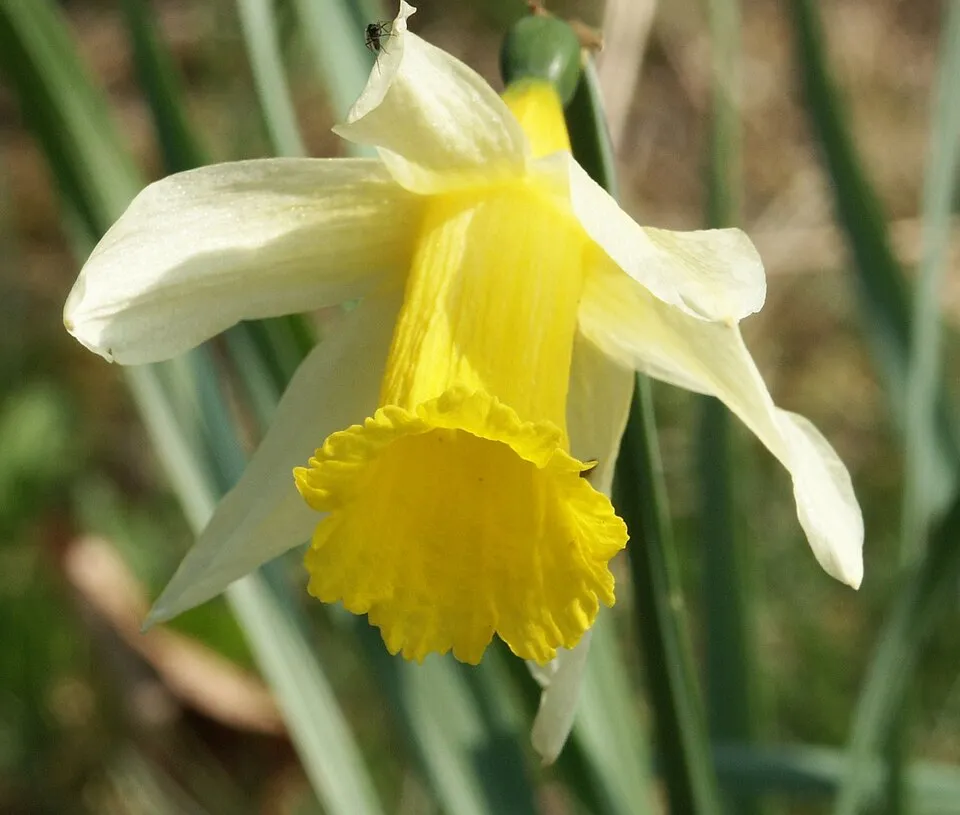
Narcissus pseudonarcissus, commonly known as the Wild Daffodil or Lent Lily, is a striking member of the Amaryllidaceae family, celebrated for its vivid yellow blooms that herald the arrival of spring. This perennial bulbous plant is indigenous to Western Europe, thriving in woodlands, meadows, and along riverbanks. Botanically, it is characterized by its distinctive morphology: a prominent, trumpet-shaped central corona encircled by six surrounding perianth segments, typically in brilliant shades of yellow. The plant’s long, strap-like leaves emerge directly from its subterranean bulb. The genus name 'Narcissus' is widely believed to originate from the ancient Greek word 'narkao,' meaning 'to numb or daze,' a direct reference to the plant's inherent narcotic properties and significant toxicity. Historically, daffodils have been revered for their aesthetic appeal since classical antiquity, featuring prominently in Greek mythology, Roman artistry, and early botanical chronicles by figures such as Theophrastus and Pliny the Elder.
While its beauty was celebrated, its medicinal applications were largely overshadowed by an awareness of its poisonous nature. In traditional European folklore, daffodils are frequently associated with themes of new beginnings, hope, and the seasonal renewal of spring. Due to its non-native status and potent toxicity, it was not a primary herb in mainstream Ayurvedic, Traditional Chinese Medicine (TCM), or Unani systems. However, some historical European herbalists did cautiously explore its topical uses, for instance, on wounds or joint pain, attempting to harness its emetic and purgative qualities. These historical applications are now largely discredited and considered unsafe due to severe adverse effects. Modern scientific inquiry has predominantly focused on isolating and characterizing the plant's diverse array of isoquinoline alkaloids, most notably galantamine and lycorine.
Galantamine, a reversible cholinesterase inhibitor, has achieved significant pharmaceutical importance, becoming a cornerstone in the treatment of mild to moderate Alzheimer's disease. This discovery led to its development as a modern prescription medication. Other alkaloids, such as lycorine, have demonstrated various in vitro biological activities, including antiviral, antimalarial, and cytotoxic effects, which continue to prompt further investigative research. Trusted Scientific References Authoritative external sources for Narcissus pseudonarcissus : ...[CURRENT TEXT EXISTS: 2657 chars]
1.1.Daffodil — Key Features
- ✓ <strong>Scientific Name</strong> — Narcissus pseudonarcissus
- ✓ <strong>Family</strong> — Amaryllidaceae
- ✓ <strong>Common Names</strong> — Daffodil, Wild Daffodil, Lent Lily
- ✓ <strong>Key Bioactive Compound</strong> — Galantamine (for Alzheimer's treatment)
- ✓ <strong>Primary Toxicity</strong> — Isoquinoline alkaloids (e.g., lycorine, galantamine)
- ✓ <strong>Distinctive Morphology</strong> — Trumpet-shaped corona, typically yellow flowers
- ✓ <strong>Native Habitat</strong> — Western Europe, temperate woodlands and meadows
- ✓ <strong>Historical Significance</strong> — Revered in ancient cultures for beauty, folklore symbol of spring
- ✓ <strong>Medical Status</strong> — Not a safe herbal remedy; source of a modern pharmaceutical drug
- ✓ <strong>Critical Safety Warning</strong> — Highly poisonous; never for consumption or direct topical application
1.2.Daffodil — Quick Summary
- ✓ Narcissus pseudonarcissus, or Daffodil, is a highly toxic plant known for its beautiful spring blooms.
- ✓ It is the natural source of galantamine, a key pharmaceutical compound used to treat Alzheimer's disease.
- ✓ All parts of the plant, especially the bulbs, are profoundly poisonous and must never be ingested.
- ✓ Ingestion can cause severe gastrointestinal distress, neurological symptoms, and can be fatal.
- ✓ Direct skin contact can lead to allergic dermatitis; handling precautions are essential.
- ✓ Its use in medicine is strictly limited to purified, extracted compounds under medical supervision, not as a direct herbal remedy.
2.Daffodil — Scientific Identity
3.Daffodil — Quick Facts
4.Daffodil — Appearance & Identification
5.Daffodil — Native Habitat
6.Daffodil — Water Requirements
- ✓ Climate — Daffodils thrive in temperate climates with distinct seasons, requiring a cold dormancy period for optimal flowering.
- ✓ Soil Requirements — Prefers well-draining, fertile soil rich in organic matter, with a slightly acidic to neutral pH (6.0-7.0).
- ✓ Planting Depth and Spacing — Bulbs should be planted in autumn, typically 6-8 inches deep and 4-6 inches apart, with the pointed end facing upwards.
- ✓ Light Exposure — Requires full sun to partial shade; too much shade can reduce flowering vigor.
- ✓ Watering — Needs consistent moisture during active growth in spring, but reduce watering significantly after flowering when foliage begins to yellow and during summer dormancy.
- ✓ Fertilization — Apply a balanced, low-nitrogen fertilizer in early spring as shoots emerge and again after flowering to replenish bulb reserves.
- ✓ Pest and Disease Management — Generally robust, but susceptible to narcissus bulb fly, basal rot (fungal), and slug damage; good sanitation and proper drainage are key.
- ✓ Propagation — Primarily propagated by dividing offsets (daughter bulbs) from mature clumps after flowering, or less commonly, by seed for genetic variation.
Reviewed by the Flora Medical Global Botanical Review Panel
Multi-disciplinary editorial group · Botany · Ethnobotany · Herbal-medicine literature
Who reviewed this: This page was checked by the Flora Medical Global Botanical Review Panel — an in-house editorial group of botany graduates, ethnobotany researchers, and horticulture practitioners who collectively maintain our 7,000+ plant encyclopedia. Meet the team.
Our 4-step verification process
1. Taxonomic verification
Scientific names and synonyms cross-checked against Kew POWO, World Flora Online, and The Plant List.
2. Phytochemical & medicinal cross-reference
Active compounds, traditional uses, and reported activities are cross-referenced with PubMed, USDA Dr. Duke's database, and peer-reviewed ethnobotanical literature.
3. Conservation & distribution check
Distribution, ecology, and conservation status confirmed against GBIF occurrence records and the IUCN Red List.
4. Editorial & safety review
Every entry passes an editorial pass for clarity, originality, and safety notices (toxicity, contraindications, dosage caveats) before publication.
Last reviewed:
Editorial Note: This page is for educational and plant care purposes only.
Written by: Flora Medical Global Editorial Team
Reviewed by: Flora Medical Global Botanical Review Panel
Last Updated: June 15, 2026







Daffodil — Comments & Community Reviews
Rate this plant