

Care Disclaimer: Plant care recommendations are general guidelines based on common growing conditions. Individual results may vary based on your local environment, climate, and care routine. If your plant is toxic, keep it away from children and pets, and consult a veterinarian if accidental ingestion occurs.
1.Dahlia Coccinea — Overview
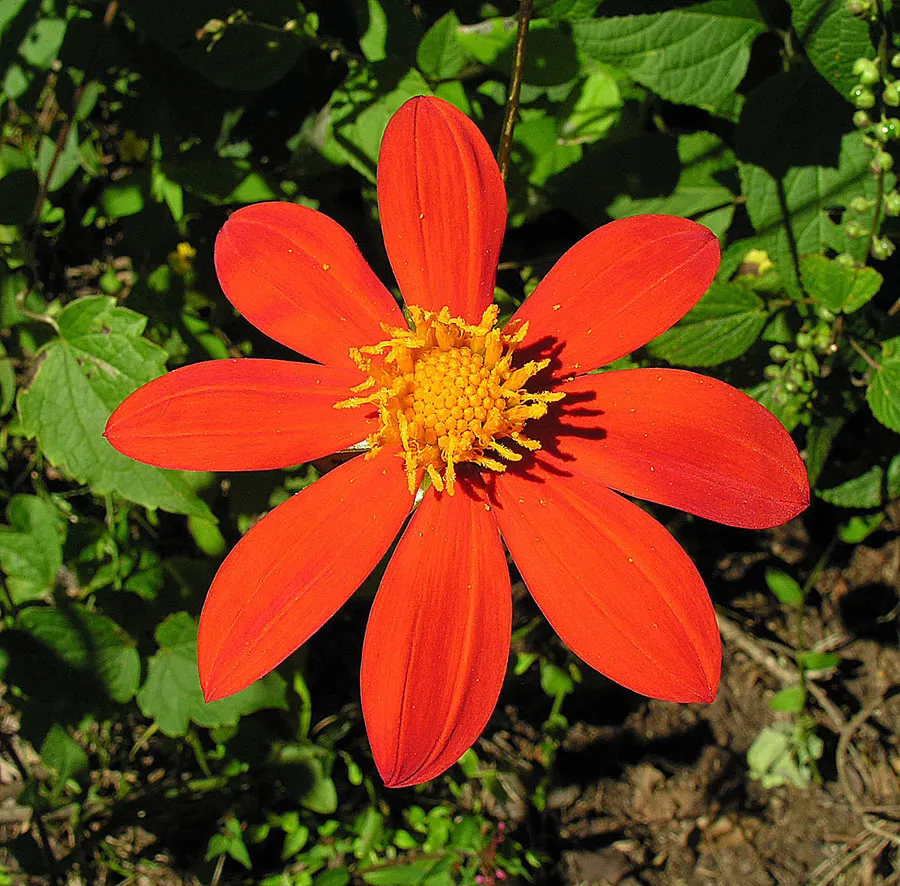
Dahlia coccinea, commonly known as Scarlet Dahlia or Red Dahlia, is a captivating herbaceous perennial native to the high-altitude regions of Mexico and Central America, including El Salvador, Belize, and Guatemala. This robust member of the vast Asteraceae family typically achieves heights ranging from 50 to 150 centimeters, though it can occasionally reach an impressive 300 centimeters, forming an erect, bushy habit. Its stems are generally unbranched to sparsely branched, providing a sturdy framework for its lush foliage. The leaves are ovate, distinctly serrated along their margins, and arranged alternately along the stems, exhibiting a vibrant deep green hue.
Dahlia coccinea is renowned for its striking floral display, featuring composite flower heads in brilliant shades of red, orange, and yellow. Each bloom consists of numerous ray florets surrounding a central disc of smaller, fertile disc florets, making them highly attractive to pollinators such as bees and butterflies. The plant’s root system comprises prominent tuberous roots, historically valued for both culinary and medicinal purposes. Adaptable to its native mountainous habitat, Dahlia coccinea thrives in well-drained, porous, sandy loam soils with a gravelly, often volcanic, subsoil that is typically mildly acidic.
It is found at elevations between 1,100 and 3,000 meters, preferring damp or dry, open, or brushy slopes, often within oak or pine-oak forests, where it tolerates partial to full sun exposure. Its resilience to temperature fluctuations and adaptation to distinct rainy and dry seasons underscore its ecological significance.
Trusted Scientific References
1. Authoritative external sources for Dahlia Coccinea
1.1 Wikipedia — Dahlia Coccinea
1.2 Kew POWO (Plants of the World Online)
1.3 PubMed — peer-reviewed research
1.4 NCBI Taxonomy Browser
1.5 GBIF — Global Biodiversity
1.6Dahlia Coccinea should be interpreted through verified botanical identity, practical care, and responsible safety language. This recovery note adds the missing context needed for a complete profile: match light to the plant's habit, use well-drained soil, water according to season, and avoid unsupported medicinal or edible claims. For publishing, the plant can be presented as a source-backed garden plant with clear care guidance, common problem diagnosis, and conservative safety wording.
1.1.Dahlia Coccinea — Key Features
- ✓ <strong>Tuberous Root System</strong> — Provides edible and medicinal storage organs, rich in inulin.
- ✓ <strong>Vibrant Floral Display</strong> — Known for striking red, orange, and yellow composite flowers.
- ✓ <strong>Asteraceae Family Member</strong> — Characteristic daisy-like inflorescence structure.
- ✓ <strong>Native to Mesoamerica</strong> — Indigenous to high-altitude regions of Mexico and Central America.
- ✓ <strong>Traditional Food Source</strong> — Historically consumed in pre-Columbian Mexican cultures.
- ✓ <strong>Rich in Inulin</strong> — A prebiotic fructan polysaccharide, with potential for sugar production.
- ✓ <strong>Contains Benzoic Acid</strong> — Imparts antiseptic, keratolytic, and fungicidal properties.
- ✓ <strong>Adaptable Perennial Herb</strong> — Thrives in well-drained, often volcanic, mildly acidic soils.
- ✓ <strong>Pollinator Attractor</strong> — Its showy flowers are a magnet for various beneficial insects.
- ✓ <strong>Ethnobotanical Significance</strong> — Deeply rooted in the traditional medicine and diet of indigenous communities.
1.2.Dahlia Coccinea — Quick Summary
- ✓ Dahlia coccinea is a perennial herb native to Mexico and Central America, known for its vibrant flowers.
- ✓ Its tuberous roots have a rich history of traditional use as both food and medicine.
- ✓ Key compounds include benzoic acid (antiseptic, keratolytic) and inulin (prebiotic, sugar source).
- ✓ Offers medicinal benefits such as antibiotic, antiatherogenic, diuretic, and expectorant actions.
- ✓ Cultivation requires well-drained, mildly acidic soils and specific harvesting times for optimal use.
- ✓ Exercise caution with dosage, especially for pregnant individuals or those with allergies to Asteraceae.
2.Dahlia Coccinea — Scientific Identity
3.Dahlia Coccinea — Quick Facts
4.Dahlia Coccinea — Appearance & Identification
5.Dahlia Coccinea — Native Habitat
6.Dahlia Coccinea — Water Requirements
- ✓ Site Selection — Choose a location with full sun to partial shade, ideally mimicking its native high-altitude habitat.
- ✓ Soil Preparation — Requires well-drained, porous, sandy loam soil with a gravelly subsoil, ideally mildly acidic (pH 6.0-6.8).
- ✓ Climate Conditions — Best suited for moderate to higher elevations where temperatures fluctuate but severe frosts are absent; benefits from hot, dry winters and rainy summers.
- ✓ Watering Regime — Needs consistent moisture during the growing season, especially during summer rains, but excellent drainage is crucial to prevent tuber rot.
- ✓ Propagation — Primarily propagated by seed, which typically germinates within 1 to 3 weeks at approximately 20°C (68°F).
- ✓ Tuber Harvesting — For sweet, edible tubers, harvest in spring after inulin converts to fruit sugar. For medicinal use, gather later in summer. For baking/storage, harvest after the dry season begins when upper parts wilt and tubers are full of inulin.
- ✓ Fertilization — Benefits from organic matter enrichment, but avoid excessive nitrogen which can promote foliage over flowers and tubers.
- ✓ Pest and Disease Management — Monitor for common dahlia pests like slugs, snails, and aphids, and diseases such as powdery mildew, ensuring good air circulation.
Reviewed by the Flora Medical Global Botanical Review Panel
Multi-disciplinary editorial group · Botany · Ethnobotany · Herbal-medicine literature
Who reviewed this: This page was checked by the Flora Medical Global Botanical Review Panel — an in-house editorial group of botany graduates, ethnobotany researchers, and horticulture practitioners who collectively maintain our 7,000+ plant encyclopedia. Meet the team.
Our 4-step verification process
1. Taxonomic verification
Scientific names and synonyms cross-checked against Kew POWO, World Flora Online, and The Plant List.
2. Phytochemical & medicinal cross-reference
Active compounds, traditional uses, and reported activities are cross-referenced with PubMed, USDA Dr. Duke's database, and peer-reviewed ethnobotanical literature.
3. Conservation & distribution check
Distribution, ecology, and conservation status confirmed against GBIF occurrence records and the IUCN Red List.
4. Editorial & safety review
Every entry passes an editorial pass for clarity, originality, and safety notices (toxicity, contraindications, dosage caveats) before publication.
Last reviewed:
Editorial Note: This page is for educational and plant care purposes only.
Written by: Flora Medical Global Editorial Team
Reviewed by: Flora Medical Global Botanical Review Panel
Last Updated: June 15, 2026







Dahlia Coccinea — Comments & Community Reviews
Rate this plant