
Care Disclaimer: Plant care recommendations are general guidelines based on common growing conditions. Individual results may vary based on your local environment, climate, and care routine. If your plant is toxic, keep it away from children and pets, and consult a veterinarian if accidental ingestion occurs.
1.Daphne Odora — Overview
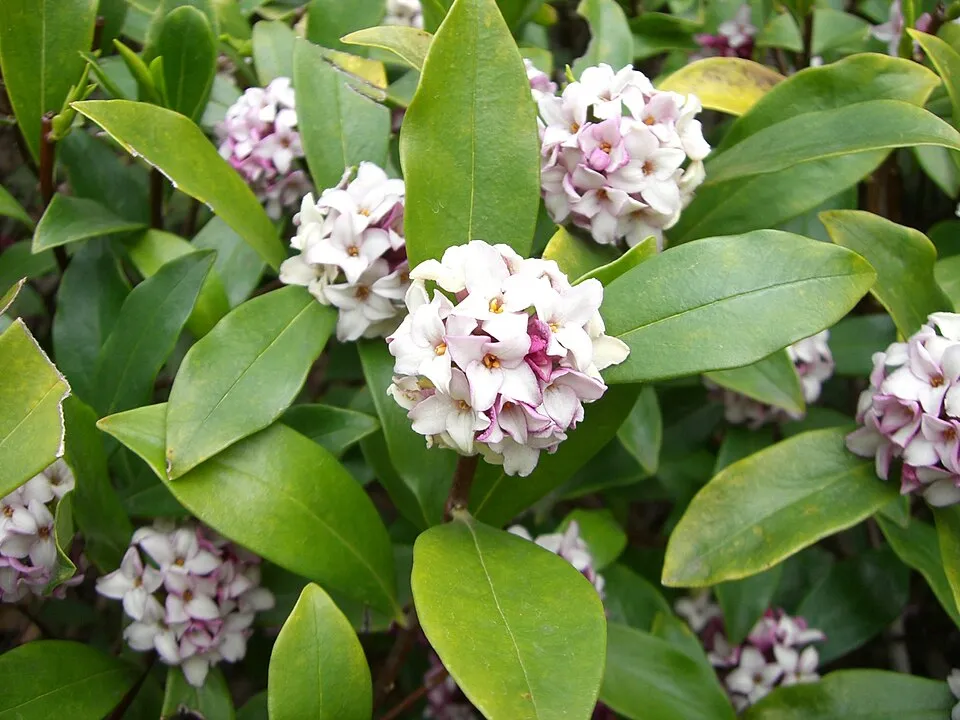
Daphne odora, commonly known as Winter Daphne or Fragrant Daphne, is an exquisite evergreen shrub belonging to the Thymelaeaceae family, celebrated for its profoundly aromatic flowers and its remarkable ability to bloom from late winter into early spring. This compact, densely branched shrub typically attains a modest height and spread of 1 to 1.5 meters (3 to 5 feet), forming an elegant, rounded silhouette. Its foliage is characterized by glossy, dark green leaves that are leathery to the touch, simple, entire-margined, and alternately arranged along the stems.
Each leaf can extend up to 10 cm (4 inches) in length, providing a lush, attractive backdrop throughout the year. The stems are generally smooth, exhibiting a reddish-brown bark that develops slight fissures with age, revealing the tough, fibrous texture distinctive of the Thymelaeaceae family. The root system is shallow and fibrous, ideally suited for well-drained soil conditions.
The true spectacle of Daphne odora is its profusion of flowers, which emerge in dense, terminal clusters during the colder months, often before the last snows have melted, signaling the imminent arrival of warmer seasons. These small, tubular blossoms typically display a captivating color gradient, ranging from pale pink or rose-purple on the exterior to creamy white on the interior. Each flower features four spreading lobes and a waxy texture, contributing to their delicate appearance.
However, their most renowned attribute is their powerful, sweet, and intoxicating fragrance, which can permeate a significant area of the garden, effectively attracting early pollinators such as bees. Native to the temperate regions of East Asia, including China, Japan, and Korea, Daphne odora thrives naturally in the understories of forests, on rocky slopes, and in open woodlands. It prefers shaded to partially shaded locations, mimicking its natural habitat where it is shielded from intense sun.
The plant adapts well to a range of well-drained soils, ideally those that are slightly acidic to neutral (pH 6.0-7.0). Its extraordinary capacity to flower when most other plants are dormant bestows immense ornamental value.
Trusted Scientific References
1. Authoritative external sources for Daphne odora
1.1 Wikipedia — Daphne odora
1.2 Kew POWO (Plants of the World Online)
1.3 PubMed — peer-reviewed research
1.4 NCBI Taxonomy Browser
1.5 GBIF — Global Biodiversity
1.1.Daphne Odora — Key Features
- ✓ <strong>Botanical Name</strong> — *Daphne odora*.
- ✓ <strong>Common Names</strong> — Winter Daphne, Fragrant Daphne, Paradise Plant, Spurge Flax.
- ✓ <strong>Family</strong> — Thymelaeaceae.
- ✓ <strong>Striking Fragrance</strong> — Emits an intense, sweet, and intoxicating scent, especially in late winter to early spring.
- ✓ <strong>Evergreen Foliage</strong> — Maintains glossy, dark green, leathery leaves throughout the year.
- ✓ <strong>Early Bloomer</strong> — Produces flowers when most other plants are dormant, acting as a harbinger of spring.
- ✓ <strong>Compact Shrub</strong> — Typically grows to a modest height and spread of 1 to 1.5 meters.
- ✓ <strong>Native Region</strong> — Indigenous to temperate East Asia, including China, Japan, and Korea.
- ✓ <strong>High Toxicity</strong> — All plant parts, especially berries, are highly poisonous if ingested.
- ✓ <strong>Ornamental Value</strong> — Highly prized in horticulture for its aesthetic beauty and powerful aroma.
1.2.Daphne Odora — Quick Summary
- ✓ Fragrant evergreen shrub, renowned for its captivating late winter to early spring blooms.
- ✓ Native to East Asia, thriving best in partial shade with well-drained soil.
- ✓ All plant parts are highly toxic, particularly the berries, if ingested.
- ✓ Contains potent daphnane-type diterpenoids (e.g., mezerein) and coumarins (e.g., daphnetin).
- ✓ Primarily valued as an ornamental garden plant for its intense fragrance.
- ✓ Traditional medicinal uses are external and require extreme caution due to toxicity.
2.Daphne Odora — Scientific Identity
3.Daphne Odora — Quick Facts
4.Daphne Odora — Appearance & Identification
5.Daphne Odora — Native Habitat
6.Daphne Odora — Water Requirements
- ✓ Climate Zone — Thrives in USDA Hardiness Zones 7-9, requiring protection in colder climates.
- ✓ Light Requirements — Prefers partial shade to full shade, especially in regions with hot summers, as direct sun can scorch leaves.
- ✓ Soil Preference — Requires moist, very well-drained, organically rich soil, ideally with a slightly acidic to neutral pH (6.0-7.0).
- ✓ Watering — Needs consistent moisture but is highly sensitive to waterlogging; allow the topsoil to dry slightly between waterings.
- ✓ Pruning — Prune lightly immediately after flowering to maintain shape and remove any dead or damaged branches; avoid heavy pruning as it can stress the plant.
- ✓ Propagation — Best propagated from semi-hardwood stem cuttings taken in late summer or by layering.
- ✓ Pests and Diseases — Generally resistant to major pests and diseases, but susceptible to root rot in poorly drained or overly wet conditions.
- ✓ Special Considerations — Extremely sensitive to root disturbance once established, so plant when young and avoid transplanting.
Reviewed by the Flora Medical Global Botanical Review Panel
Multi-disciplinary editorial group · Botany · Ethnobotany · Herbal-medicine literature
Who reviewed this: This page was checked by the Flora Medical Global Botanical Review Panel — an in-house editorial group of botany graduates, ethnobotany researchers, and horticulture practitioners who collectively maintain our 7,000+ plant encyclopedia. Meet the team.
Our 4-step verification process
1. Taxonomic verification
Scientific names and synonyms cross-checked against Kew POWO, World Flora Online, and The Plant List.
2. Phytochemical & medicinal cross-reference
Active compounds, traditional uses, and reported activities are cross-referenced with PubMed, USDA Dr. Duke's database, and peer-reviewed ethnobotanical literature.
3. Conservation & distribution check
Distribution, ecology, and conservation status confirmed against GBIF occurrence records and the IUCN Red List.
4. Editorial & safety review
Every entry passes an editorial pass for clarity, originality, and safety notices (toxicity, contraindications, dosage caveats) before publication.
Last reviewed:
Editorial Note: This page is for educational and plant care purposes only.
Written by: Flora Medical Global Editorial Team
Reviewed by: Flora Medical Global Botanical Review Panel
Last Updated: June 15, 2026







Daphne Odora — Comments & Community Reviews
Rate this plant