
Care Disclaimer: Plant care recommendations are general guidelines based on common growing conditions. Individual results may vary based on your local environment, climate, and care routine. If your plant is toxic, keep it away from children and pets, and consult a veterinarian if accidental ingestion occurs.
1.Darmera Peltata — Overview
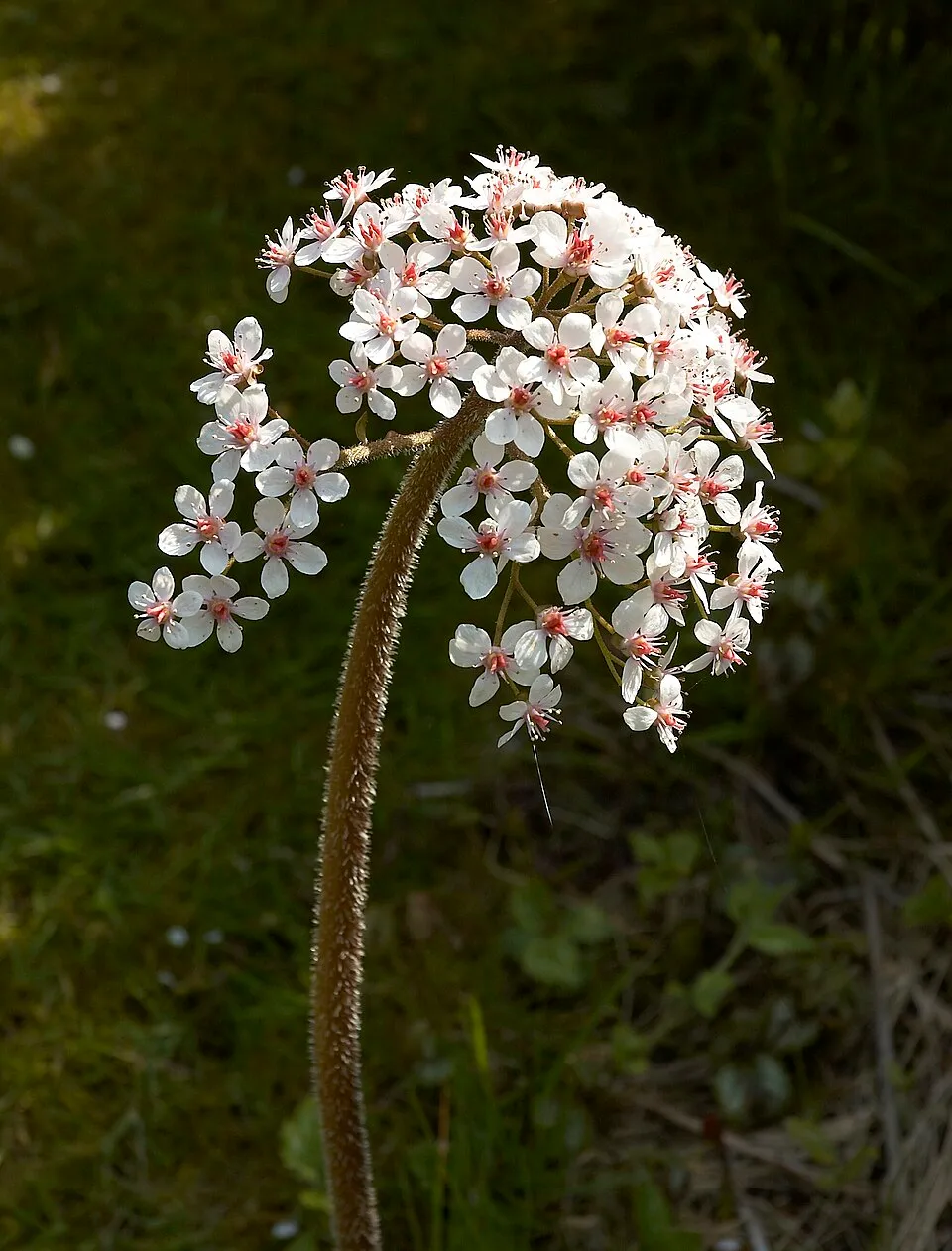
Darmera peltata, commonly known as Indian Rhubarb or Umbrella Plant, is a striking perennial herbaceous plant belonging to the Saxifragaceae family. Native to the cold, rocky banks of mountain streams and rivers in western North America, particularly in California, Oregon, and Utah, it thrives in consistently moist to wet conditions. This rhizomatous plant is characterized by its magnificent, large, nearly round leaves, which can reach up to 2-3 feet in diameter, featuring jaggedly toothed margins and a distinctive peltate attachment where the leafstalk connects near the center of the blade, giving it an umbrella-like appearance.
The plant is winter dormant, with its dramatic foliage unfurling after the bloom period. In mid to late spring, before the leaves fully expand, it sends up robust, naked flowering stalks, typically 3-5 feet tall, topped with large, rounded clusters of small, delicate white to pale pink flowers. These panicles of showy blooms are followed by decorative, reddish, follicle-like seed pods.
In autumn, the lush green leaves transform into vibrant shades of russet, adding seasonal interest. Its luxuriant growth and architectural form make it a popular ornamental plant, often anchoring firmly among water-washed rocks, contributing a verdant, almost tropical aspect to its native habitats.
Trusted Scientific References
1. Authoritative external sources for Darmera Peltata
1.1 Wikipedia — Darmera Peltata
1.2 Kew POWO (Plants of the World Online)
1.3 PubMed — peer-reviewed research
1.4 NCBI Taxonomy Browser
1.5 GBIF — Global Biodiversity
1.6Darmera Peltata should be interpreted through verified botanical identity, practical care, and responsible safety language. This recovery note adds the missing context needed for a complete profile: match light to the plant's habit, use well-drained soil, water according to season, and avoid unsupported medicinal or edible claims. For publishing, the plant can be presented as a source-backed garden plant with clear care guidance, common problem diagnosis, and conservative safety wording.
1.1.Darmera Peltata — Key Features
- ✓ <strong>Striking architectural perennial with large, umbrella</strong> — like leaves.
- ✓ <strong>Native to the</strong> — Native to the cold, rocky stream banks of western North America.
- ✓ <strong>Produces showy clusters</strong> — Produces showy clusters of pink to white flowers in early spring before the foliage.
- ✓ <strong>Characterized by peltate</strong> — Characterized by peltate leaves, where the stem attaches near the center of the blade.
- ✓ <strong>Rhizomatous growth habit,</strong> — Rhizomatous growth habit, forming impressive colonies over time.
- ✓ <strong>Rich in beneficial</strong> — Rich in beneficial phytochemicals such as flavonoids, tannins, and phenolic acids.
- ✓ <strong>Traditionally used for its anti</strong> — inflammatory, antioxidant, and digestive properties.
- ✓ <strong>Thrives in consistently</strong> — Thrives in consistently moist, partially shaded environments, ideal for waterside gardens.
- ✓ <strong>Exhibits vibrant russet</strong> — Exhibits vibrant russet fall foliage, adding seasonal color to landscapes.
- ✓ <strong>Attracts early pollinators,</strong> — Attracts early pollinators, contributing to local biodiversity.
1.2.Darmera Peltata — Quick Summary
- ✓ Darmera peltata, or Indian Rhubarb, is a striking perennial native to western North America, known for its large, umbrella-like leaves.
- ✓ It produces delicate pink to white flowers in early spring, often before the foliage fully develops.
- ✓ Traditionally valued for its anti-inflammatory, antioxidant, and digestive support properties.
- ✓ Rich in beneficial phytochemicals including flavonoids, terpenoids, and phenolic acids.
- ✓ Requires consistently moist, well-draining soil and partial shade for optimal growth and health.
- ✓ Use with caution, especially during pregnancy, lactation, or when taking prescription medications.
2.Darmera Peltata — Scientific Identity
3.Darmera Peltata — Quick Facts
4.Darmera Peltata — Appearance & Identification
5.Darmera Peltata — Native Habitat
6.Darmera Peltata — Water Requirements
- ✓ Soil Preference — Thrives in rich, deep, consistently moist to wet soils that are well-draining, mimicking its native riverside habitat.
- ✓ pH Range — Optimal growth occurs in slightly acidic to neutral soil conditions, ideally within a pH range of 6.0 to 7.0.
- ✓ Light Requirements — Prefers partial to full shade, especially in warmer climates, where intense sun can scorch its large leaves.
- ✓ Watering Regimen — Requires abundant and consistent moisture; the soil should never be allowed to dry out, but avoid stagnant waterlogging.
- ✓ Spacing Guidelines — Plant rhizomes or young plants approximately 30-45 cm (12-18 inches) apart to accommodate their mature spread and ensure adequate air circulation.
- ✓ Soil Amendments — Incorporate generous amounts of organic matter, such as compost or leaf mold, to improve soil structure, moisture retention, and nutrient availability.
- ✓ Winter Hardiness — Fully deciduous in winter, it is hardy in USDA zones 5-9 and will re-emerge vigorously in spring from its rhizomatous rootstock.
- ✓ Propagation — Easily propagated by division of its rhizomes in early spring or fall, or by seed, though seed germination can be slow.
Reviewed by the Flora Medical Global Botanical Review Panel
Multi-disciplinary editorial group · Botany · Ethnobotany · Herbal-medicine literature
Who reviewed this: This page was checked by the Flora Medical Global Botanical Review Panel — an in-house editorial group of botany graduates, ethnobotany researchers, and horticulture practitioners who collectively maintain our 7,000+ plant encyclopedia. Meet the team.
Our 4-step verification process
1. Taxonomic verification
Scientific names and synonyms cross-checked against Kew POWO, World Flora Online, and The Plant List.
2. Phytochemical & medicinal cross-reference
Active compounds, traditional uses, and reported activities are cross-referenced with PubMed, USDA Dr. Duke's database, and peer-reviewed ethnobotanical literature.
3. Conservation & distribution check
Distribution, ecology, and conservation status confirmed against GBIF occurrence records and the IUCN Red List.
4. Editorial & safety review
Every entry passes an editorial pass for clarity, originality, and safety notices (toxicity, contraindications, dosage caveats) before publication.
Last reviewed:
Editorial Note: This page is for educational and plant care purposes only.
Written by: Flora Medical Global Editorial Team
Reviewed by: Flora Medical Global Botanical Review Panel
Last Updated: June 15, 2026







Darmera Peltata — Comments & Community Reviews
Rate this plant