
Care Disclaimer: Plant care recommendations are general guidelines based on common growing conditions. Individual results may vary based on your local environment, climate, and care routine. If your plant is toxic, keep it away from children and pets, and consult a veterinarian if accidental ingestion occurs.
1.Dasylirion Wheeleri — Overview
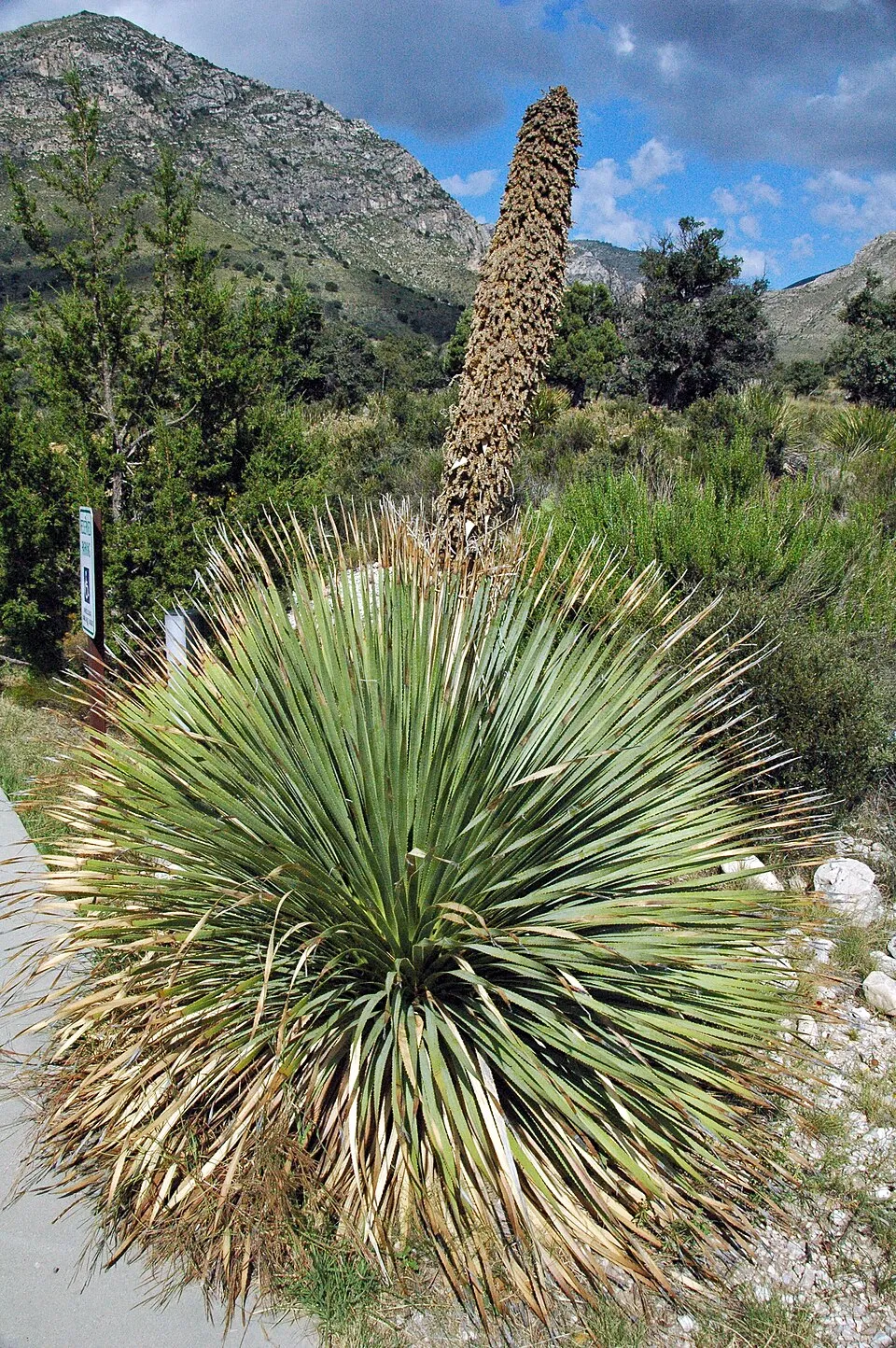
Dasylirion wheeleri, commonly known as common sotol or desert spoon, is a striking, large native desert leaf succulent shrub belonging to the Asparagaceae family (historically classified under Nolinaceae or Agavaceae). This resilient perennial forms a dense basal clump of slender, sword-like leaves, each typically 0.8 to 1.6 inches (2-4 cm) wide at the base and notably edged with sharp, marginal prickles. The plant develops a short, woody trunk, which can be partially buried or rise up to 3 feet (0.91 m) above ground.
Its most dramatic feature is a towering, central inflorescence, a long terminal panicle that can reach an impressive 6 to 17 feet (1.8-5.2 m) in height, bearing thousands of tiny, inconspicuous flowers. Dasylirion wheeleri is a dioecious species, meaning individual plants are either male or female, with the female plants producing small, three-winged capsules containing the seeds.
Native to the arid and semi-arid regions of the southwestern United States and Mexico, Dasylirion wheeleri thrives across western Texas, southern Arizona, and New Mexico, extending into parts of Mexico. Its distribution in Arizona spans from the Mazatzal and Quivari mountains to Greenlee and Cochise counties, while in New Mexico, it is found along the Gila River and Rio Grande drainages, reaching eastward to White Mountain in Lincoln County. In Texas, it is prevalent in the Trans-Pecos region and western Edwards Plateau.
This plant typically inhabits hillsides and slopes within chaparral, desert and semidesert grasslands, and southwestern oak woodland communities, at elevations ranging from 3,000 to 5,000 feet (914-1,524 m). It prefers shallow, rocky, or gravelly soils with excellent drainage, often found on limestone and granite substrates, and is well-adapted to conditions where subsurface water is generally scarce.
Trusted Scientific References
1. Authoritative external sources for Dasylirion Wheeleri
1.1 Wikipedia — Dasylirion Wheeleri
1.2 Kew POWO (Plants of the World Online)
1.3 PubMed — peer-reviewed research
1.4 NCBI Taxonomy Browser
1.5 GBIF — Global Biodiversity
1.1.Dasylirion Wheeleri — Key Features
- ✓ <strong>Botanical Name</strong> — Dasylirion wheeleri S. Wats.
- ✓ <strong>Common Names</strong> — Common sotol, desert spoon, spoon-flower, Wheeler sotol.
- ✓ <strong>Family</strong> — Asparagaceae (formerly Nolinaceae or Agavaceae).
- ✓ <strong>Growth Habit</strong> — Large, succulent, perennial shrub forming dense basal clumps.
- ✓ <strong>Distinctive Foliage</strong> — Slender, sword-like leaves with characteristic marginal prickles.
- ✓ <strong>Impressive Inflorescence</strong> — Produces a tall, central flowering stalk up to 17 feet high.
- ✓ <strong>Native Range</strong> — Arid and semi-arid regions of western Texas, New Mexico, Arizona, and Mexico.
- ✓ <strong>Ecological Role</strong> — Important browse and cover for bighorn sheep and other native wildlife.
- ✓ <strong>Traditional Uses</strong> — Source of the alcoholic beverage 'sotol,' fiber for crafts, and emergency livestock feed.
- ✓ <strong>Xeriscape Plant</strong> — Highly prized for its extreme drought tolerance and architectural beauty in dryland landscaping.
1.2.Dasylirion Wheeleri — Quick Summary
- ✓ Dasylirion wheeleri is a resilient desert succulent shrub native to the Southwestern US and Mexico.
- ✓ Valued historically for its traditional 'sotol' alcoholic beverage and versatile fibrous materials.
- ✓ Highly drought-tolerant, it thrives in rocky, well-drained soils and high-desert elevations.
- ✓ Serves as crucial fodder for livestock during droughts and a prominent ornamental in xeriscaping.
- ✓ Lacks extensive modern medicinal research; its primary significance lies in cultural and utilitarian applications.
2.Dasylirion Wheeleri — Scientific Identity
3.Dasylirion Wheeleri — Quick Facts
4.Dasylirion Wheeleri — Appearance & Identification
5.Dasylirion Wheeleri — Native Habitat
6.Dasylirion Wheeleri — Water Requirements
- ✓ Seed Propagation — Dasylirion wheeleri can be easily propagated from seed, which is typically encased in a three-winged capsule; cold stratification may enhance germination rates.
- ✓ Vegetative Reproduction — The plant effectively reproduces vegetatively by sprouting from its thick, woody, and often subterranean caudex, enabling rapid regrowth after disturbance.
- ✓ Soil Requirements — Thrives in well-drained, shallow, rocky, or gravelly soils, showing a particular preference for limestone and granite substrates.
- ✓ Water Management — Highly drought-tolerant once established, requiring minimal to no supplemental irrigation, making it an ideal choice for xeriscaping.
- ✓ Light Exposure — Prefers full sun exposure for optimal growth, mimicking its natural habitat on open hillsides and desert plains.
- ✓ Temperature Tolerance — Exhibits good cold tolerance, adapting well to the significant temperature fluctuations characteristic of its native high desert elevations.
- ✓ Planting Location — Best situated on hillsides, slopes, or elevated garden beds to ensure excellent drainage and prevent waterlogging, which can be detrimental to succulents.
- ✓ Growth Rate — Generally a slow-growing plant, especially when young, but can achieve significant size and develop its characteristic trunk over many years.
Reviewed by the Flora Medical Global Botanical Review Panel
Multi-disciplinary editorial group · Botany · Ethnobotany · Herbal-medicine literature
Who reviewed this: This page was checked by the Flora Medical Global Botanical Review Panel — an in-house editorial group of botany graduates, ethnobotany researchers, and horticulture practitioners who collectively maintain our 7,000+ plant encyclopedia. Meet the team.
Our 4-step verification process
1. Taxonomic verification
Scientific names and synonyms cross-checked against Kew POWO, World Flora Online, and The Plant List.
2. Phytochemical & medicinal cross-reference
Active compounds, traditional uses, and reported activities are cross-referenced with PubMed, USDA Dr. Duke's database, and peer-reviewed ethnobotanical literature.
3. Conservation & distribution check
Distribution, ecology, and conservation status confirmed against GBIF occurrence records and the IUCN Red List.
4. Editorial & safety review
Every entry passes an editorial pass for clarity, originality, and safety notices (toxicity, contraindications, dosage caveats) before publication.
Last reviewed:
Editorial Note: This page is for educational and plant care purposes only.
Written by: Flora Medical Global Editorial Team
Reviewed by: Flora Medical Global Botanical Review Panel
Last Updated: June 15, 2026







Dasylirion Wheeleri — Comments & Community Reviews
Rate this plant