


Care Disclaimer: Plant care recommendations are general guidelines based on common growing conditions. Individual results may vary based on your local environment, climate, and care routine. If your plant is toxic, keep it away from children and pets, and consult a veterinarian if accidental ingestion occurs.
1.Delosperma Cooperi — Overview
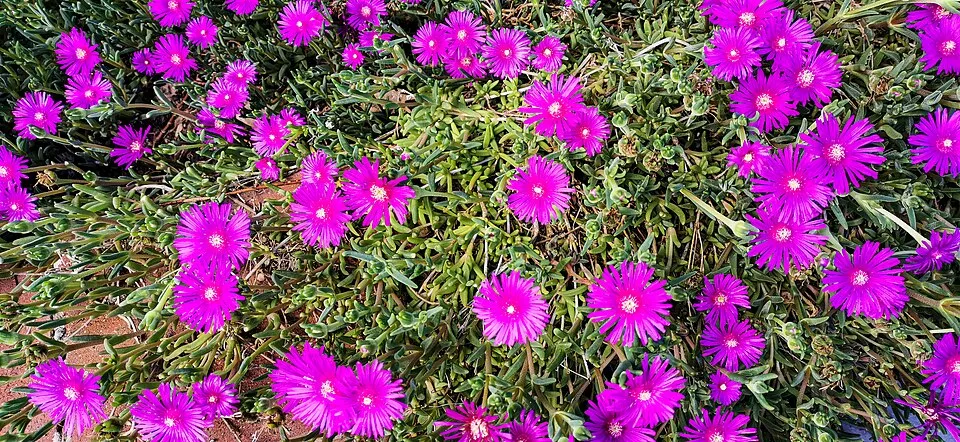
Delosperma cooperi, commonly known as Cooper's Hardy Ice Plant or simply Hardy Ice Plant, is a vibrant, mat-forming succulent perennial belonging to the Aizoaceae family. Native to South Africa, particularly the Free State and KwaZulu-Natal provinces, this resilient plant thrives in arid and semi-arid regions. Its morphology is characterized by fleshy, cylindrical, bright green leaves that are often tinged with red or purple, especially under stress or in cooler temperatures.
These succulent leaves are typically 2-3 cm long and arranged oppositely along sprawling stems, forming a dense, low-lying carpet. The plant produces an abundance of striking, daisy-like flowers, typically a brilliant purplish-pink, with numerous slender petals and a contrasting yellow center. These iridescent blooms open in full sun and close at night, creating a dazzling display from late spring through summer and into fall.
Delosperma cooperi is highly valued in horticulture for its exceptional drought tolerance, heat resistance, and ability to flourish in poor, well-drained soils, making it an ideal choice for xeriscaping, rock gardens, green roofs, and as an effective groundcover for erosion control. Its robust nature and long blooming season contribute significantly to its popularity in diverse landscape settings, where it provides continuous visual interest and ecological benefits by attracting pollinators.
Trusted Scientific References
1. Authoritative external sources for Delosperma Cooperi
1.1 Wikipedia — Delosperma Cooperi
1.2 Kew POWO (Plants of the World Online)
1.3 PubMed — peer-reviewed research
1.4 NCBI Taxonomy Browser
1.5 GBIF — Global Biodiversity
1.6Delosperma Cooperi should be interpreted through verified botanical identity, practical care, and responsible safety language. This recovery note adds the missing context needed for a complete profile: match light to the plant's habit, use well-drained soil, water according to season, and avoid unsupported medicinal or edible claims. For publishing, the plant can be presented as a source-backed garden plant with clear care guidance, common problem diagnosis, and conservative safety wording.
1.1.Delosperma Cooperi — Key Features
- ✓ <strong>Succulent Perennial</strong> — Fleshy leaves store water, allowing it to tolerate dry conditions.
- ✓ <strong>Mat</strong> — Forming Groundcover — Spreads to create a dense, low carpet, ideal for covering large areas.
- ✓ <strong>Vibrant Flowers</strong> — Produces abundant, daisy-like, purplish-pink blooms with yellow centers.
- ✓ <strong>Long Blooming Season</strong> — Flowers from late spring through summer and into fall.
- ✓ <strong>Drought Tolerant</strong> — Highly resistant to dry spells, perfect for xeriscape landscapes.
- ✓ <strong>Heat Tolerant</strong> — Performs well in hot climates and full sun exposure.
- ✓ <strong>Salt Tolerant</strong> — Can withstand moderate levels of salt, suitable for coastal areas.
- ✓ <strong>Low Maintenance</strong> — Requires minimal care once established, making it gardener-friendly.
- ✓ <strong>Evergreen in Warm Climates</strong> — Retains its foliage year-round in milder winter regions.
- ✓ <strong>Erosion Control</strong> — Effective for stabilizing soil on slopes and embankments.
1.2.Delosperma Cooperi — Quick Summary
- ✓ Delosperma cooperi is Cooper's Hardy Ice Plant, a South African succulent.
- ✓ Valued ornamental groundcover with vibrant purplish-pink flowers.
- ✓ Exceptionally drought-tolerant, thrives in full sun and well-drained soil.
- ✓ Contains potential phytochemicals like betalains and flavonoids.
- ✓ Medicinal uses are not well-documented or scientifically proven.
- ✓ Primarily used for xeriscaping, rock gardens, and erosion control.
2.Delosperma Cooperi — Scientific Identity
3.Delosperma Cooperi — Quick Facts
4.Delosperma Cooperi — Appearance & Identification
5.Delosperma Cooperi — Native Habitat
6.Delosperma Cooperi — Water Requirements
- ✓ Soil Preference — Thrives in dry, sandy, or gravelly soils with excellent drainage; heavy clay soils or poor drainage should be avoided to prevent root rot.
- ✓ Sunlight Requirements — Requires full sun exposure for optimal growth and flowering, ideally 6 or more hours of direct sunlight daily.
- ✓ Watering Regimen — Extremely drought tolerant once established; water sparingly, allowing the soil to dry out completely between waterings, especially in winter.
- ✓ Temperature and Hardiness — Hardy in USDA Zones 5-10, tolerating cold temperatures down to -20°F (-29°C) if kept dry; evergreen in warmer climates.
- ✓ Spacing — Space plants 16-24 inches apart to allow for spreading and formation of a dense groundcover.
- ✓ Maintenance — Low maintenance; occasional deadheading can encourage more blooms, and minimal fertilization is needed, if any, in poor soils.
- ✓ Propagation — Easily propagated by stem cuttings or division in spring or early summer, allowing cuttings to callus before planting.
Reviewed by the Flora Medical Global Botanical Review Panel
Multi-disciplinary editorial group · Botany · Ethnobotany · Herbal-medicine literature
Who reviewed this: This page was checked by the Flora Medical Global Botanical Review Panel — an in-house editorial group of botany graduates, ethnobotany researchers, and horticulture practitioners who collectively maintain our 7,000+ plant encyclopedia. Meet the team.
Our 4-step verification process
1. Taxonomic verification
Scientific names and synonyms cross-checked against Kew POWO, World Flora Online, and The Plant List.
2. Phytochemical & medicinal cross-reference
Active compounds, traditional uses, and reported activities are cross-referenced with PubMed, USDA Dr. Duke's database, and peer-reviewed ethnobotanical literature.
3. Conservation & distribution check
Distribution, ecology, and conservation status confirmed against GBIF occurrence records and the IUCN Red List.
4. Editorial & safety review
Every entry passes an editorial pass for clarity, originality, and safety notices (toxicity, contraindications, dosage caveats) before publication.
Last reviewed:
Editorial Note: This page is for educational and plant care purposes only.
Written by: Flora Medical Global Editorial Team
Reviewed by: Flora Medical Global Botanical Review Panel
Last Updated: June 15, 2026







Delosperma Cooperi — Comments & Community Reviews
Rate this plant