
Care Disclaimer: Plant care recommendations are general guidelines based on common growing conditions. Individual results may vary based on your local environment, climate, and care routine. If your plant is toxic, keep it away from children and pets, and consult a veterinarian if accidental ingestion occurs.
1.Delosperma Nubigenum — Overview
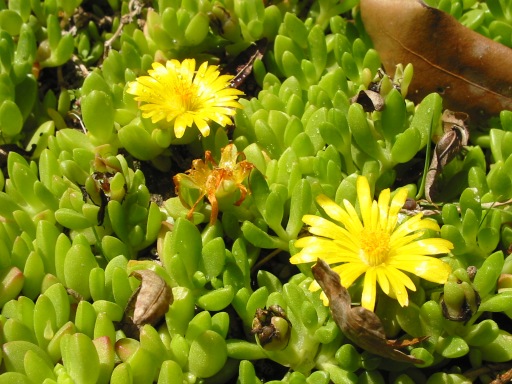
Delosperma nubigenum, commonly known as Cloud-loving Hardy Ice Plant or Hardy Yellow Ice Plant, is a resilient perennial succulent native to the mountainous regions of South Africa. As a member of the Aizoaceae family, it exhibits characteristic adaptations for arid and semi-arid environments. This mat-forming groundcover typically spreads horizontally, creating a dense carpet of foliage. Its striking morphology includes thick, fleshy, shiny, bright, light green leaves, approximately 1.2 inches (3 cm) in length, which develop an attractive reddish tinge during the cooler fall and winter months.
These succulent leaves are crucial for water storage, enabling the plant to withstand periods of drought. In spring, Delosperma nubigenum produces an abundance of solitary, chartreuse-yellow, daisy-like flowers, measuring 1-3 inches (2.5-7.5 cm) in diameter. These vibrant blooms emerge directly from the foliage, attracting various pollinators, including bees and butterflies. The plant thrives in well-drained, sandy or rocky soils and prefers full sun to partial shade exposures.
Its remarkable hardiness and tolerance to drought and moderate salinity make it an excellent choice for xeriscaping, rock gardens, and green roof applications, particularly in USDA Plant Hardiness Zones 6a through 9b. Historically, it was also known by the scientific synonym Mesembryanthemum nubigenum.
Trusted Scientific References
1. Authoritative external sources for Delosperma Nubigenum
1.1 Wikipedia — Delosperma Nubigenum
1.2 Kew POWO (Plants of the World Online)
1.3 PubMed — peer-reviewed research
1.4 NCBI Taxonomy Browser
1.5 GBIF — Global Biodiversity
1.6Delosperma Nubigenum should be interpreted through verified botanical identity, practical care, and responsible safety language. This recovery note adds the missing context needed for a complete profile: match light to the plant's habit, use well-drained soil, water according to season, and avoid unsupported medicinal or edible claims. For publishing, the plant can be presented as a source-backed garden plant with clear care guidance, common problem diagnosis, and conservative safety wording.
1.1.Delosperma Nubigenum — Key Features
- ✓ <strong>Hardy Ice Plant</strong> — Renowned for its resilience and cold tolerance down to USDA Zone 6a.
- ✓ <strong>Mat</strong> — Forming Succulent — Creates a dense, spreading groundcover, excellent for erosion control.
- ✓ <strong>Vibrant Yellow Flowers</strong> — Produces abundant, solitary chartreuse-yellow, daisy-like blooms in spring.
- ✓ <strong>Drought Tolerant</strong> — Highly adapted to dry conditions, requiring minimal water once established.
- ✓ <strong>Salt Tolerant</strong> — Capable of thriving in coastal areas or landscapes exposed to road salt.
- ✓ <strong>Evergreen Foliage</strong> — Maintains bright green, fleshy leaves year-round, often tinged reddish in winter.
- ✓ <strong>Low Maintenance</strong> — Requires minimal care, making it suitable for busy gardeners.
- ✓ <strong>Attracts Pollinators</strong> — Flowers provide nectar for bees and butterflies.
- ✓ <strong>Ideal for Rock Gardens</strong> — Perfect for xeriscaping, green roofs, and sunny, well-drained locations.
- ✓ <strong>South African Native</strong> — Originates from the high-altitude regions of South Africa.
1.2.Delosperma Nubigenum — Quick Summary
- ✓ Delosperma nubigenum is a hardy, mat-forming succulent groundcover native to South Africa.
- ✓ Features vibrant chartreuse-yellow, daisy-like flowers in spring and fleshy, evergreen leaves.
- ✓ Highly drought and salt tolerant, making it ideal for low-maintenance landscapes and rock gardens.
- ✓ Contains beneficial phytochemicals like flavonoids and triterpenes, offering potential antioxidant and anti-inflammatory support.
- ✓ Primarily an ornamental plant, with traditional medicinal applications of related species suggesting topical soothing properties.
- ✓ Requires well-drained soil and full sun for optimal growth, with minimal watering needs.
2.Delosperma Nubigenum — Scientific Identity
3.Delosperma Nubigenum — Quick Facts
4.Delosperma Nubigenum — Appearance & Identification
5.Delosperma Nubigenum — Native Habitat
6.Delosperma Nubigenum — Water Requirements
- ✓ Soil Preference — Ensure well-drained, gritty or sandy loam soil; avoid heavy clay as it leads to root rot.
- ✓ Light Requirements — Provide full sun exposure for at least 6 hours daily for optimal flowering and growth, though partial shade is tolerated.
- ✓ Watering Schedule — Water thoroughly when the soil is dry to the touch, then allow it to dry out completely before the next watering; *Delosperma nubigenum* is drought tolerant.
- ✓ Fertilization — Apply a balanced, slow-release granular fertilizer sparingly in early spring, or a diluted liquid feed during the growing season.
- ✓ Propagation — Easily propagated by stem cuttings taken in spring or early summer; allow cuttings to callus for a day or two before planting.
- ✓ Hardiness Zone — Thrives in USDA Plant Hardiness Zones 6a-9b, demonstrating significant cold tolerance for an ice plant.
- ✓ Maintenance — Low maintenance; prune as needed to control spread or remove spent flowers for aesthetic purposes.
- ✓ Pest and Disease Control — Generally resistant to most pests and diseases, but watch for mealybugs or root rot in overly wet conditions.
Reviewed by the Flora Medical Global Botanical Review Panel
Multi-disciplinary editorial group · Botany · Ethnobotany · Herbal-medicine literature
Who reviewed this: This page was checked by the Flora Medical Global Botanical Review Panel — an in-house editorial group of botany graduates, ethnobotany researchers, and horticulture practitioners who collectively maintain our 7,000+ plant encyclopedia. Meet the team.
Our 4-step verification process
1. Taxonomic verification
Scientific names and synonyms cross-checked against Kew POWO, World Flora Online, and The Plant List.
2. Phytochemical & medicinal cross-reference
Active compounds, traditional uses, and reported activities are cross-referenced with PubMed, USDA Dr. Duke's database, and peer-reviewed ethnobotanical literature.
3. Conservation & distribution check
Distribution, ecology, and conservation status confirmed against GBIF occurrence records and the IUCN Red List.
4. Editorial & safety review
Every entry passes an editorial pass for clarity, originality, and safety notices (toxicity, contraindications, dosage caveats) before publication.
Last reviewed:
Editorial Note: This page is for educational and plant care purposes only.
Written by: Flora Medical Global Editorial Team
Reviewed by: Flora Medical Global Botanical Review Panel
Last Updated: June 15, 2026







Delosperma Nubigenum — Comments & Community Reviews
Rate this plant