


Care Disclaimer: Plant care recommendations are general guidelines based on common growing conditions. Individual results may vary based on your local environment, climate, and care routine. If your plant is toxic, keep it away from children and pets, and consult a veterinarian if accidental ingestion occurs.
1.Dianella Caerulea — Overview
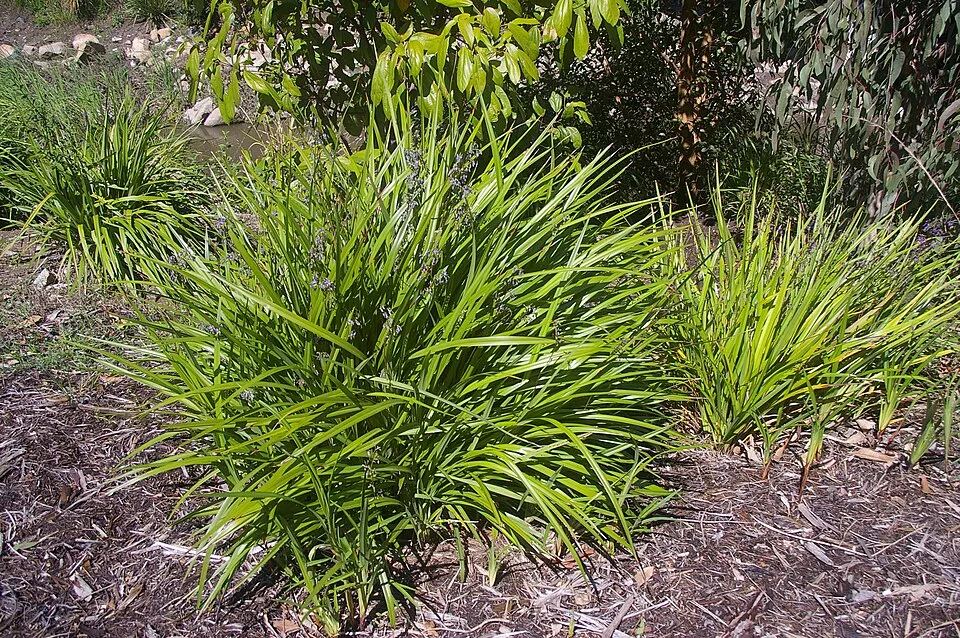
Dianella caerulea, commonly known as the Blue Flax Lily, is a highly variable, evergreen perennial plant belonging to the Asphodelaceae family. It typically forms dense, tufted clumps, emerging from a robust, rhizomatous rootstock.
The plant usually reaches heights of less than 100cm, though certain forms can extend up to 200cm, showcasing its significant intraspecific diversity. Its distinctive strap-like leaves are linear to lanceolate, often with serrated or smooth margins, varying in color from bright green to glaucous blue-green depending on the variety and environmental conditions.
During its flowering season, Dianella caerulea produces delicate, star-shaped flowers that are typically pale blue to purple, borne on erect flower stalks. These vibrant blooms are followed by striking, globose blue berries, approximately 1.5cm in diameter, which are a prominent feature of the plant.
Native to a wide range across eastern Australia, including Tasmania, New South Wales, and Queensland, extending into southern New Guinea, Dianella caerulea thrives in diverse habitats. It is commonly found in sandy soils near creeks, in heathlands, and as an understory plant in sparse woodlands.
Its adaptability allows it to flourish in conditions ranging from warm temperate to subtropical zones, with hardier forms capable of tolerating some snow and short-lived frosts, making it a resilient and widespread species across its native range.
Trusted Scientific References
1. Authoritative external sources for Dianella Caerulea
1.1 Wikipedia — Dianella Caerulea
1.2 Kew POWO (Plants of the World Online)
1.3 PubMed — peer-reviewed research
1.4 NCBI Taxonomy Browser
1.5 GBIF — Global Biodiversity
1.6Dianella Caerulea should be interpreted through verified botanical identity, practical care, and responsible safety language. This recovery note adds the missing context needed for a complete profile: match light to the plant's habit, use well-drained soil, water according to season, and avoid unsupported medicinal or edible claims. For publishing, the plant can be presented as a source-backed garden plant with clear care guidance, common problem diagnosis, and conservative safety wording.
1.1.Dianella Caerulea — Key Features
- ✓ <strong>Botanical Name</strong> — Dianella caerulea Sims.
- ✓ <strong>Common Name</strong> — Blue Flax Lily.
- ✓ <strong>Family</strong> — Asphodelaceae (formerly placed in Hemerocallidaceae or Liliaceae).
- ✓ <strong>Native Range</strong> — Eastern Australia (Tasmania to Queensland) and southern New Guinea.
- ✓ <strong>Edible Part</strong> — Ripe, globose blue berries, consumed raw or cooked.
- ✓ <strong>Other Uses</strong> — Leaves provide strong, silky fiber for weaving and traditional crafts.
- ✓ <strong>Growth Habit</strong> — Rhizomatous, evergreen perennial forming tufted clumps.
- ✓ <strong>Environmental Adaptability</strong> — Tolerates diverse conditions from temperate to subtropical, including light frosts.
- ✓ <strong>Distinctive Feature</strong> — Produces vibrant, metallic blue fruits, highly ornamental.
- ✓ <strong>Cultural Significance</strong> — Important traditional food and material source for indigenous Australians.
1.2.Dianella Caerulea — Quick Summary
- ✓ Evergreen perennial with striking blue berries.
- ✓ Native to eastern Australia and southern New Guinea.
- ✓ Ripe berries are edible, traditionally consumed by indigenous peoples.
- ✓ Leaves yield strong, silky fiber for traditional crafts like basket weaving.
- ✓ Highly adaptable to various soil and light conditions, including some frost.
- ✓ Primarily valued for ornamental appeal, food, and fiber; no specific medicinal uses widely documented.
2.Dianella Caerulea — Scientific Identity
3.Dianella Caerulea — Quick Facts
4.Dianella Caerulea — Appearance & Identification
5.Dianella Caerulea — Native Habitat
6.Dianella Caerulea — Water Requirements
- ✓ Soil Preference — Thrives in well-drained, neutral to acidic soil, adapting well to sandy loam conditions, reflecting its natural habitat.
- ✓ Light Requirements — Prefers full sun to dappled shade, with dappled shade offering protection in hotter climates and promoting lush foliage.
- ✓ Watering Needs — Requires moderate watering, especially during dry periods, but is generally drought-tolerant once established, making it suitable for water-wise gardens.
- ✓ Temperature Tolerance — Exhibits a wide range of adaptability, tolerating light frosts and some snow in its hardier forms, making it suitable for various temperate and subtropical zones.
- ✓ Propagation — Can be propagated effectively from fresh seeds, requiring pre-soaking for 24 hours, or by division of established rhizomatous clumps during active growth.
- ✓ Maintenance — Generally low maintenance, benefiting from occasional removal of spent flower stalks and old foliage to maintain vigor and prevent overcrowding.
- ✓ Habitat Mimicry — Best grown in conditions mimicking its natural habitat, such as sparse woodlands or heathlands, to ensure optimal growth and resilience.
Reviewed by the Flora Medical Global Botanical Review Panel
Multi-disciplinary editorial group · Botany · Ethnobotany · Herbal-medicine literature
Who reviewed this: This page was checked by the Flora Medical Global Botanical Review Panel — an in-house editorial group of botany graduates, ethnobotany researchers, and horticulture practitioners who collectively maintain our 7,000+ plant encyclopedia. Meet the team.
Our 4-step verification process
1. Taxonomic verification
Scientific names and synonyms cross-checked against Kew POWO, World Flora Online, and The Plant List.
2. Phytochemical & medicinal cross-reference
Active compounds, traditional uses, and reported activities are cross-referenced with PubMed, USDA Dr. Duke's database, and peer-reviewed ethnobotanical literature.
3. Conservation & distribution check
Distribution, ecology, and conservation status confirmed against GBIF occurrence records and the IUCN Red List.
4. Editorial & safety review
Every entry passes an editorial pass for clarity, originality, and safety notices (toxicity, contraindications, dosage caveats) before publication.
Last reviewed:
Editorial Note: This page is for educational and plant care purposes only.
Written by: Flora Medical Global Editorial Team
Reviewed by: Flora Medical Global Botanical Review Panel
Last Updated: June 15, 2026







Dianella Caerulea — Comments & Community Reviews
Rate this plant