
Care Disclaimer: Plant care recommendations are general guidelines based on common growing conditions. Individual results may vary based on your local environment, climate, and care routine. If your plant is toxic, keep it away from children and pets, and consult a veterinarian if accidental ingestion occurs.
1.Dianthus Ground Cover — Overview
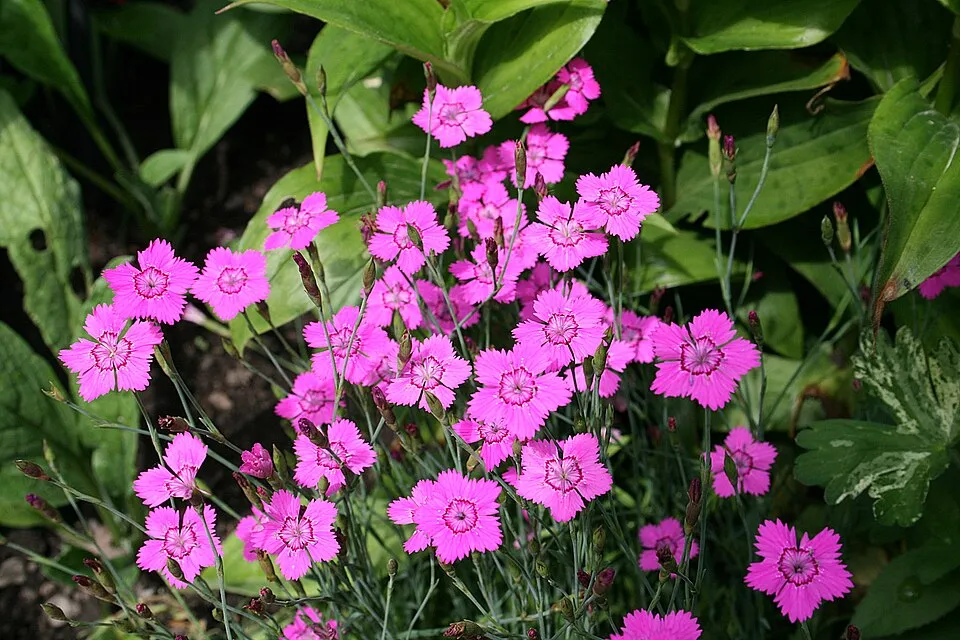
Dianthus deltoides, widely recognized as Maiden Pink, Lady's Cushion, or Meadow Pink, is a charming perennial herbaceous plant belonging to the Caryophyllaceae family, commonly known as the carnation family. This species typically establishes itself as a low-growing ground cover, reaching heights of 6 to 12 inches (15 to 30 cm) and spreading outwards 12 to 24 inches (30 to 60 cm) to form a dense mat. Its foliage consists of narrow, lanceolate leaves, approximately 2 to 4 inches (5 to 10 cm) long, often exhibiting a vibrant green to bluish-green hue.
The specific epithet 'deltoides' refers to the narrowly triangular shape of its leaves, reminiscent of the Greek letter delta. From late spring through early summer, Dianthus deltoides produces an abundance of striking, fragrant flowers. These five-petaled blooms appear in a spectrum of colors including shades of pink, red, lavender, and white, frequently adorned with serrated or fringed edges and often featuring a darker, star-like ring near their center.
The slender, erect stems support these delicate flowers above the compact foliage. Native to Europe and western Asia, Maiden Pink thrives in open, sunny habitats and prefers well-drained, sandy, rocky, or even poor soils, demonstrating notable drought tolerance. It has since been introduced and naturalized in various regions, including parts of the United States and Canada, where it is valued in gardens for its aesthetic appeal, low maintenance, and ability to form an effective groundcover in rock gardens, borders, and slopes.
Trusted Scientific References
1. Authoritative external sources for Dianthus deltoides
1.1 Wikipedia — Dianthus deltoides
1.2 Kew POWO (Plants of the World Online)
1.3 PubMed — peer-reviewed research
1.4 NCBI Taxonomy Browser
1.5 GBIF — Global Biodiversity
1.6Dianthus Ground Cover should be interpreted through verified botanical identity, practical care, and responsible safety language. This recovery note adds the missing context needed for a complete profile: match light to the plant's habit, use well-drained soil, water according to season, and avoid unsupported medicinal or edible claims. For publishing, the plant can be presented as a source-backed garden plant with clear care guidance, common problem diagnosis, and conservative safety wording.
1.1.Dianthus Ground Cover — Key Features
- ✓ <strong>Attractive, Fragrant Flowers</strong> — Blooms in pink, red, white, often with serrated edges and a central star pattern.
- ✓ <strong>Excellent Groundcover</strong> — Forms a dense, mat-like spread ideal for various landscape applications.
- ✓ <strong>Drought Tolerant</strong> — Once established, it requires minimal watering, suitable for xeriscaping.
- ✓ <strong>Deer and Rabbit Resistant</strong> — Generally not favored by garden pests, making it a robust choice.
- ✓ <strong>Low Maintenance</strong> — Requires minimal care, thriving in less-than-ideal soil conditions.
- ✓ <strong>Traditional Medicinal Uses</strong> — Historically valued in Ayurvedic and Unani medicine for digestive and respiratory support.
- ✓ <strong>Adaptable to Poor Soils</strong> — Thrives in sandy, rocky, or poor soil types, provided drainage is good.
- ✓ <strong>Self</strong> — Seeding Nature — Can readily reseed, contributing to its groundcover capabilities.
- ✓ <strong>Perennial Longevity</strong> — Returns year after year, though division every few years is recommended for vigor.
- ✓ <strong>Native to Europe and Asia</strong> — Reflects its hardiness and natural adaptability to temperate climates.
1.2.Dianthus Ground Cover — Quick Summary
- ✓ Dianthus deltoides, or Maiden Pink, is a low-growing, fragrant perennial with colorful flowers.
- ✓ Traditionally used in Ayurveda and Unani for digestion, inflammation, and respiratory issues.
- ✓ Contains general plant compounds like flavonoids and saponins, which suggest potential benefits.
- ✓ Requires well-drained soil and full sun; easy to grow and drought-tolerant.
- ✓ Possesses low severity poison characteristics, especially for pets; internal use requires caution.
- ✓ Always consult a healthcare professional before medicinal use.
2.Dianthus Ground Cover — Scientific Identity
3.Dianthus Ground Cover — Quick Facts
4.Dianthus Ground Cover — Appearance & Identification
5.Dianthus Ground Cover — Native Habitat
6.Dianthus Ground Cover — Water Requirements
- ✓ Soil Preference — Dianthus deltoides thrives in well-drained soils, including sandy, rocky, or loamy types, and is tolerant of poor, dry, and alkaline conditions.
- ✓ Light Requirements — Full sun exposure (6 or more hours of direct sunlight daily) is essential for optimal growth and abundant flowering.
- ✓ Watering — Once established, Maiden Pink is drought-tolerant; water sparingly, allowing the soil to dry out between waterings to prevent crown rot.
- ✓ Propagation — Easily propagated by division every 2-3 years to maintain plant vigor and prevent overcrowding, or by seed, as it is a self-seeding species.
- ✓ Maintenance — This is a low-maintenance plant. Deadhead spent flowers to encourage continuous blooming and remove any diseased foliage.
- ✓ Pests and Diseases — Generally resistant to deer and rabbits. Watch for leaf spot in humid summers and crown rot in poorly drained, wet soils.
- ✓ Spacing — When planting as a groundcover, space plants about 12-18 inches apart to allow for spreading and mat formation.
- ✓ Hardiness — Suitable for USDA Plant Hardiness Zones 3a-8b, indicating good cold tolerance.
Reviewed by the Flora Medical Global Botanical Review Panel
Multi-disciplinary editorial group · Botany · Ethnobotany · Herbal-medicine literature
Who reviewed this: This page was checked by the Flora Medical Global Botanical Review Panel — an in-house editorial group of botany graduates, ethnobotany researchers, and horticulture practitioners who collectively maintain our 7,000+ plant encyclopedia. Meet the team.
Our 4-step verification process
1. Taxonomic verification
Scientific names and synonyms cross-checked against Kew POWO, World Flora Online, and The Plant List.
2. Phytochemical & medicinal cross-reference
Active compounds, traditional uses, and reported activities are cross-referenced with PubMed, USDA Dr. Duke's database, and peer-reviewed ethnobotanical literature.
3. Conservation & distribution check
Distribution, ecology, and conservation status confirmed against GBIF occurrence records and the IUCN Red List.
4. Editorial & safety review
Every entry passes an editorial pass for clarity, originality, and safety notices (toxicity, contraindications, dosage caveats) before publication.
Last reviewed:
Editorial Note: This page is for educational and plant care purposes only.
Written by: Flora Medical Global Editorial Team
Reviewed by: Flora Medical Global Botanical Review Panel
Last Updated: June 15, 2026







Dianthus Ground Cover — Comments & Community Reviews
Rate this plant