

Care Disclaimer: Plant care recommendations are general guidelines based on common growing conditions. Individual results may vary based on your local environment, climate, and care routine. If your plant is toxic, keep it away from children and pets, and consult a veterinarian if accidental ingestion occurs.
1.Dianthus Pinks — Overview
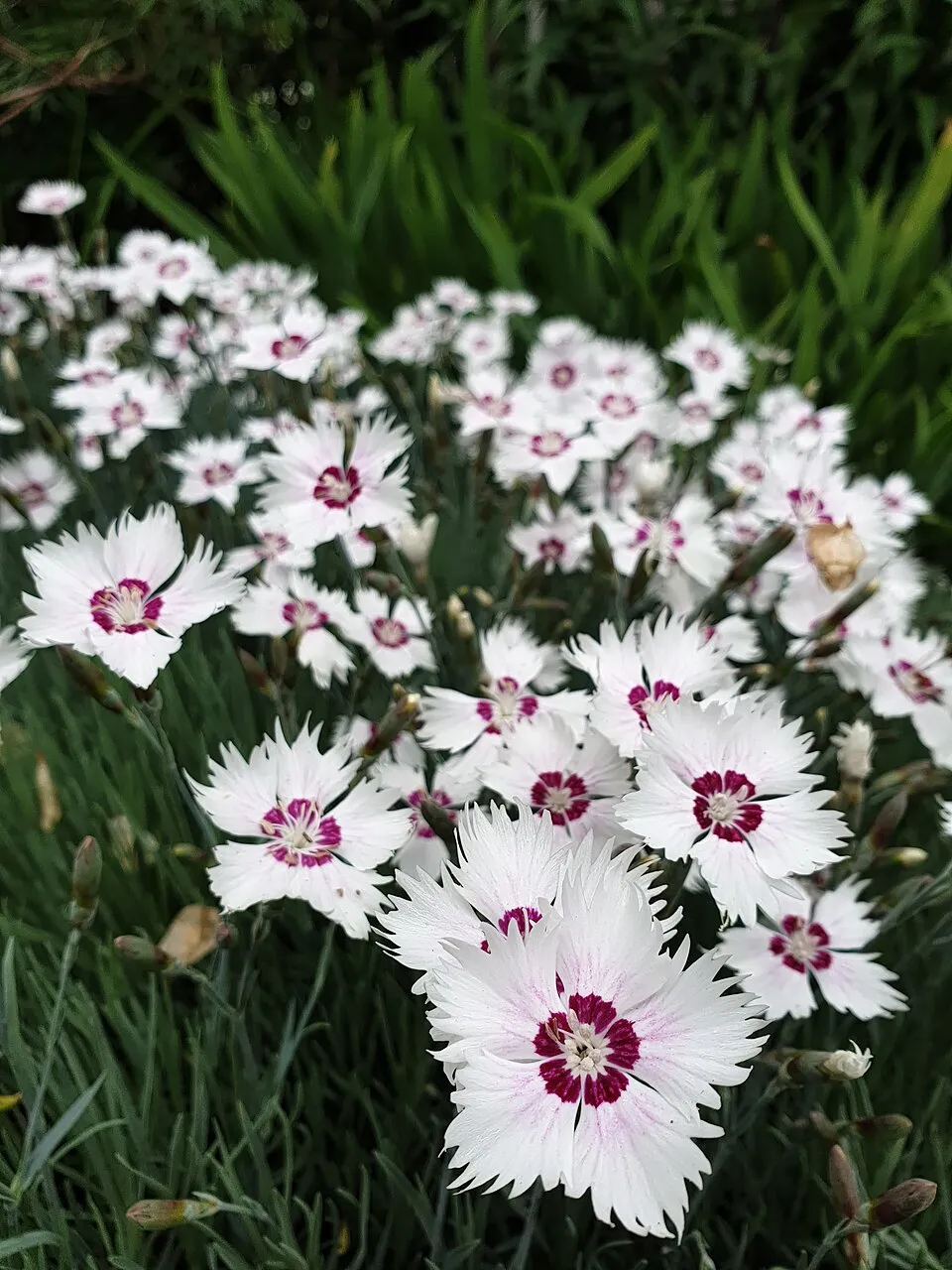
Dianthus plumarius, commonly known as Pinks, Cottage Pink, Feathered Pink, or Garden Pink, is a charming perennial herbaceous plant belonging to the extensive Caryophyllaceae family. This species is characterized by its compact, clumping growth habit, forming dense, evergreen mounds of slender, grey-green leaves that typically reach a height of 20 to 30 centimeters. The linear foliage, often up to 10 cm long, exhibits a soft texture and a distinctive bluish tint.
The most striking feature of Dianthus plumarius is its profusion of fragrant, star-shaped flowers, which emerge from late spring through early summer. These blooms, measuring approximately 3 to 5 cm in diameter, are available in a delightful spectrum of colors including various shades of pink, white, and red, frequently adorned with intricately frilled or serrated petal edges. The characteristic spicy, clove-like scent adds to their appeal.
Native to Europe, Dianthus plumarius thrives in well-drained, neutral to slightly alkaline soils and prefers full sun conditions, which are crucial for encouraging abundant flowering. Its adaptability allows it to tolerate poorer, sandy, or dry soils once established, making it a resilient choice for rock gardens, border fronts, container plantings, and along paths or rock walls. This plant is often found flourishing in wildflower meadows and rocky terrains, demonstrating its hardiness and drought resistance.
Beyond its ornamental value, the Pinks plant plays an ecological role by attracting various pollinators, such as butterflies and bees, thereby supporting local biodiversity. It is sometimes confused with other Dianthus species like Dianthus caryophyllus (carnation) or Dianthus deltoides, but D. plumarius maintains its distinct characteristics.
Trusted Scientific References
1. Authoritative external sources for Dianthus plumarius
1.1 Wikipedia — Dianthus plumarius
1.2 Kew POWO (Plants of the World Online)
1.3 PubMed — peer-reviewed research
1.4 NCBI Taxonomy Browser
1.5 GBIF — Global Biodiversity
1.1.Dianthus Pinks — Key Features
- ✓ <strong>Botanical Name</strong> — Dianthus plumarius
- ✓ <strong>Common Names</strong> — Pinks, Cottage Pink, Feathered Pink, Garden Pink, Scotch Pink
- ✓ <strong>Family</strong> — Caryophyllaceae
- ✓ <strong>Growth Habit</strong> — Compact, evergreen perennial forming dense mounds
- ✓ <strong>Flower Characteristics</strong> — Fragrant, ruffled, and fringed petals in pink, white, and red hues
- ✓ <strong>Bloom Time</strong> — Late spring through early summer
- ✓ <strong>Soil Preference</strong> — Well-drained, neutral to slightly alkaline; tolerates poor soils
- ✓ <strong>Sun Exposure</strong> — Full sun for optimal flowering
- ✓ <strong>Traditional Uses</strong> — Diuretic, antipyretic, antispasmodic, laxative
- ✓ <strong>Key Constituents</strong> — Flavonoids, saponins, phenolic compounds
1.2.Dianthus Pinks — Quick Summary
- ✓ Dianthus plumarius, or Pinks, is a fragrant perennial with distinctive fringed flowers.
- ✓ Traditionally used for ailments like kidney stones, UTIs, fever, and menstrual issues.
- ✓ Rich in beneficial compounds including flavonoids, saponins, and phenolic acids.
- ✓ Valued ornamentally in gardens and culinarily as an edible garnish or flavoring.
- ✓ Thrives in well-drained soil and full sun, demonstrating good drought tolerance.
- ✓ Generally low toxicity, but caution is advised for pets and during pregnancy; consult a health expert for medicinal use.
2.Dianthus Pinks — Scientific Identity
3.Dianthus Pinks — Quick Facts
4.Dianthus Pinks — Appearance & Identification
5.Dianthus Pinks — Native Habitat
6.Dianthus Pinks — Water Requirements
- ✓ Soil Preference — Requires well-drained, neutral to slightly alkaline soil; tolerates poor, sandy, or dry conditions but flourishes in nutrient-rich environments.
- ✓ Sunlight Requirements — Thrives in full sun, needing at least six hours of direct sunlight daily for optimal growth and prolific blooming.
- ✓ Watering Regimen — Prefers soil to dry out between waterings; avoid consistently wet or poorly drained conditions to prevent crown rot and fungal diseases.
- ✓ Hardiness Zones — Generally hardy in USDA Zones 3-9, with specific hardiness varying slightly by cultivar.
- ✓ Maintenance Practices — Deadhead spent flowers regularly to encourage continuous blooming; shearing after the main flush of flowers can rejuvenate the plant.
- ✓ Propagation Techniques — Easily propagated by division every 2-3 years in spring, and also readily self-seeds in favorable conditions.
- ✓ Pest and Disease Management — Monitor for common pests like slugs, aphids, cutworms, and spider mites; susceptible to fungal rot in excessively moist conditions.
- ✓ Landscape Application — Ideal for rock gardens, border fronts, ground cover, container planting, and along paths or garden walls.
Reviewed by the Flora Medical Global Botanical Review Panel
Multi-disciplinary editorial group · Botany · Ethnobotany · Herbal-medicine literature
Who reviewed this: This page was checked by the Flora Medical Global Botanical Review Panel — an in-house editorial group of botany graduates, ethnobotany researchers, and horticulture practitioners who collectively maintain our 7,000+ plant encyclopedia. Meet the team.
Our 4-step verification process
1. Taxonomic verification
Scientific names and synonyms cross-checked against Kew POWO, World Flora Online, and The Plant List.
2. Phytochemical & medicinal cross-reference
Active compounds, traditional uses, and reported activities are cross-referenced with PubMed, USDA Dr. Duke's database, and peer-reviewed ethnobotanical literature.
3. Conservation & distribution check
Distribution, ecology, and conservation status confirmed against GBIF occurrence records and the IUCN Red List.
4. Editorial & safety review
Every entry passes an editorial pass for clarity, originality, and safety notices (toxicity, contraindications, dosage caveats) before publication.
Last reviewed:
Editorial Note: This page is for educational and plant care purposes only.
Written by: Flora Medical Global Editorial Team
Reviewed by: Flora Medical Global Botanical Review Panel
Last Updated: June 15, 2026







Dianthus Pinks — Comments & Community Reviews
Rate this plant