

Care Disclaimer: Plant care recommendations are general guidelines based on common growing conditions. Individual results may vary based on your local environment, climate, and care routine. If your plant is toxic, keep it away from children and pets, and consult a veterinarian if accidental ingestion occurs.
1.Dietes Grandiflora — Overview
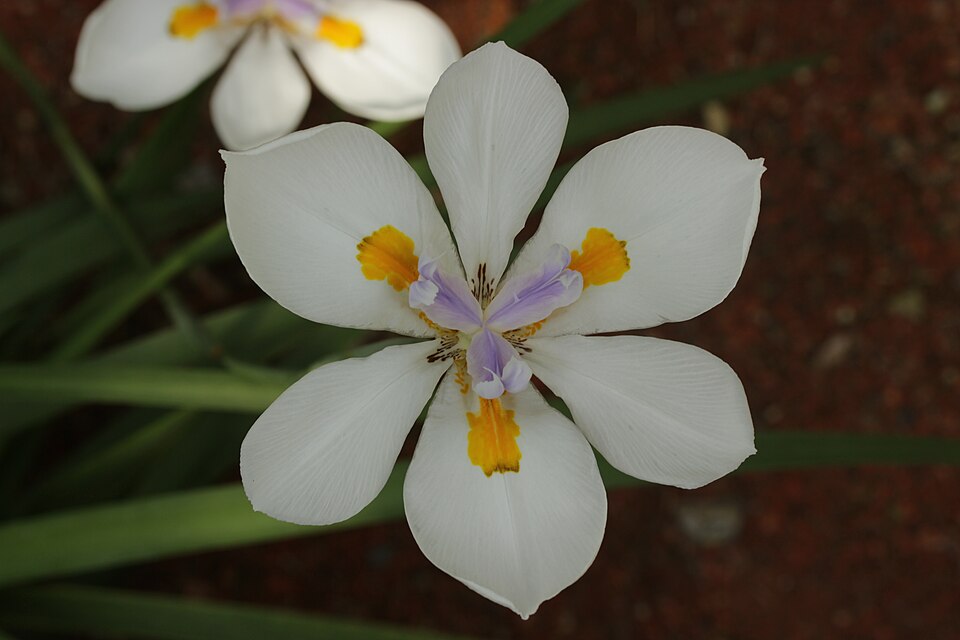
Dietes grandiflora, commonly known as the Large Wild Iris, Fortnight Lily, African Iris, or Fairy Iris, is a striking rhizomatous perennial belonging to the Iridaceae family. This species typically forms large clumps, reaching heights of up to 5 feet, with erect, slender stems that hold its elegant flowers aloft. Its foliage consists of rigid, sword-shaped, dark green leaves arranged in a distinctive fan shape, providing year-round visual interest.
The blossoms are particularly notable, measuring up to four inches in diameter, featuring large white tepals marked with vibrant yellow nectar guides and violet central segments, often accompanied by subtle dark markings at the base of the outer tepals. These exquisite flowers bloom abundantly throughout the summer in its native Southern Hemisphere, though individual blooms are ephemeral, lasting only a couple of days. Following successful pollination, the plant produces 5 cm long green capsules that eventually split open to disperse very dark brown seeds.
Native to the eastern coastal regions of South Africa, specifically the southern and eastern capes and southern Kwazulu-Natal, Dietes grandiflora thrives naturally at forest margins or in the shelter of taller shrubs on exposed, sea-facing slopes. It demonstrates remarkable adaptability, flourishing in a range of conditions from dappled shade to full sun, where it flowers most profusely, and tolerating well-drained to moderate soils.
The plant is celebrated for its drought and frost hardiness, making it a popular choice for low-maintenance landscaping and xeriscaping in USDA Hardiness Zones 8-9. Taxonomically, its genus name, Dietes, signifies 'having two relatives,' while grandiflora aptly means 'large flower,' reflecting its prominent floral display.
Trusted Scientific References
1. Authoritative external sources for Dietes Grandiflora
1.1 Wikipedia — Dietes Grandiflora
1.2 Kew POWO (Plants of the World Online)
1.3 PubMed — peer-reviewed research
1.4 NCBI Taxonomy Browser
1.5 GBIF — Global Biodiversity
1.1.Dietes Grandiflora — Key Features
- ✓ <strong>Botanical Name</strong> — Dietes grandiflora
- ✓ <strong>Common Names</strong> — Large Wild Iris, Fortnight Lily, African Iris, Fairy Iris
- ✓ <strong>Family</strong> — Iridaceae (Iris Family)
- ✓ <strong>Origin</strong> — Eastern coastal regions of South Africa
- ✓ <strong>Growth Habit</strong> — Rhizomatous perennial, forming large clumps up to 5 feet tall
- ✓ <strong>Flowers</strong> — White with yellow and violet markings, approximately 4 inches in diameter, short-lived but profuse
- ✓ <strong>Foliage</strong> — Dark green, rigid, sword-shaped leaves arranged in a fan
- ✓ <strong>Hardiness</strong> — USDA Zones 8-9; notable for drought and frost tolerance
- ✓ <strong>Sun Exposure</strong> — Thrives in full sun to partial shade, with best flowering in full sun
- ✓ <strong>Landscape Use</strong> — Highly valued for ornamental planting, borders, mass plantings, and xeriscaping
1.2.Dietes Grandiflora — Quick Summary
- ✓ Dietes grandiflora is an ornamental perennial known as Large Wild Iris or Fortnight Lily.
- ✓ Features striking white, yellow, and violet flowers on sword-shaped leaves.
- ✓ Native to South Africa, thriving in full sun to partial shade and well-drained soil.
- ✓ Drought and frost hardy, popular for low-maintenance landscaping and xeriscaping.
- ✓ Primarily cultivated for beautification; no documented medicinal uses.
- ✓ Can be invasive in some non-native environments, requiring responsible planting.
2.Dietes Grandiflora — Scientific Identity
3.Dietes Grandiflora — Quick Facts
4.Dietes Grandiflora — Appearance & Identification
5.Dietes Grandiflora — Native Habitat
6.Dietes Grandiflora — Water Requirements
- ✓ Site Selection — Choose a location with full sun to partial shade; full sun promotes the most profuse flowering.
- ✓ Soil Preparation — Ensure well-drained soil with moderate fertility; Dietes grandiflora is adaptable but dislikes waterlogged conditions.
- ✓ Planting — Plant rhizomes or young plants in spring or autumn, spacing them adequately to allow for their clumping growth habit.
- ✓ Watering — Water regularly until established, then the plant becomes drought-tolerant, requiring only moderate watering during prolonged dry spells.
- ✓ Fertilization — Light fertilization in spring with a balanced slow-release fertilizer can encourage vigorous growth and flowering.
- ✓ Pruning — Remove spent flower stalks to maintain tidiness and encourage continuous blooming; dead or damaged leaves can be trimmed to the base.
- ✓ Propagation — Easily propagated by dividing the rhizomatous clumps in early spring or by sowing seeds collected from mature capsules.
- ✓ Pest and Disease Management — Generally robust, but monitor for common garden pests like aphids or slugs and address any fungal issues in overly damp conditions.
Reviewed by the Flora Medical Global Botanical Review Panel
Multi-disciplinary editorial group · Botany · Ethnobotany · Herbal-medicine literature
Who reviewed this: This page was checked by the Flora Medical Global Botanical Review Panel — an in-house editorial group of botany graduates, ethnobotany researchers, and horticulture practitioners who collectively maintain our 7,000+ plant encyclopedia. Meet the team.
Our 4-step verification process
1. Taxonomic verification
Scientific names and synonyms cross-checked against Kew POWO, World Flora Online, and The Plant List.
2. Phytochemical & medicinal cross-reference
Active compounds, traditional uses, and reported activities are cross-referenced with PubMed, USDA Dr. Duke's database, and peer-reviewed ethnobotanical literature.
3. Conservation & distribution check
Distribution, ecology, and conservation status confirmed against GBIF occurrence records and the IUCN Red List.
4. Editorial & safety review
Every entry passes an editorial pass for clarity, originality, and safety notices (toxicity, contraindications, dosage caveats) before publication.
Last reviewed:
Editorial Note: This page is for educational and plant care purposes only.
Written by: Flora Medical Global Editorial Team
Reviewed by: Flora Medical Global Botanical Review Panel
Last Updated: June 15, 2026







Dietes Grandiflora — Comments & Community Reviews
Rate this plant