
Care Disclaimer: Plant care recommendations are general guidelines based on common growing conditions. Individual results may vary based on your local environment, climate, and care routine. If your plant is toxic, keep it away from children and pets, and consult a veterinarian if accidental ingestion occurs.
1.Digitalis Garden — Overview
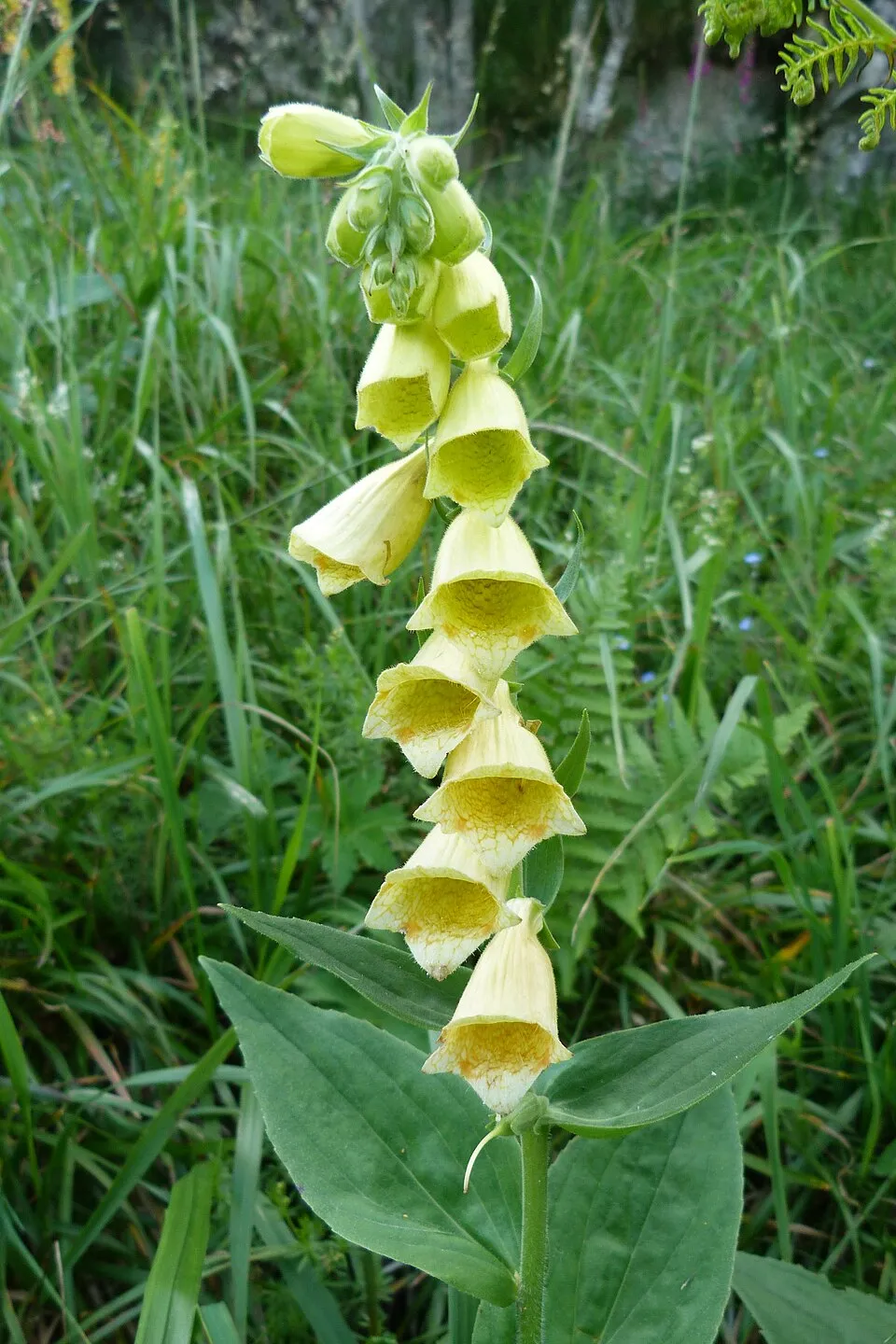
Digitalis grandiflora, commonly known as the Digitalis Garden or Yellow Foxglove, is an exquisite perennial herbaceous plant renowned for its striking floral displays and potent medicinal properties. Typically reaching majestic heights of 60 to 90 cm (24 to 36 inches), and occasionally up to 120 cm, it forms a robust basal rosette of foliage from which stately flower stalks emerge.
Its leaves are distinctively long, narrow, and lanceolate, measuring between 15 to 30 cm (6 to 12 inches) in length, characterized by finely serrated margins that impart a slightly undulating or ruffled texture. The foliage presents a rich, deep green hue, often with a somewhat rugose or wrinkled surface and prominent venation on the underside, creating a lush and dense backdrop for its captivating inflorescence.
The plant develops a fibrous root system that anchors it firmly, though it lacks a woody bark, instead exhibiting smooth, often purplish-tinged green stems that ascend vertically. Flowering occurs from late spring through early summer, producing a raceme of pendulous, bell-shaped flowers. These blossoms exhibit a beautiful clear yellow coloration, frequently adorned with intricate internal speckling of purple or brownish-red dots, serving as nectar guides for its primary pollinators, bees and butterflies.
Each flowering spike can bear numerous individual blooms, contributing significantly to a vibrant garden ecosystem and offering substantial vertical interest in ornamental plantings. Digitalis grandiflora is native to the temperate zones of Europe and parts of Western Asia, thriving naturally in diverse habitats such as open woodlands, forest margins, meadows, and rocky slopes. Its adaptability allows it to flourish in well-drained, loamy soils rich in organic matter, tolerating partial shade but achieving its most vigorous growth and prolific flowering in full sun conditions.
Taxonomically, it is classified within the Plantaginaceae family, a diverse group of flowering plants, highlighting its botanical lineage.
Trusted Scientific References
1. Authoritative external sources for Digitalis grandiflora
1.1 Wikipedia — Digitalis grandiflora
1.2 Kew POWO (Plants of the World Online)
1.3 PubMed — peer-reviewed research
1.4 NCBI Taxonomy Browser
1.5 GBIF — Global Biodiversity
1.1.Digitalis Garden — Key Features
- ✓ <strong>Striking Yellow Bell</strong> — Shaped Flowers with Internal Markings
- ✓ <strong>Contains Potent Cardiotonic</strong> — Contains Potent Cardiotonic Glycosides (e.g., Digitoxin)
- ✓ <strong>Native to Temperate</strong> — Native to Temperate European Woodlands and Meadows
- ✓ <strong>Perennial Herbaceous Growth</strong> — Perennial Herbaceous Growth Habit
- ✓ <strong>Crucial Source Plant</strong> — Crucial Source Plant for Pharmaceutical Digoxin
- ✓ <strong>Highly Toxic and</strong> — Highly Toxic and Poisonous if Ingested
- ✓ <strong>Attracts and Supports</strong> — Attracts and Supports Pollinators like Bees and Butterflies
- ✓ <strong>Distinctive Lanceolate, Finely</strong> — Distinctive Lanceolate, Finely Serrated Foliage
- ✓ <strong>Thrives in Well</strong> — Drained Soil and Partial to Full Sun
- ✓ <strong>Significant Historical and</strong> — Significant Historical and Modern Pharmaceutical Importance
1.2.Digitalis Garden — Quick Summary
- ✓ Digitalis grandiflora, or Yellow Foxglove, is a perennial plant known for its beautiful flowers.
- ✓ All parts of the plant are profoundly toxic due to cardiotonic glycosides.
- ✓ It is the historical and current source of pharmaceutical drugs like digoxin, used for heart conditions.
- ✓ Derivatives are strictly prescribed and monitored by medical professionals for conditions like heart failure and certain arrhythmias.
- ✓ Self-medication or direct ingestion of the raw plant material is extremely dangerous and can be fatal.
2.Digitalis Garden — Scientific Identity
3.Digitalis Garden — Quick Facts
4.Digitalis Garden — Appearance & Identification
5.Digitalis Garden — Native Habitat
6.Digitalis Garden — Water Requirements
- ✓ Site Selection — Choose a location with partial shade to full sun exposure, ensuring good air circulation to prevent fungal issues.
- ✓ Soil Requirements — Prefers well-drained, fertile, loamy soils rich in organic matter; an ideal pH range is between 6.0 and 7.0.
- ✓ Planting — Sow Digitalis grandiflora seeds in late spring or early summer, or plant young nursery-grown seedlings in autumn for establishment before winter.
- ✓ Watering — Maintain consistent soil moisture, particularly during dry spells, but always avoid waterlogging, which can lead to root rot.
- ✓ Fertilization — Apply a balanced slow-release granular fertilizer in early spring, or incorporate well-rotted compost around the base of the plant.
- ✓ Pest and Disease Management — Generally robust, but monitor for common garden pests like slugs and snails, and address powdery mildew in humid conditions with appropriate fungicides.
- ✓ Propagation — Primarily propagated from seed, which can self-sow readily, but it can also be divided carefully in early spring or propagated from basal cuttings.
- ✓ Winter Care — In colder temperate zones, apply a layer of protective mulch around the plant's crown in late autumn to insulate roots from severe frosts.
Reviewed by the Flora Medical Global Botanical Review Panel
Multi-disciplinary editorial group · Botany · Ethnobotany · Herbal-medicine literature
Who reviewed this: This page was checked by the Flora Medical Global Botanical Review Panel — an in-house editorial group of botany graduates, ethnobotany researchers, and horticulture practitioners who collectively maintain our 7,000+ plant encyclopedia. Meet the team.
Our 4-step verification process
1. Taxonomic verification
Scientific names and synonyms cross-checked against Kew POWO, World Flora Online, and The Plant List.
2. Phytochemical & medicinal cross-reference
Active compounds, traditional uses, and reported activities are cross-referenced with PubMed, USDA Dr. Duke's database, and peer-reviewed ethnobotanical literature.
3. Conservation & distribution check
Distribution, ecology, and conservation status confirmed against GBIF occurrence records and the IUCN Red List.
4. Editorial & safety review
Every entry passes an editorial pass for clarity, originality, and safety notices (toxicity, contraindications, dosage caveats) before publication.
Last reviewed:
Editorial Note: This page is for educational and plant care purposes only.
Written by: Flora Medical Global Editorial Team
Reviewed by: Flora Medical Global Botanical Review Panel
Last Updated: June 15, 2026







Digitalis Garden — Comments & Community Reviews
Rate this plant