
Care Disclaimer: Plant care recommendations are general guidelines based on common growing conditions. Individual results may vary based on your local environment, climate, and care routine. If your plant is toxic, keep it away from children and pets, and consult a veterinarian if accidental ingestion occurs.
1.Dipladenia Garden — Overview
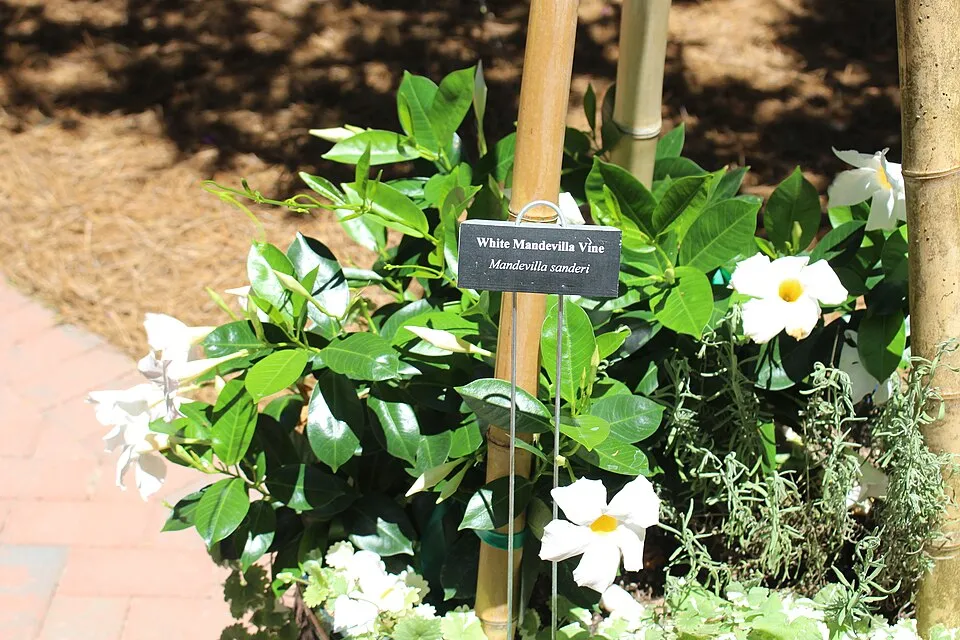
Mandevilla sanderi, commonly known in horticulture as Dipladenia or Brazilian Jasmine, is a captivating perennial vine belonging to the Apocynaceae family, native to the tropical and subtropical regions of South America, particularly Brazil. This species is renowned for its striking ornamental appeal, characterized by a vigorous, twining growth habit that can reach impressive lengths, often requiring structural support like trellises or arbors to showcase its full splendor. The foliage consists of glossy, dark green, ovate to elliptical leaves, typically arranged oppositely along the stems and measuring approximately 4 to 8 inches in length.
Its most celebrated feature is the profusion of large, trumpet-shaped, five-petaled flowers, which bloom from spring through fall. These vibrant blossoms commonly appear in shades of pink, white, or red, often with a contrasting yellow throat, and are highly attractive to various pollinators, including hummingbirds, bees, and butterflies. While Mandevilla sanderi is distinctly a climbing vine, it is frequently confused with or marketed alongside shrub-like cultivars also broadly termed 'Dipladenia,' which share similar floral characteristics but exhibit a more compact, upright growth.
This plant thrives in well-drained, organically rich soils and prefers warm, humid conditions with ample sunlight, though it can exhibit some adaptability to drier climates once established.
Trusted Scientific References
1. Authoritative external sources for Mandevilla sanderi Garden
1.1 Wikipedia — Mandevilla sanderi Garden
1.2 Kew POWO (Plants of the World Online)
1.3 PubMed — peer-reviewed research
1.4 NCBI Taxonomy Browser
1.5 GBIF — Global Biodiversity
1.6Dipladenia Garden should be interpreted through verified botanical identity, practical care, and responsible safety language. This recovery note adds the missing context needed for a complete profile: match light to the plant's habit, use well-drained soil, water according to season, and avoid unsupported medicinal or edible claims. For publishing, the plant can be presented as a source-backed garden plant with clear care guidance, common problem diagnosis, and conservative safety wording.
1.1.Dipladenia Garden — Key Features
- ✓ <strong>Vining Growth Habit</strong> — A strong climber that twines around supports, ideal for vertical garden displays.
- ✓ <strong>Showy Trumpet Flowers</strong> — Large, vibrant blooms in pink, red, or white, with a prolonged flowering season.
- ✓ <strong>Glossy Dark Green Foliage</strong> — Attractive, leathery leaves provide a lush backdrop to the flowers.
- ✓ <strong>Pollinator Attractor</strong> — Flowers draw hummingbirds, bees, and butterflies, enhancing garden biodiversity.
- ✓ <strong>Tropical Origin</strong> — Native to South America, thriving in warm, humid conditions.
- ✓ <strong>Container Adaptability</strong> — Excellent for pots, hanging baskets, and patio decoration.
- ✓ <strong>Tender Perennial</strong> — Can be overwintered indoors in cooler climates or grown as an annual.
- ✓ <strong>Milky Sap</strong> — Contains a latex sap that can be irritating to skin and mucous membranes.
- ✓ <strong>Ornamental Primary Use</strong> — Valued almost exclusively for its aesthetic contribution to landscapes.
- ✓ <strong>Apocynaceae Family Member</strong> — Shares characteristics with other plants in this diverse botanical family.
1.2.Dipladenia Garden — Quick Summary
- ✓ Mandevilla sanderi is a vibrant, tropical vining plant, widely known as Dipladenia, prized for its ornamental value.
- ✓ Produces showy, trumpet-shaped flowers in pink, red, or white, attracting pollinators from spring to fall.
- ✓ Belongs to the Apocynaceae family, characterized by glossy foliage and a milky sap that can cause skin irritation.
- ✓ Requires full sun, well-drained soil, and support for its climbing habit; often treated as an annual in colder climates.
- ✓ Contains alkaloids, flavonoids, and saponins, with potential but unverified traditional medicinal uses in related species.
- ✓ Caution is advised due to potential toxicity from ingestion and skin irritation from sap; primarily for external ornamental enjoyment.
2.Dipladenia Garden — Scientific Identity
3.Dipladenia Garden — Quick Facts
4.Dipladenia Garden — Appearance & Identification
5.Dipladenia Garden — Native Habitat
6.Dipladenia Garden — Water Requirements
- ✓ Sunlight — Ensure at least 6 hours of direct sunlight daily for optimal flowering; partial shade is beneficial in extremely hot climates to prevent leaf scorching.
- ✓ Soil — Plant in well-drained, organically rich soil that retains consistent moisture but avoids waterlogging; a slightly acidic to neutral pH is preferred.
- ✓ Watering — Maintain consistent soil moisture, especially for container-grown plants; allow the top inch of soil to dry slightly between waterings, but never let it completely dry out.
- ✓ Support Structure — Provide a sturdy trellis, arbor, or other support for this climbing vine to twine around, encouraging vertical growth and abundant blooms.
- ✓ Fertilization — Feed actively growing plants every 2-4 weeks with a balanced, water-soluble fertilizer formulated for flowering plants to support continuous blooming.
- ✓ Pruning — Prune to shape the plant, remove spent flowers, and encourage new growth, as Mandevilla sanderi flowers on new wood; it tolerates heavy pruning well.
- ✓ Overwintering — In frost-prone regions, treat as an annual or overwinter indoors as a houseplant by reducing water and light, then restarting growth in spring.
- ✓ Pest Management — Monitor for common pests like spider mites, mealybugs, and aphids, treating with insecticidal soap or horticultural oil as needed.
Reviewed by the Flora Medical Global Botanical Review Panel
Multi-disciplinary editorial group · Botany · Ethnobotany · Herbal-medicine literature
Who reviewed this: This page was checked by the Flora Medical Global Botanical Review Panel — an in-house editorial group of botany graduates, ethnobotany researchers, and horticulture practitioners who collectively maintain our 7,000+ plant encyclopedia. Meet the team.
Our 4-step verification process
1. Taxonomic verification
Scientific names and synonyms cross-checked against Kew POWO, World Flora Online, and The Plant List.
2. Phytochemical & medicinal cross-reference
Active compounds, traditional uses, and reported activities are cross-referenced with PubMed, USDA Dr. Duke's database, and peer-reviewed ethnobotanical literature.
3. Conservation & distribution check
Distribution, ecology, and conservation status confirmed against GBIF occurrence records and the IUCN Red List.
4. Editorial & safety review
Every entry passes an editorial pass for clarity, originality, and safety notices (toxicity, contraindications, dosage caveats) before publication.
Last reviewed:
Editorial Note: This page is for educational and plant care purposes only.
Written by: Flora Medical Global Editorial Team
Reviewed by: Flora Medical Global Botanical Review Panel
Last Updated: June 15, 2026







Dipladenia Garden — Comments & Community Reviews
Rate this plant