
Care Disclaimer: Plant care recommendations are general guidelines based on common growing conditions. Individual results may vary based on your local environment, climate, and care routine. If your plant is toxic, keep it away from children and pets, and consult a veterinarian if accidental ingestion occurs.
1.Drimiopsis Maculata — Overview
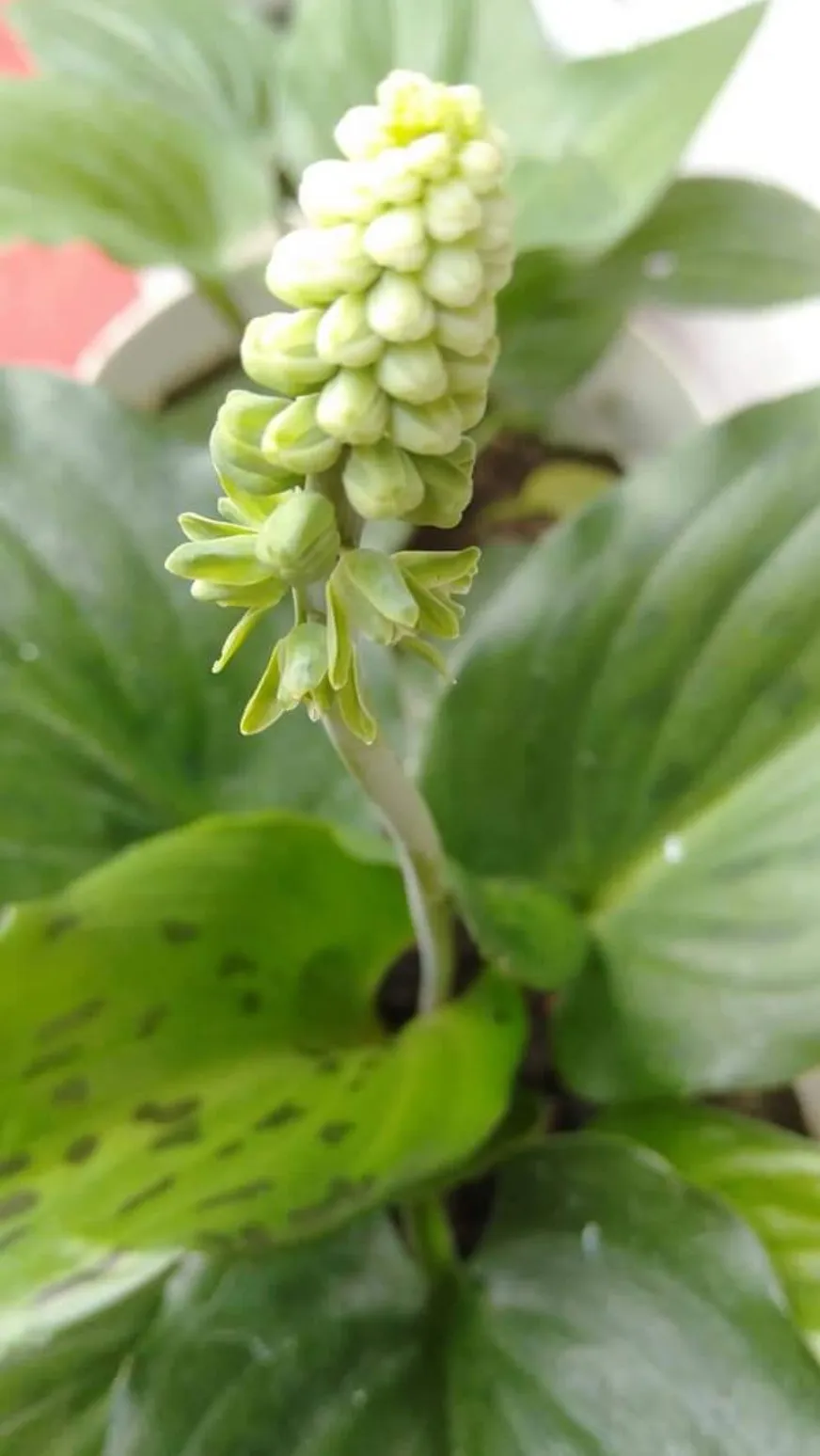
Drimiopsis maculata, commonly known as African Hosta, Leopard Plant, or Little White Soldiers, is an intriguing bulbous geophyte belonging to the Asparagaceae family. Native to the diverse landscapes of Southern Africa, including South Africa, Tanzania, and Mozambique, this perennial herbaceous plant typically reaches heights of up to 35 cm. It emerges from a globose bulb, measuring 1.5 to 5 cm in diameter, which readily produces offsets, allowing it to form attractive dense clumps.
The most striking feature of Drimiopsis maculata is its foliage: 2 to 6 fleshy, oblong-ovate to triangular leaves, often 5 to 30 cm long, display a vibrant shiny green hue accentuated by distinctive dark blotches or spots and wavy margins. A purple-spotted pseudopetiole adds to its unique appearance. The plant produces a subspicate raceme inflorescence, bearing numerous tiny, cream or off-white flowers, each with tepals approximately 4 mm long and stamens significantly shorter.
Following flowering, it develops small capsules as fruit. Drimiopsis maculata thrives in a variety of natural habitats, including riverbanks, forest understories, coastal regions, and open grasslands, from sea level up to 990 meters elevation. It prefers semi-shade to full shade conditions and requires moist, well-drained soil, making it a popular choice for ornamental cultivation in shade gardens or as an indoor potted plant.
Trusted Scientific References
1. Authoritative external sources for Drimiopsis Maculata
1.1 Wikipedia — Drimiopsis Maculata
1.2 Kew POWO (Plants of the World Online)
1.3 PubMed — peer-reviewed research
1.4 NCBI Taxonomy Browser
1.5 GBIF — Global Biodiversity
1.6Drimiopsis Maculata should be interpreted through verified botanical identity, practical care, and responsible safety language. This recovery note adds the missing context needed for a complete profile: match light to the plant's habit, use well-drained soil, water according to season, and avoid unsupported medicinal or edible claims. For publishing, the plant can be presented as a source-backed garden plant with clear care guidance, common problem diagnosis, and conservative safety wording.
1.1.Drimiopsis Maculata — Key Features
- ✓ <strong>Distinctive Spotted Foliage</strong> — Characterized by shiny green leaves adorned with prominent dark blotches or spots, creating a unique ornamental appeal.
- ✓ <strong>Bulbous Perennial Herb</strong> — Grows from a globose bulb, enabling its perennial habit and capacity to form dense clumps over time.
- ✓ <strong>Native to Southern Africa</strong> — Indigenous to regions like South Africa, Tanzania, and Mozambique, thriving in diverse natural habitats.
- ✓ <strong>Traditional Medicinal Plant</strong> — Valued in South African folk medicine, particularly for its historical uses in pediatric care and for alleviating pain and fever.
- ✓ <strong>Scientifically Validated Antimicrobial Properties</strong> — Research confirms its activity against various microbial strains, supporting its traditional applications.
- ✓ <strong>Potent Antioxidant Capacity</strong> — Rich in phytochemicals that effectively combat oxidative stress and protect cellular integrity.
- ✓ <strong>Shade</strong> — Loving Plant — Naturally thrives in semi-shade to full shade environments, making it suitable for understory planting or indoor cultivation.
- ✓ <strong>Easy to Propagate</strong> — Multiplies readily via sucker division, making it simple to expand collections or share with others.
- ✓ <strong>Ornamental Appeal</strong> — Highly regarded as an attractive indoor plant or for shade gardens due to its striking and decorative leaves.
- ✓ <strong>Unique Phytochemical Profile</strong> — Contains specific and rare compounds such as scillascillin-type homoisoflavanones, norlignans, and xanthones.
1.2.Drimiopsis Maculata — Quick Summary
- ✓ Drimiopsis maculata is a distinctive South African bulbous perennial known for its shiny, dark-spotted leaves.
- ✓ It holds significant value in traditional medicine for treating pain, fever, and children's stomach ailments.
- ✓ The plant's unique phytochemical profile includes homoisoflavanones, norlignans, and xanthones.
- ✓ Modern research supports its notable antimicrobial and antioxidant properties.
- ✓ Thrives in semi-shade to full shade with moderate water, making it a popular ornamental plant.
- ✓ Use requires strict caution, especially for internal consumption and in children, always seeking professional advice.
2.Drimiopsis Maculata — Scientific Identity
3.Drimiopsis Maculata — Quick Facts
4.Drimiopsis Maculata — Appearance & Identification
5.Drimiopsis Maculata — Native Habitat
6.Drimiopsis Maculata — Water Requirements
- ✓ Light — Drimiopsis maculata thrives in semi-shade to full shade conditions, preferring dappled light and protection from intense, direct sunlight.
- ✓ Soil — Requires moist, well-drained soil that is rich in organic matter to support healthy bulb and vigorous foliage development.
- ✓ Watering — Needs moderate and consistent watering; keep the soil evenly moist but be careful to avoid waterlogging, especially during cooler or dormant periods.
- ✓ Temperature — Best suited for warm, tropical to subtropical climates; in regions where temperatures drop below freezing, it should be grown in pots and brought indoors or heavily mulched.
- ✓ Propagation — Easily propagated through vegetative division of its rapidly multiplying offsets or suckers, a method typically performed in the spring or early summer months.
- ✓ Location — Ideal for sheltered garden spots, associating well with other shade-loving plants like ferns and hostas, or as an attractive and low-maintenance indoor potted plant.
- ✓ Mulching — Applying a layer of organic mulch, particularly in autumn, helps protect the bulbs from temperature extremes and retains soil moisture, especially where leaves die back in winter.
Reviewed by the Flora Medical Global Botanical Review Panel
Multi-disciplinary editorial group · Botany · Ethnobotany · Herbal-medicine literature
Who reviewed this: This page was checked by the Flora Medical Global Botanical Review Panel — an in-house editorial group of botany graduates, ethnobotany researchers, and horticulture practitioners who collectively maintain our 7,000+ plant encyclopedia. Meet the team.
Our 4-step verification process
1. Taxonomic verification
Scientific names and synonyms cross-checked against Kew POWO, World Flora Online, and The Plant List.
2. Phytochemical & medicinal cross-reference
Active compounds, traditional uses, and reported activities are cross-referenced with PubMed, USDA Dr. Duke's database, and peer-reviewed ethnobotanical literature.
3. Conservation & distribution check
Distribution, ecology, and conservation status confirmed against GBIF occurrence records and the IUCN Red List.
4. Editorial & safety review
Every entry passes an editorial pass for clarity, originality, and safety notices (toxicity, contraindications, dosage caveats) before publication.
Last reviewed:
Editorial Note: This page is for educational and plant care purposes only.
Written by: Flora Medical Global Editorial Team
Reviewed by: Flora Medical Global Botanical Review Panel
Last Updated: June 15, 2026







Drimiopsis Maculata — Comments & Community Reviews
Rate this plant