
Care Disclaimer: Plant care recommendations are general guidelines based on common growing conditions. Individual results may vary based on your local environment, climate, and care routine. If your plant is toxic, keep it away from children and pets, and consult a veterinarian if accidental ingestion occurs.
1.Echeveria Garden — Overview
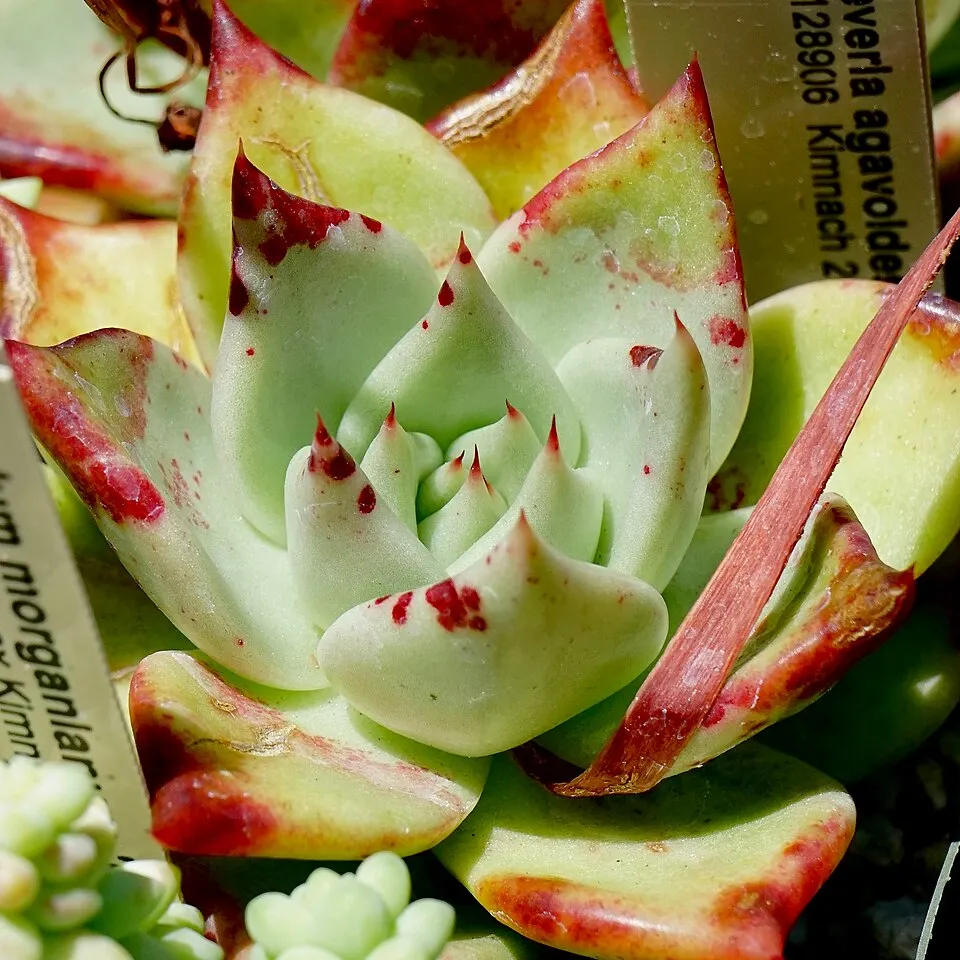
Echeveria agavoides, commonly known as "Lipstick Echeveria" or "Wax Agave," is a striking succulent belonging to the Crassulaceae family. Native to the semi-arid, rocky regions and mountainous terrains of central Mexico, particularly states like San Luis Potosí, Hidalgo, Guanajuato, and Querétaro, it thrives in conditions of intense sun exposure and intermittent rainfall. The species epithet "agavoides" aptly describes its resemblance to Agave plants, characterized by its robust, triangular, and often sharply-tipped leaves. These leaves are arranged in a dense, symmetrical rosette, typically reaching 10-15 cm in height and 10-20 cm in diameter, though larger cultivars exist.
The foliage exhibits a range from light to bluish-green, often coated with a waxy, glaucous layer, and is notably thick and fleshy. A distinguishing feature is the vibrant red or coppery-red margins and tips of its obovate-lanceolate leaves, which intensify dramatically under environmental stress such as cold temperatures or drought, giving rise to its "Lipstick" moniker. Flowering occurs predominantly from late winter into early spring, with tall, arching inflorescences emerging, sometimes reaching up to 50 cm. These bear delicate, bell-shaped flowers in an appealing spectrum of yellow, orange, and red hues, often tipped with a darker yellow.
Botanically, E. agavoides is recognized for its compact growth habit and remarkable resilience, making it a favored ornamental succulent globally. Its natural distribution extends across various Mexican states, including Aguascalientes, Durango, Jalisco, and Zacatecas, highlighting its adaptability to diverse arid landscapes.
Trusted Scientific References
1. Authoritative external sources for Echeveria agavoides
1.1 Wikipedia — Echeveria agavoides
1.2 Kew POWO (Plants of the World Online)
1.3 PubMed — peer-reviewed research
1.4 NCBI Taxonomy Browser
1.5 GBIF — Global Biodiversity
1.6Echeveria Garden should be interpreted through verified botanical identity, practical care, and responsible safety language. This recovery note adds the missing context needed for a complete profile: match light to the plant's habit, use well-drained soil, water according to season, and avoid unsupported medicinal or edible claims. For publishing, the plant can be presented as a source-backed garden plant with clear care guidance, common problem diagnosis, and conservative safety wording.
1.1.Echeveria Garden — Key Features
- ✓ <strong>Botanical Name</strong> — Echeveria agavoides.
- ✓ <strong>Common Names</strong> — Lipstick Echeveria, Wax Agave, Echeveria Garden.
- ✓ <strong>Family</strong> — Crassulaceae.
- ✓ <strong>Origin</strong> — Central Mexico.
- ✓ <strong>Growth Habit</strong> — Stemless, symmetrical rosette succulent.
- ✓ <strong>Foliage</strong> — Fleshy, obovate-lanceolate leaves, light green to bluish-green with red tips/margins.
- ✓ <strong>Flowers</strong> — Bell-shaped, yellow, orange, or red blooms on tall cymes in late winter/early spring.
- ✓ <strong>Drought Tolerance</strong> — High, adapted to arid conditions.
- ✓ <strong>Hardiness</strong> — Winter hardy to 15-20°F (-9 to -6°C).
- ✓ <strong>Ornamental Value</strong> — Highly valued for architectural form and vibrant stress coloration.
1.2.Echeveria Garden — Quick Summary
- ✓ Ornamental Succulent — Prized for its striking rosette form and vibrant, lipstick-red leaf margins.
- ✓ Mexican Native — Thrives in arid, rocky habitats of central Mexico.
- ✓ Low Maintenance — Drought-tolerant and easy to care for, ideal for xeriscaping and containers.
- ✓ No Established Medicinal Use — Primarily valued for aesthetic and horticultural purposes.
- ✓ Pet-Friendly — Generally considered non-toxic to humans and common household pets.
- ✓ Unique Foliage — Thick, fleshy leaves with distinct coloration that intensifies under stress.
2.Echeveria Garden — Scientific Identity
3.Echeveria Garden — Quick Facts
4.Echeveria Garden — Appearance & Identification
5.Echeveria Garden — Native Habitat
6.Echeveria Garden — Water Requirements
- Cultivating Echeveria agavoides is relatively straightforward due to its resilient nature. Here are key guidelines for successful growth:
- ✓ Light Requirement — Plant in an area receiving full sun to partial shade; direct sunlight is crucial for intensifying the vibrant red leaf margins and promoting flowering.
- ✓ Soil Preference — Utilize well-draining soil, ideally a succulent or cactus mix, to prevent root rot, as these plants are highly sensitive to excessive moisture.
- ✓ Watering Schedule — Water thoroughly after planting, then drastically reduce frequency to rarely, allowing the soil to dry out completely between waterings, especially during winter dormancy.
- ✓ Temperature Tolerance — Hardy down to 15-20°F (-9 to -6°C), but prefers warmer conditions. In temperate regions, protect from frost or bring indoors during winter.
- ✓ Winter Rest — Provide a cool, dry winter rest period above 5°C (41°F) without water to encourage robust growth and subsequent flowering in spring.
- ✓ Container or Ground Planting — Suitable for both containers, allowing for easy relocation during cold seasons, and in-ground planting in arid, well-drained garden beds.
- ✓ Propagation — Easily propagated from leaf cuttings or stem cuttings; allow cut surfaces to callus for several days before planting to prevent rot.
- ✓ Low Maintenance — Requires minimal pruning and generally thrives with infrequent attention, making it an excellent choice for low-care landscapes.
Reviewed by the Flora Medical Global Botanical Review Panel
Multi-disciplinary editorial group · Botany · Ethnobotany · Herbal-medicine literature
Who reviewed this: This page was checked by the Flora Medical Global Botanical Review Panel — an in-house editorial group of botany graduates, ethnobotany researchers, and horticulture practitioners who collectively maintain our 7,000+ plant encyclopedia. Meet the team.
Our 4-step verification process
1. Taxonomic verification
Scientific names and synonyms cross-checked against Kew POWO, World Flora Online, and The Plant List.
2. Phytochemical & medicinal cross-reference
Active compounds, traditional uses, and reported activities are cross-referenced with PubMed, USDA Dr. Duke's database, and peer-reviewed ethnobotanical literature.
3. Conservation & distribution check
Distribution, ecology, and conservation status confirmed against GBIF occurrence records and the IUCN Red List.
4. Editorial & safety review
Every entry passes an editorial pass for clarity, originality, and safety notices (toxicity, contraindications, dosage caveats) before publication.
Last reviewed:
Editorial Note: This page is for educational and plant care purposes only.
Written by: Flora Medical Global Editorial Team
Reviewed by: Flora Medical Global Botanical Review Panel
Last Updated: June 15, 2026







Echeveria Garden — Comments & Community Reviews
Rate this plant