

Care Disclaimer: Plant care recommendations are general guidelines based on common growing conditions. Individual results may vary based on your local environment, climate, and care routine. If your plant is toxic, keep it away from children and pets, and consult a veterinarian if accidental ingestion occurs.
1.Echinacea Pallida — Overview
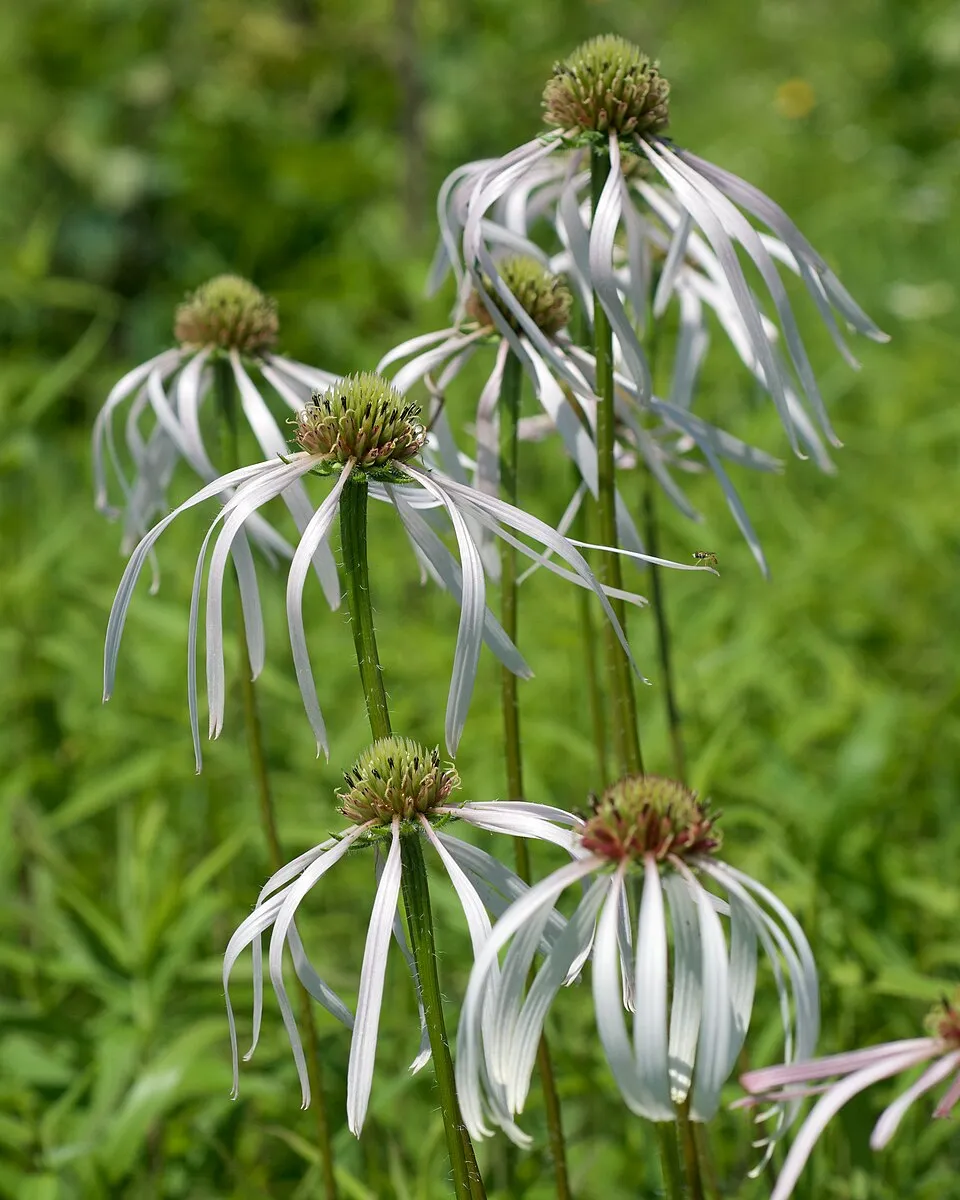
Echinacea pallida, commonly known as Pale Purple Coneflower, is a striking herbaceous perennial native to the central and eastern regions of North America. This resilient plant, belonging to the Asteraceae family, is characterized by its stout, erect, and often hairy stems that typically reach heights of up to 90 centimeters. Its basal and lower stem leaves are simple, lanceolate, and covered with a rough, hairy texture, distinguishing it from other Echinacea species like E. purpurea by their longer, narrower, and lighter green appearance, often concentrated at the base.
The plant's most notable feature is its distinctive flower, blooming from early June to late July. Each flower presents 12-20 long, slender, pale pink to purple ray florets that gracefully droop downwards, surrounding a prominent, domed reddish-brown central disk. This spiny central cone, which gives the genus its Greek name 'Echinos' meaning 'hedgehog' or 'sea urchin,' contains white pollen, a key differentiator from the yellow pollen of E. purpurea.
E. pallida thrives in diverse habitats including rocky prairies, open woodlands, hillsides, glades, and roadsides. It prefers well-drained soils, ranging from sandy to clay, with a pH between 4.5 and 7.5, and requires full sun exposure. Its deep, chocolate-brown taproot enables it to tolerate prolonged droughts, making it a robust and adaptable species in its native environment.
Trusted Scientific References
1. Authoritative external sources for Echinacea Pallida
1.1 Wikipedia — Echinacea Pallida
1.2 Kew POWO (Plants of the World Online)
1.3 PubMed — peer-reviewed research
1.4 NCBI Taxonomy Browser
1.5 GBIF — Global Biodiversity
1.6Echinacea Pallida should be interpreted through verified botanical identity, practical care, and responsible safety language. This recovery note adds the missing context needed for a complete profile: match light to the plant's habit, use well-drained soil, water according to season, and avoid unsupported medicinal or edible claims. For publishing, the plant can be presented as a source-backed garden plant with clear care guidance, common problem diagnosis, and conservative safety wording.
1.1.Echinacea Pallida — Key Features
- ✓ <strong>Botanical Name</strong> — Echinacea pallida, commonly known as Pale Purple Coneflower.
- ✓ <strong>Family</strong> — Asteraceae (Daisy Family), a large and diverse plant family.
- ✓ <strong>Perennial Herb</strong> — A long-lived herbaceous plant that returns annually from its rootstock.
- ✓ <strong>Drought Tolerant</strong> — Adaptable to dry conditions, thanks to its deep and robust taproot system.
- ✓ <strong>Attracts Pollinators</strong> — Highly attractive to various pollinators, including bees, butterflies, and hummingbirds, supporting biodiversity.
- ✓ <strong>Immunomodulatory</strong> — Its primary medicinal use is to modulate and enhance the body's immune system function.
- ✓ <strong>Anti</strong> — inflammatory Action — Contains bioactive compounds that help reduce inflammation throughout the body.
- ✓ <strong>Antimicrobial Properties</strong> — Offers defense against various microbial pathogens, contributing to its traditional use against infections.
- ✓ <strong>Native to Prairies</strong> — Found naturally in open woodlands, prairies, and glades of Central and Eastern North America.
- ✓ <strong>Ornamental Value</strong> — Valued in native, wildflower, and cutting gardens for its aesthetic appeal and unique floral structure.
1.2.Echinacea Pallida — Quick Summary
- ✓ Immune Enhancer — Pale Purple Coneflower is renowned for its significant immune-modulating properties, aiding in the prevention and treatment of infections.
- ✓ Native North American Herb — Historically used by Native Americans for various ailments, including bites, wounds, and infections.
- ✓ Distinctive Morphology — Features drooping pale pink-purple ray florets and a spiny, domed central cone with white pollen.
- ✓ Rich Phytochemistry — Contains alkylamides, phenolic compounds (like echinacoside), and polysaccharides contributing to its therapeutic effects.
- ✓ Versatile Applications — Utilized internally as teas or tinctures for colds and UTIs, and topically for skin issues and wound healing.
- ✓ Caution Advised — Contraindicated in autoimmune conditions and for those on immunosuppressants due to its immune-stimulating nature.
2.Echinacea Pallida — Scientific Identity
3.Echinacea Pallida — Quick Facts
4.Echinacea Pallida — Appearance & Identification
5.Echinacea Pallida — Native Habitat
6.Echinacea Pallida — Water Requirements
- ✓ Soil Preference — Echinacea pallida thrives in well-drained soil types, including sandy, loamy, or clay, with a slightly acidic to neutral pH range of 4.5-7.5. Enriching the soil with organic matter is beneficial.
- ✓ Sun Exposure — Full sun is essential for optimal growth, flowering, and robust development of medicinal compounds.
- ✓ Watering — Provide moderate watering to keep the soil consistently moist but never waterlogged. Once established, its deep taproot makes it highly drought tolerant.
- ✓ Fertilization — A balanced, slow-release fertilizer applied in early spring can promote vigorous growth, though excessive fertilization is generally not required for this native plant.
- ✓ Propagation — Can be propagated from seeds, which require cold stratification for spring planting, or unstratified seeds sown in fall. Division of mature clumps every 3-4 years helps maintain plant vigor.
- ✓ Spacing and Competition — As an aggressive grower, it benefits from competition with other prairie grasses or plants to limit its spread and maintain a naturalized appearance.
- ✓ Pest and Disease Management — Monitor for common issues like Japanese Beetles and fungal leaf spots; ensure good air circulation to prevent disease.
- ✓ Hardiness Zones — Ideal for USDA hardiness zones 3 to 10, indicating good cold tolerance.
Reviewed by the Flora Medical Global Botanical Review Panel
Multi-disciplinary editorial group · Botany · Ethnobotany · Herbal-medicine literature
Who reviewed this: This page was checked by the Flora Medical Global Botanical Review Panel — an in-house editorial group of botany graduates, ethnobotany researchers, and horticulture practitioners who collectively maintain our 7,000+ plant encyclopedia. Meet the team.
Our 4-step verification process
1. Taxonomic verification
Scientific names and synonyms cross-checked against Kew POWO, World Flora Online, and The Plant List.
2. Phytochemical & medicinal cross-reference
Active compounds, traditional uses, and reported activities are cross-referenced with PubMed, USDA Dr. Duke's database, and peer-reviewed ethnobotanical literature.
3. Conservation & distribution check
Distribution, ecology, and conservation status confirmed against GBIF occurrence records and the IUCN Red List.
4. Editorial & safety review
Every entry passes an editorial pass for clarity, originality, and safety notices (toxicity, contraindications, dosage caveats) before publication.
Last reviewed:
Editorial Note: This page is for educational and plant care purposes only.
Written by: Flora Medical Global Editorial Team
Reviewed by: Flora Medical Global Botanical Review Panel
Last Updated: June 15, 2026







Echinacea Pallida — Comments & Community Reviews
Rate this plant