

Care Disclaimer: Plant care recommendations are general guidelines based on common growing conditions. Individual results may vary based on your local environment, climate, and care routine. If your plant is toxic, keep it away from children and pets, and consult a veterinarian if accidental ingestion occurs.
1.Echium Vulgare — Overview
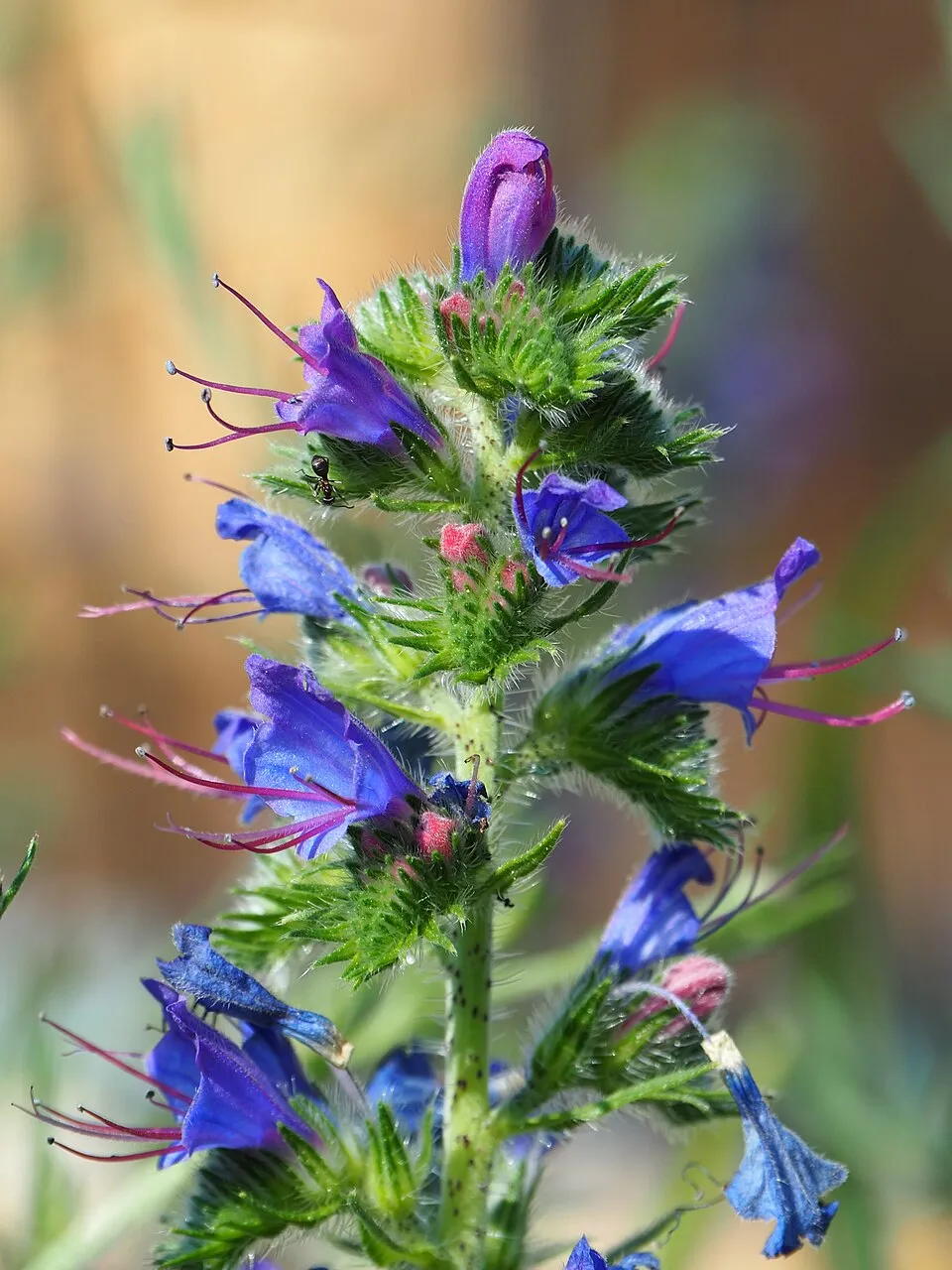
Echium vulgare, commonly known as Viper's Bugloss, Blueweed, or Adderwort, is a striking herbaceous plant belonging to the Boraginaceae family. It typically functions as a biennial, forming a basal rosette of leaves in its first year and producing erect, bristly stems in its second, which can reach heights of 30 to 90 cm (1 to 3 feet). The plant's leaves are lanceolate to ovate, measuring 5 to 10 cm in length, often covered in stiff, irritating hairs.
From late spring through early autumn (May to September), Echium vulgare displays its most captivating feature: dense, coiled cymes of vibrant blue, funnel-shaped flowers, which initially emerge pink in bud. These blossoms are a significant draw for a variety of pollinators, including bees and butterflies.
Native to Europe and Asia, Viper's Bugloss has naturalized extensively across temperate regions globally, including parts of North America, South America, and New Zealand. It thrives in disturbed habitats, such as dry pastures, roadsides, waste areas, and coastal environments like cliffs, sand dunes, and shingle banks. The plant is highly tolerant of poor, well-drained soils and prefers full sun, exhibiting notable drought and deer resistance.
While often appreciated as a beautiful wildflower and a crucial pollinator plant, its vigorous self-seeding habit can lead it to be considered weedy or invasive in certain agricultural or ecological contexts, notably in states like Washington. The genus name 'Echium' is derived from the Greek word 'echis,' meaning viper, a reference to the nutlets' resemblance to a viper's head and its traditional use in treating snakebites.
Trusted Scientific References
1. Authoritative external sources for Echium Vulgare
1.1 Wikipedia — Echium Vulgare
1.2 Kew POWO (Plants of the World Online)
1.3 PubMed — peer-reviewed research
1.4 NCBI Taxonomy Browser
1.5 GBIF — Global Biodiversity
1.6Echium Vulgare should be interpreted through verified botanical identity, practical care, and responsible safety language. This recovery note adds the missing context needed for a complete profile: match light to the plant's habit, use well-drained soil, water according to season, and avoid unsupported medicinal or edible claims. For publishing, the plant can be presented as a source-backed garden plant with clear care guidance, common problem diagnosis, and conservative safety wording.
1.1.Echium Vulgare — Key Features
- ✓ <strong>Striking Blue Flowers</strong> — Distinctive vibrant blue, funnel-shaped flowers that emerge from pink buds, creating a visually appealing display.
- ✓ <strong>Biennial Growth Habit</strong> — Typically completes its life cycle over two years, forming a rosette in the first and flowering in the second.
- ✓ <strong>Pollinator Magnet</strong> — Highly attractive to bees, butterflies, and other beneficial insects, making it excellent for biodiversity.
- ✓ <strong>Drought and Deer Resistant</strong> — Tolerant of dry conditions and generally unpalatable to deer, suitable for low-maintenance landscapes.
- ✓ <strong>Pyrrolizidine Alkaloid Content</strong> — Contains toxic PAs in its foliage and flowers, posing a significant health risk if ingested.
- ✓ <strong>Viper's Bugloss Seed Oil</strong> — A commercially valuable source of Gamma-Linolenic Acid (GLA) and Stearidonic Acid (SDA) for health supplements.
- ✓ <strong>Naturalized and Weedy</strong> — Widely naturalized globally and can become invasive in certain environments due to prolific self-seeding.
- ✓ <strong>Bristly Hairs</strong> — Covered in stiff, irritating hairs that can cause contact dermatitis upon skin contact.
- ✓ <strong>Adaptable to Poor Soils</strong> — Thrives in nutrient-poor, well-drained soils, often found in disturbed areas and roadsides.
- ✓ <strong>Traditional Medicinal History</strong> — Historically used in folk medicine, though modern internal use is contraindicated due to toxicity.
1.2.Echium Vulgare — Quick Summary
- ✓ Viper's Bugloss (Echium vulgare) is a beautiful biennial wildflower native to Europe and Asia, known for its vibrant blue flowers.
- ✓ It is a significant pollinator plant, attracting bees and butterflies to gardens and wild spaces.
- ✓ Historically used in traditional medicine for various ailments, including digestive issues and inflammation.
- ✓ The plant contains hepatotoxic pyrrolizidine alkaloids (PAs), making internal consumption extremely dangerous.
- ✓ Its seed oil, however, is a source of beneficial omega fatty acids (GLA, SDA) and is processed to remove PAs for safe supplemental use.
- ✓ Contact with the plant's bristly hairs can cause skin irritation, emphasizing the need for caution.
2.Echium Vulgare — Scientific Identity
3.Echium Vulgare — Quick Facts
4.Echium Vulgare — Appearance & Identification
5.Echium Vulgare — Native Habitat
6.Echium Vulgare — Water Requirements
- ✓ Soil Preference — Echium vulgare thrives in well-drained, poor to moderately fertile soils, including loamy, sandy, or rocky types; it does not perform well in rich, heavily fertilized soils.
- ✓ Sunlight Requirements — Prefers full sun exposure for optimal growth and flowering, though it can tolerate partial shade, which may result in fewer blooms.
- ✓ Watering Regime — Drought-tolerant once established, but requires regular watering during prolonged dry spells, ensuring not to overwater to prevent root rot.
- ✓ Propagation — Easily propagated by seeds, which can be direct-sown in spring or autumn; it readily self-seeds, so deadheading is recommended to control spread.
- ✓ Planting Spacing — When cultivating, space individual plants approximately 30 cm (12 inches) apart to allow for adequate air circulation and growth.
- ✓ Fertilization — Avoid over-fertilizing, as this can lead to lush foliage at the expense of flower production; a light, balanced fertilizer can be applied sparingly if the soil is extremely poor.
- ✓ Maintenance — Cut back spent flower stalks in late winter or early spring to encourage a showy display and prevent aggressive reseeding, especially in garden settings.
- ✓ Pest and Disease Resistance — Generally robust with few significant pest or disease issues, though slugs can occasionally be a problem.
Reviewed by the Flora Medical Global Botanical Review Panel
Multi-disciplinary editorial group · Botany · Ethnobotany · Herbal-medicine literature
Who reviewed this: This page was checked by the Flora Medical Global Botanical Review Panel — an in-house editorial group of botany graduates, ethnobotany researchers, and horticulture practitioners who collectively maintain our 7,000+ plant encyclopedia. Meet the team.
Our 4-step verification process
1. Taxonomic verification
Scientific names and synonyms cross-checked against Kew POWO, World Flora Online, and The Plant List.
2. Phytochemical & medicinal cross-reference
Active compounds, traditional uses, and reported activities are cross-referenced with PubMed, USDA Dr. Duke's database, and peer-reviewed ethnobotanical literature.
3. Conservation & distribution check
Distribution, ecology, and conservation status confirmed against GBIF occurrence records and the IUCN Red List.
4. Editorial & safety review
Every entry passes an editorial pass for clarity, originality, and safety notices (toxicity, contraindications, dosage caveats) before publication.
Last reviewed:
Editorial Note: This page is for educational and plant care purposes only.
Written by: Flora Medical Global Editorial Team
Reviewed by: Flora Medical Global Botanical Review Panel
Last Updated: June 15, 2026







Echium Vulgare — Comments & Community Reviews
Rate this plant