
Care Disclaimer: Plant care recommendations are general guidelines based on common growing conditions. Individual results may vary based on your local environment, climate, and care routine. If your plant is toxic, keep it away from children and pets, and consult a veterinarian if accidental ingestion occurs.
1.Edgeworthia Chrysantha — Overview
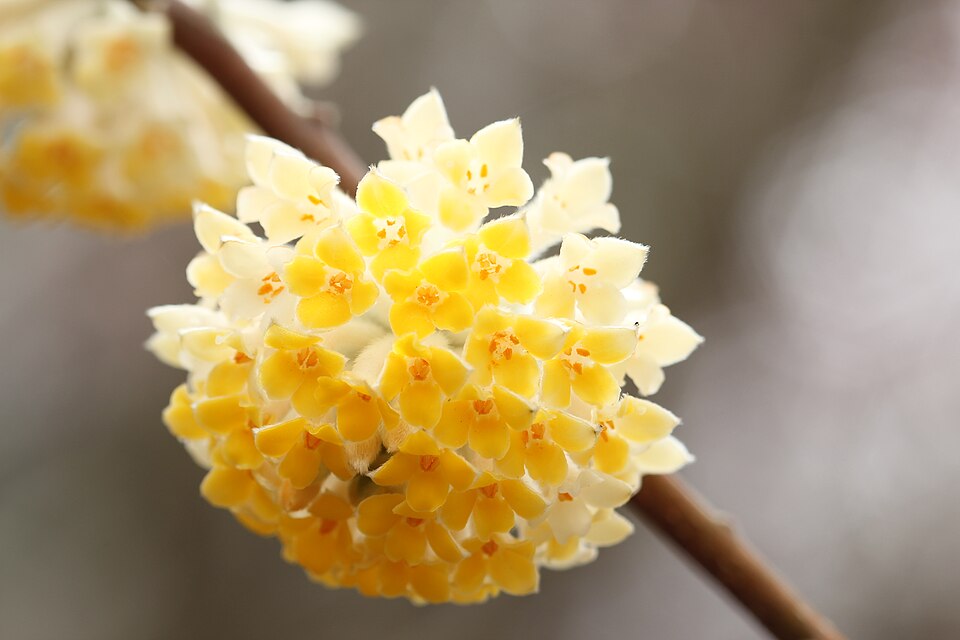
Edgeworthia chrysantha, commonly known as paperbush, yellow-drumstick, or Oriental paperbush, is an exquisite deciduous shrub belonging to the Thymelaeaceae family, a group well-recognized for its remarkably tough and fibrous bark. Native to the mountainous and woodland regions of East Asia, encompassing China, Japan, Nepal, and Bhutan, this species flourishes in the understory of broadleaf forests and on shaded slopes, adapting gracefully to dappled sunlight and moist, humus-rich soils. The plant typically develops into a rounded, compact shrub, generally attaining an average height and spread of 1 to 2 meters. Its growth habit is distinguished by thick, somewhat brittle stems that branch sparingly, often in a unique three-pronged pattern, contributing to its distinctive silhouette, particularly striking in the winter months.
The root system of Edgeworthia chrysantha is characteristically shallow and fibrous, perfectly adapted to anchoring the shrub in the nutrient-rich, well-draining soils of its natural forest understory, while efficiently absorbing surface moisture and nutrients. The bark is smooth and reddish-brown on younger stems, gradually maturing to a grayish-brown, and retaining a distinctive fibrous quality that is fundamental to its traditional uses, most notably in high-quality paper production. The foliage of Edgeworthia chrysantha is a key ornamental feature, with spirally arranged, simple, lanceolate to oblanceolate leaves measuring 10 to 15 cm in length. They exhibit a vibrant, deep green on their upper surface and a paler, often glaucous underside, with a prominent midrib and intricate reticulate venation.
The texture is distinctly leathery, providing a robust backdrop throughout the growing season, before transforming into attractive yellow hues in autumn prior to leaf fall. The most striking characteristic is its unique floral display, with pendulous clusters of highly fragrant, tubular flowers emerging from late winter to early spring, often before the new leaves appear, adorning the tips of its leafless branches.
Trusted Scientific References
1. Authoritative external sources for Edgeworthia chrysantha
1.1 Wikipedia — Edgeworthia chrysantha
1.2 Kew POWO (Plants of the World Online)
1.3 PubMed — peer-reviewed research
1.4 NCBI Taxonomy Browser
1.5 GBIF — Global Biodiversity
1.1.Edgeworthia Chrysantha — Key Features
- ✓ <strong>Winter Blooming</strong> — Produces abundant, highly fragrant, pendulous clusters of yellow, tubular flowers from late winter to early spring on bare stems.
- ✓ <strong>Fibrous Bark</strong> — Possesses exceptionally strong and pliable bark, traditionally harvested for high-quality paper production (mitsumata paper).
- ✓ <strong>Ornamental Value</strong> — Highly prized for its unique floral display, attractive lanceolate foliage, and distinctive growth habit, providing year-round garden interest.
- ✓ <strong>Deciduous Shrub</strong> — A compact, rounded shrub typically growing 1-2 meters tall and wide, shedding its leaves in autumn after a vibrant yellow color display.
- ✓ <strong>Intense Fragrance</strong> — Emits a sweet, gardenia-like scent that is particularly potent and noticeable during its winter flowering period.
- ✓ <strong>East Asian Native</strong> — Indigenous to mountainous and woodland regions across China, Japan, Nepal, and Bhutan, thriving in understory conditions.
- ✓ <strong>Low Maintenance</strong> — Generally robust, pest and disease resistant, requiring minimal care once established in suitable conditions.
- ✓ <strong>Distinctive Branching</strong> — Characterized by a unique three-pronged branching pattern, which adds architectural interest, especially evident in winter.
- ✓ <strong>Shade Tolerant</strong> — Adaptable to partial shade to dappled sunlight, preferring sheltered locations away from harsh, direct afternoon sun.
- ✓ <strong>Fall Foliage Color</strong> — Leaves turn an attractive shade of yellow in autumn, adding seasonal visual appeal before they drop.
1.2.Edgeworthia Chrysantha — Quick Summary
- ✓ Edgeworthia chrysantha is a captivating deciduous shrub renowned for its highly fragrant winter-to-early-spring blooms.
- ✓ Its exceptionally fibrous bark is traditionally utilized for producing high-quality paper, including Japanese banknotes.
- ✓ Primarily cultivated for its significant ornamental value, offering unique winter interest with its distinctive flowers and branching.
- ✓ Native to East Asia, it thrives in partial shade and moist, well-draining, humus-rich soils with minimal maintenance.
- ✓ While not a primary medicinal plant, its phytochemical profile suggests potential for anti-inflammatory and antioxidant activities.
- ✓ Ingestion of plant parts is not recommended due to potential mild toxicity and lack of comprehensive safety data.
2.Edgeworthia Chrysantha — Scientific Identity
3.Edgeworthia Chrysantha — Quick Facts
4.Edgeworthia Chrysantha — Appearance & Identification
5.Edgeworthia Chrysantha — Native Habitat
6.Edgeworthia Chrysantha — Water Requirements
- ✓ Optimal Lighting — Thrives best in partial shade to dappled sunlight, replicating its native forest understory habitat; intense afternoon sun can lead to leaf scorch.
- ✓ Soil Requirements — Prefers well-enriched, consistently moist, humus-rich, and well-draining soils with an acidic to neutral pH (5.5-7.0) to support its shallow, fibrous root system.
- ✓ Watering Practices — Requires regular and consistent moisture, especially during dry periods, but ensure excellent drainage to prevent root rot, which it is susceptible to.
- ✓ Pruning Guidelines — Minimal pruning is needed; primarily remove any dead, damaged, or crossing branches in late winter or early spring immediately after flowering, as blooms develop on old wood.
- ✓ Spacing and Placement — Plant approximately 1.5 to 2 meters (5-7 feet) apart to allow for its mature spread; ideal as a standalone specimen, in mixed borders, or for winter interest gardens.
- ✓ Pest and Disease Management — Generally considered robust and resistant to most common pests and diseases, requiring little intervention for healthy growth.
- ✓ Propagation Techniques — Can be propagated effectively from semi-hardwood cuttings taken in late summer, or by seed, although seed germination can be slow and somewhat erratic.
Reviewed by the Flora Medical Global Botanical Review Panel
Multi-disciplinary editorial group · Botany · Ethnobotany · Herbal-medicine literature
Who reviewed this: This page was checked by the Flora Medical Global Botanical Review Panel — an in-house editorial group of botany graduates, ethnobotany researchers, and horticulture practitioners who collectively maintain our 7,000+ plant encyclopedia. Meet the team.
Our 4-step verification process
1. Taxonomic verification
Scientific names and synonyms cross-checked against Kew POWO, World Flora Online, and The Plant List.
2. Phytochemical & medicinal cross-reference
Active compounds, traditional uses, and reported activities are cross-referenced with PubMed, USDA Dr. Duke's database, and peer-reviewed ethnobotanical literature.
3. Conservation & distribution check
Distribution, ecology, and conservation status confirmed against GBIF occurrence records and the IUCN Red List.
4. Editorial & safety review
Every entry passes an editorial pass for clarity, originality, and safety notices (toxicity, contraindications, dosage caveats) before publication.
Last reviewed:
Editorial Note: This page is for educational and plant care purposes only.
Written by: Flora Medical Global Editorial Team
Reviewed by: Flora Medical Global Botanical Review Panel
Last Updated: June 15, 2026







Edgeworthia Chrysantha — Comments & Community Reviews
Rate this plant