


Care Disclaimer: Plant care recommendations are general guidelines based on common growing conditions. Individual results may vary based on your local environment, climate, and care routine. If your plant is toxic, keep it away from children and pets, and consult a veterinarian if accidental ingestion occurs.
1.Elephant Ear Indoor — Overview
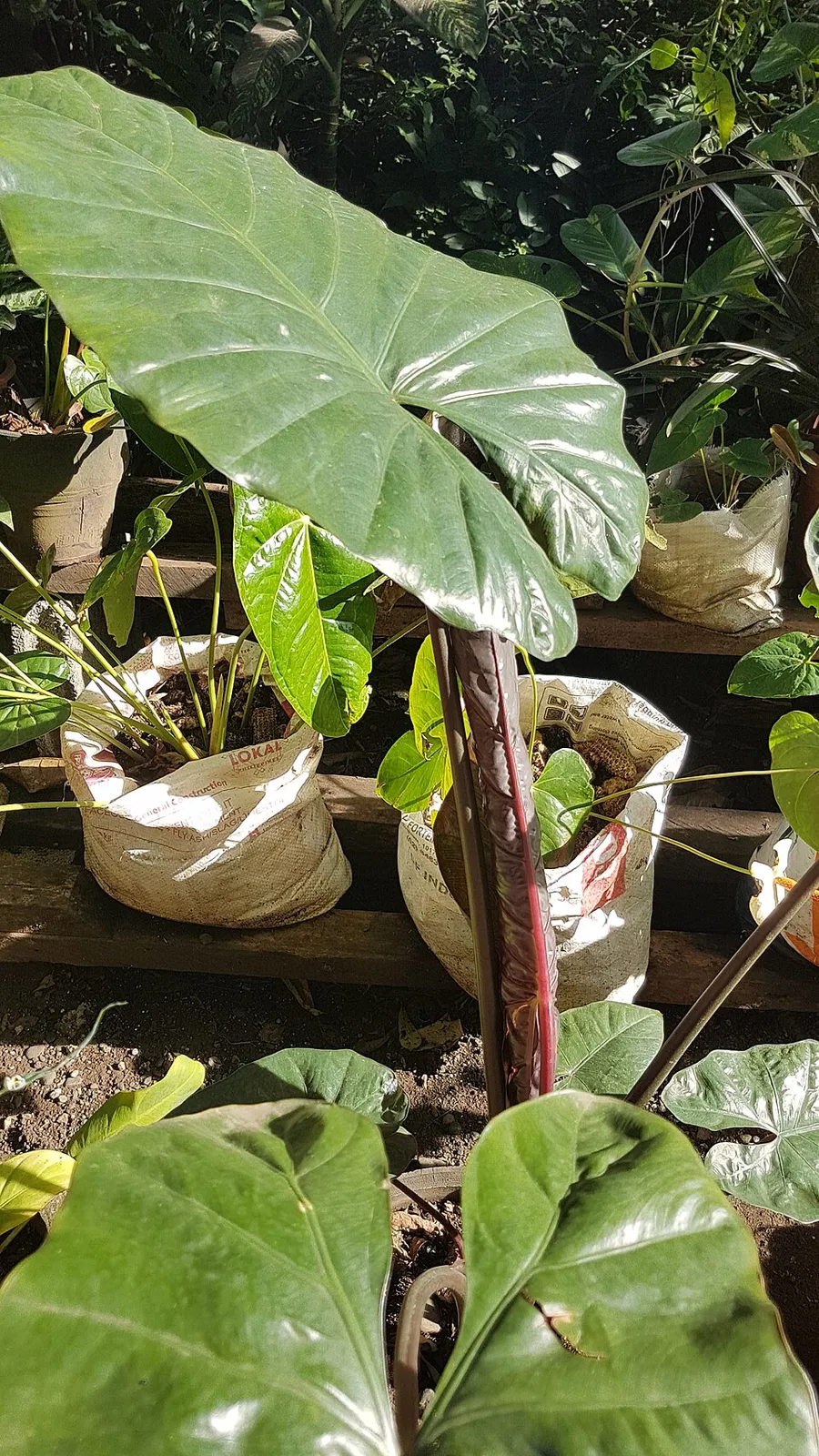
Alocasia macrorrhizos, often referred to as Elephant Ear or Giant Taro, is a striking herbaceous perennial belonging to the Araceae family. Native to the tropical and subtropical regions of Southeast Asia and Eastern Australia, this plant thrives in environments with abundant rainfall and warm temperatures. It is renowned for its magnificent foliage, featuring immense, glossy, heart-shaped or arrow-shaped leaves that can reach impressive sizes, often exceeding three feet in length and two feet in width, supported by thick, robust, upright stems.
The leaves typically display a vibrant dark green hue with prominent, often contrasting, venation, contributing to its dramatic tropical aesthetic. While primarily cultivated for its ornamental leaves, Alocasia macrorrhizos can produce an inflorescence consisting of a creamy white or greenish spadix enclosed by a hooded spathe, though these are often inconspicuous, hidden beneath the dense foliage. This species typically prefers moist, well-draining soils rich in organic matter.
Despite its beauty, it is critical to note that all parts of the plant contain calcium oxalate crystals, which render it toxic if ingested raw, causing significant irritation. Cultivated widely as an indoor houseplant in temperate climates and as a landscape feature in tropical zones, Alocasia macrorrhizos requires bright, indirect light, high humidity, and consistent warmth to flourish, making it a favored choice for adding a lush, exotic touch to homes and gardens.
Trusted Scientific References
1. Authoritative external sources for Alocasia macrorrhizos
1.1 Wikipedia — Alocasia macrorrhizos
1.2 Kew POWO (Plants of the World Online)
1.3 PubMed — peer-reviewed research
1.4 NCBI Taxonomy Browser
1.5 GBIF — Global Biodiversity
1.6Elephant Ear Indoor should be interpreted through verified botanical identity, practical care, and responsible safety language. This recovery note adds the missing context needed for a complete profile: match light to the plant's habit, use well-drained soil, water according to season, and avoid unsupported medicinal or edible claims. For publishing, the plant can be presented as a source-backed indoor plant with clear care guidance, common problem diagnosis, and conservative safety wording.
1.1.Elephant Ear Indoor — Key Features
- ✓ <strong>Large, dramatic, heart</strong> — shaped or arrow-shaped leaves.
- ✓ <strong>Prominent, often contrasting,</strong> — Prominent, often contrasting, venation on foliage.
- ✓ <strong>Upright, robust stems</strong> — Upright, robust stems supporting massive leaves.
- ✓ <strong>Distinctive tropical aesthetic</strong> — Distinctive tropical aesthetic suitable for indoor and outdoor display.
- ✓ <strong>Contains irritating calcium</strong> — Contains irritating calcium oxalate crystals in all raw tissues.
- ✓ <strong>Can produce a</strong> — Can produce a spadix and spathe inflorescence, though often hidden.
- ✓ <strong>Requires high humidity</strong> — Requires high humidity and warm temperatures to thrive.
- ✓ <strong>Corms are traditionally</strong> — Corms are traditionally consumed as food after extensive processing.
- ✓ <strong>Herbaceous perennial belonging</strong> — Herbaceous perennial belonging to the Araceae family.
- ✓ <strong>Adaptable as a</strong> — Adaptable as a houseplant with proper care and environmental conditions.
1.2.Elephant Ear Indoor — Quick Summary
- ✓ Stunning tropical foliage plant, often called Elephant Ear.
- ✓ All raw parts contain irritating calcium oxalate crystals.
- ✓ Corms (Giant Taro) are edible only after thorough cooking.
- ✓ Native to Southeast Asia and Eastern Australia.
- ✓ Popular as an ornamental indoor plant.
- ✓ Traditional uses for processed parts exist, but require extreme caution.
2.Elephant Ear Indoor — Scientific Identity
3.Elephant Ear Indoor — Quick Facts
4.Elephant Ear Indoor — Appearance & Identification
5.Elephant Ear Indoor — Native Habitat
6.Elephant Ear Indoor — Water Requirements
- ✓ Light — Prefers bright, indirect light; direct sunlight can scorch leaves, while too little light inhibits growth.
- ✓ Soil — Requires well-draining, humus-rich, fertile loam with a slightly acidic to neutral pH for optimal health.
- ✓ Water — Keep soil consistently moist during the growing season, but avoid waterlogging; reduce watering significantly in winter.
- ✓ Temperature — Thrives in warm temperatures, ideally between 65-80°F (18-27°C); sensitive to cold drafts and temperatures below 60°F (15°C).
- ✓ Humidity — Demands high humidity; misting, pebble trays, or a humidifier can help replicate its native tropical environment.
- ✓ Fertilization — Fertilize monthly during spring and summer with a balanced liquid fertilizer diluted to half strength.
- ✓ Propagation — Easily propagated by dividing offsets or tubers from the parent plant, typically in spring or early summer.
- ✓ Pests & Diseases — Monitor for common pests like spider mites, aphids, and mealybugs; prevent root rot by ensuring proper drainage.
Reviewed by the Flora Medical Global Botanical Review Panel
Multi-disciplinary editorial group · Botany · Ethnobotany · Herbal-medicine literature
Who reviewed this: This page was checked by the Flora Medical Global Botanical Review Panel — an in-house editorial group of botany graduates, ethnobotany researchers, and horticulture practitioners who collectively maintain our 7,000+ plant encyclopedia. Meet the team.
Our 4-step verification process
1. Taxonomic verification
Scientific names and synonyms cross-checked against Kew POWO, World Flora Online, and The Plant List.
2. Phytochemical & medicinal cross-reference
Active compounds, traditional uses, and reported activities are cross-referenced with PubMed, USDA Dr. Duke's database, and peer-reviewed ethnobotanical literature.
3. Conservation & distribution check
Distribution, ecology, and conservation status confirmed against GBIF occurrence records and the IUCN Red List.
4. Editorial & safety review
Every entry passes an editorial pass for clarity, originality, and safety notices (toxicity, contraindications, dosage caveats) before publication.
Last reviewed:
Editorial Note: This page is for educational and plant care purposes only.
Written by: Flora Medical Global Editorial Team
Reviewed by: Flora Medical Global Botanical Review Panel
Last Updated: June 15, 2026







Elephant Ear Indoor — Comments & Community Reviews
Rate this plant