

Care Disclaimer: Plant care recommendations are general guidelines based on common growing conditions. Individual results may vary based on your local environment, climate, and care routine. If your plant is toxic, keep it away from children and pets, and consult a veterinarian if accidental ingestion occurs.
1.Eleutherine Bulbosa — Overview
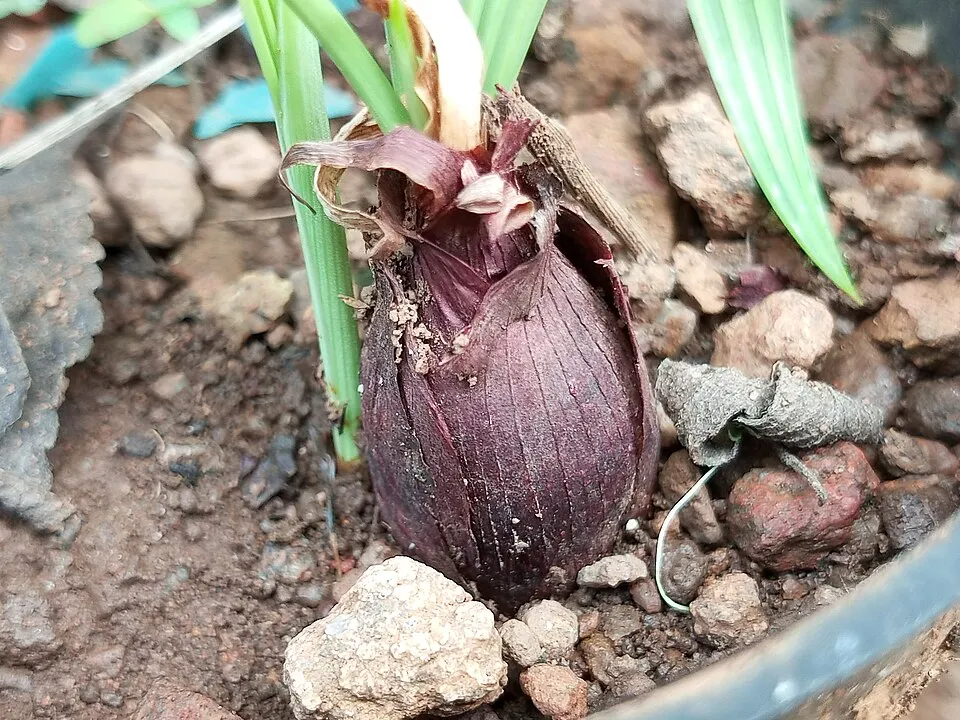
Eleutherine bulbosa, commonly known as Bulbous Eleutherine or 'Red Bulb Lily' due to its distinct coloration, is a fascinating perennial herb belonging to the Iridaceae family. This bulbous geophyte typically forms dense clumps of grass-like foliage, reaching heights of 15 to 75 cm (6 to 30 inches). The leaves are characteristically linear to lanceolate, emerging directly from the underground bulb, and possess a distinct plicate (pleated) venation, giving them a subtly ribbed appearance.
The flowering stems are slender and erect, bearing delicate, ephemeral flowers that typically open in the evening and close by morning, a characteristic trait of some Iridaceae species. These flowers usually feature three white or pale yellow petals, often with a contrasting central marking, and are arranged in terminal cymes or panicles. The robust, often reddish-tinged bulb is the plant's primary storage organ and the focus of its traditional medicinal uses.
Ecologically, Eleutherine bulbosa is indigenous to the tropical and subtropical regions of South America, with its native range extending across Argentina, Paraguay, Brazil, Bolivia, Peru, Ecuador, Colombia, Venezuela, and the Guyanas, as well as parts of the Caribbean, including Trinidad and Cuba. While its exact original habitat remains somewhat elusive due to widespread cultivation, it thrives in open woodlands, forest margins, and disturbed areas.
The species has demonstrated significant adaptability, escaping cultivation to become naturalized in various other tropical regions globally, including Southeast Asia (e.g., the Philippines and Indochina) and parts of Africa (e.g., Kwazulu, South Africa), where it is also recognized for its medicinal properties.
Trusted Scientific References
1. Authoritative external sources for Eleutherine Bulbosa
1.1 Wikipedia — Eleutherine Bulbosa
1.2 Kew POWO (Plants of the World Online)
1.3 PubMed — peer-reviewed research
1.4 NCBI Taxonomy Browser
1.5 GBIF — Global Biodiversity
1.6Eleutherine Bulbosa should be interpreted through verified botanical identity, practical care, and responsible safety language. This recovery note adds the missing context needed for a complete profile: match light to the plant's habit, use well-drained soil, water according to season, and avoid unsupported medicinal or edible claims. For publishing, the plant can be presented as a source-backed garden plant with clear care guidance, common problem diagnosis, and conservative safety wording.
1.1.Eleutherine Bulbosa — Key Features
- ✓ <strong>Botanical Classification</strong> — Perennial bulbous herb belonging to the Iridaceae family.
- ✓ <strong>Geographic Origin</strong> — Native to tropical and subtropical South America and the Caribbean.
- ✓ <strong>Distinct Morphology</strong> — Characterized by a reddish bulb and grass-like, plicate leaves.
- ✓ <strong>Medicinal Versatility</strong> — Known for antibacterial, demulcent, haemostatic, and anthelmintic actions.
- ✓ <strong>Key Phytochemicals</strong> — Rich in naphthoquinones (eleutherine, isoeleutherine), flavonoids, and saponins.
- ✓ <strong>Traditional Uses</strong> — Integral to American Indian pharmacopeia and Vietnamese traditional medicine.
- ✓ <strong>Cultivation Status</strong> — Widely cultivated as an ornamental and medicinal plant, often naturalized.
- ✓ <strong>Ecological Role</strong> — Adapted to open woodlands and disturbed areas, showing resilience.
- ✓ <strong>Unique Flowering</strong> — Produces delicate, ephemeral white or pale yellow flowers, often nocturnal.
- ✓ <strong>Health Benefits</strong> — Supports wound healing, respiratory health, digestive cleansing, and blood regulation.
1.2.Eleutherine Bulbosa — Quick Summary
- ✓ Eleutherine bulbosa is a South American bulbous herb of the Iridaceae family.
- ✓ Traditionally valued for its antibacterial, haemostatic, and anthelmintic properties.
- ✓ Key compounds include naphthoquinones, flavonoids, and saponins.
- ✓ Used for conditions ranging from infections and bleeding to parasitic infestations.
- ✓ Cultivated globally as an ornamental and medicinal plant.
- ✓ Requires careful dosage and professional consultation due to potential interactions and specific contraindications.
2.Eleutherine Bulbosa — Scientific Identity
3.Eleutherine Bulbosa — Quick Facts
4.Eleutherine Bulbosa — Appearance & Identification
5.Eleutherine Bulbosa — Native Habitat
6.Eleutherine Bulbosa — Water Requirements
- ✓ Site Selection — Eleutherine bulbosa thrives best in full sun to partial shade, requiring at least 6 hours of direct sunlight daily for optimal growth and flowering.
- ✓ Soil Requirements — It prefers well-draining, fertile soil rich in organic matter, with a slightly acidic to neutral pH (6.0-7.0) to prevent bulb rot.
- ✓ Planting Depth — Plant the bulbs approximately 5-10 cm (2-4 inches) deep and 10-15 cm (4-6 inches) apart, with the pointed end facing upwards.
- ✓ Watering — Maintain consistent moisture, especially during the growing season, but avoid waterlogging. Reduce watering significantly during dormancy.
- ✓ Fertilization — Apply a balanced, slow-release granular fertilizer in early spring or a liquid feed every 4-6 weeks during active growth.
- ✓ Propagation — Primarily propagated by offsets (bulbils) that form around the mother bulb, or by seeds. Division of clumps is best done in late winter or early spring.
- ✓ Pest and Disease Management — Generally robust, but watch for common bulb pests like aphids or fungal issues in overly wet conditions. Good air circulation is key.
Reviewed by the Flora Medical Global Botanical Review Panel
Multi-disciplinary editorial group · Botany · Ethnobotany · Herbal-medicine literature
Who reviewed this: This page was checked by the Flora Medical Global Botanical Review Panel — an in-house editorial group of botany graduates, ethnobotany researchers, and horticulture practitioners who collectively maintain our 7,000+ plant encyclopedia. Meet the team.
Our 4-step verification process
1. Taxonomic verification
Scientific names and synonyms cross-checked against Kew POWO, World Flora Online, and The Plant List.
2. Phytochemical & medicinal cross-reference
Active compounds, traditional uses, and reported activities are cross-referenced with PubMed, USDA Dr. Duke's database, and peer-reviewed ethnobotanical literature.
3. Conservation & distribution check
Distribution, ecology, and conservation status confirmed against GBIF occurrence records and the IUCN Red List.
4. Editorial & safety review
Every entry passes an editorial pass for clarity, originality, and safety notices (toxicity, contraindications, dosage caveats) before publication.
Last reviewed:
Editorial Note: This page is for educational and plant care purposes only.
Written by: Flora Medical Global Editorial Team
Reviewed by: Flora Medical Global Botanical Review Panel
Last Updated: June 15, 2026







Eleutherine Bulbosa — Comments & Community Reviews
Rate this plant