

Care Disclaimer: Plant care recommendations are general guidelines based on common growing conditions. Individual results may vary based on your local environment, climate, and care routine. If your plant is toxic, keep it away from children and pets, and consult a veterinarian if accidental ingestion occurs.
1.Emmenopterys Henryi — Overview
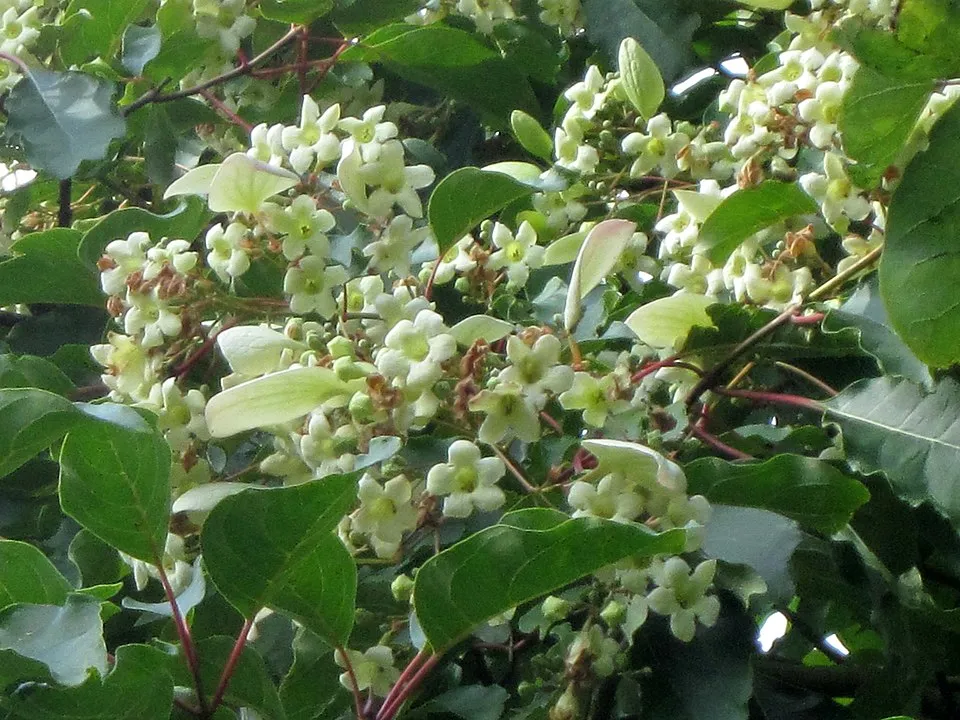
Emmenopterys henryi, popularly known as Henry's Emmenopterys or the Wonderful Tree, is a distinguished deciduous tree within the vast and economically significant family Rubiaceae. This species is native to the montane forests of central and southern China, thriving in provinces like Guizhou, Hubei, Hunan, Sichuan, and Yunnan.
It typically inhabits elevations ranging from 1,200 to 2,000 meters above sea level, preferring cool, moist environments found along forest peripheries, in sun-dappled clearings, or on mountain slopes.
As a medium to large tree, Emmenopterys henryi can achieve heights of 20 to 25 meters, developing a broad, dense, and often rounded canopy that offers considerable shade. Its growth habit is characterized by an upright, relatively straight trunk, which, in mature specimens, exhibits an appealing grayish-brown bark that exfoliates in irregular patches, revealing a smoother, lighter underbark.
The root system is robust, deep, and spreading, providing excellent anchorage in its mountainous native soils and contributing to its notable drought tolerance once fully established.
The foliage of Henry's Emmenopterys is a prominent feature, with simple, oppositely arranged leaves that are ovate to broadly elliptic. These leaves typically measure 8 to 15 cm in length and 4 to 8 cm in width, showcasing a glossy, dark green upper surface and a slightly paler, often pubescent underside. Distinctive venation patterns, comprising 8-12 pairs of arching lateral veins, are clearly visible.
In autumn, the leaves transform into vibrant shades of yellow, orange, and red, enhancing its seasonal ornamental value. However, the most celebrated aspect of Emmenopterys henryi is its spectacular, yet often elusive, flowering display, which historically takes many decades to appear in cultivation, making its bloom a rare and highly anticipated event.
Trusted Scientific References
1. Authoritative external sources for Emmenopterys henryi
1.1 Wikipedia — Emmenopterys henryi
1.2 Kew POWO (Plants of the World Online)
1.3 PubMed — peer-reviewed research
1.4 NCBI Taxonomy Browser
1.5 GBIF — Global Biodiversity
1.1.Emmenopterys Henryi — Key Features
- ✓ <strong>Spectacular, late</strong> — blooming white flowers with prominent bracts.
- ✓ <strong>Native to the</strong> — Native to the montane forests of central and southern China.
- ✓ <strong>Deciduous tree reaching</strong> — Deciduous tree reaching up to 25 meters with a broad canopy.
- ✓ <strong>Attractive exfoliating grayish</strong> — brown bark.
- ✓ <strong>Glossy, dark green</strong> — Glossy, dark green opposite leaves with prominent venation.
- ✓ <strong>Foliage turns vibrant</strong> — Foliage turns vibrant yellow, orange, and red in autumn.
- ✓ <strong>Historically difficult to</strong> — Historically difficult to flower in cultivation, taking decades.
- ✓ <strong>A monotypic genus</strong> — A monotypic genus within the diverse Rubiaceae family.
- ✓ <strong>Considered an endangered</strong> — Considered an endangered species in its natural habitat.
- ✓ <strong>Highly prized ornamental</strong> — Highly prized ornamental tree for large landscapes and botanical gardens.
1.2.Emmenopterys Henryi — Quick Summary
- ✓ Henry's Emmenopterys is a rare and striking deciduous tree native to China.
- ✓ Renowned for its magnificent, often delayed, white floral display.
- ✓ Belongs to the economically and medicinally important Rubiaceae family.
- ✓ Primarily valued as an ornamental specimen in horticulture.
- ✓ Specific medicinal uses are not widely documented or scientifically validated.
- ✓ An endangered species, highlighting its ecological significance.
2.Emmenopterys Henryi — Scientific Identity
3.Emmenopterys Henryi — Quick Facts
4.Emmenopterys Henryi — Appearance & Identification
5.Emmenopterys Henryi — Native Habitat
6.Emmenopterys Henryi — Water Requirements
- ✓ Site Selection — Henry's Emmenopterys thrives in cool, moist conditions with dappled sunlight, preferring well-drained, fertile, slightly acidic to neutral soils.
- ✓ Propagation — Primarily propagated from fresh seeds, which can be challenging to germinate, often requiring stratification; vegetative propagation through cuttings is also possible but difficult.
- ✓ Watering — Requires consistent moisture, especially during establishment; mature trees show some drought tolerance but benefit from supplemental watering during dry periods.
- ✓ Fertilization — Benefits from a balanced, slow-release fertilizer in spring, particularly for young trees, to support vigorous growth.
- ✓ Pruning — Generally requires minimal pruning; focus on removing dead or crossing branches to maintain a strong structure and healthy canopy.
- ✓ Flowering — Known for its extremely late and infrequent flowering in cultivation, often taking 30-75 years or more, though younger blooms have been observed under specific conditions.
- ✓ Climate Suitability — Best suited for USDA hardiness zones 7-9, protected from harsh winds and extreme temperatures.
- ✓ Pests & Diseases — Generally robust, but monitor for common tree pests and fungal diseases, especially in stressed specimens.
Reviewed by the Flora Medical Global Botanical Review Panel
Multi-disciplinary editorial group · Botany · Ethnobotany · Herbal-medicine literature
Who reviewed this: This page was checked by the Flora Medical Global Botanical Review Panel — an in-house editorial group of botany graduates, ethnobotany researchers, and horticulture practitioners who collectively maintain our 7,000+ plant encyclopedia. Meet the team.
Our 4-step verification process
1. Taxonomic verification
Scientific names and synonyms cross-checked against Kew POWO, World Flora Online, and The Plant List.
2. Phytochemical & medicinal cross-reference
Active compounds, traditional uses, and reported activities are cross-referenced with PubMed, USDA Dr. Duke's database, and peer-reviewed ethnobotanical literature.
3. Conservation & distribution check
Distribution, ecology, and conservation status confirmed against GBIF occurrence records and the IUCN Red List.
4. Editorial & safety review
Every entry passes an editorial pass for clarity, originality, and safety notices (toxicity, contraindications, dosage caveats) before publication.
Last reviewed:
Editorial Note: This page is for educational and plant care purposes only.
Written by: Flora Medical Global Editorial Team
Reviewed by: Flora Medical Global Botanical Review Panel
Last Updated: June 15, 2026







Emmenopterys Henryi — Comments & Community Reviews
Rate this plant