
Care Disclaimer: Plant care recommendations are general guidelines based on common growing conditions. Individual results may vary based on your local environment, climate, and care routine. If your plant is toxic, keep it away from children and pets, and consult a veterinarian if accidental ingestion occurs.
1.Erica Carnea — Overview
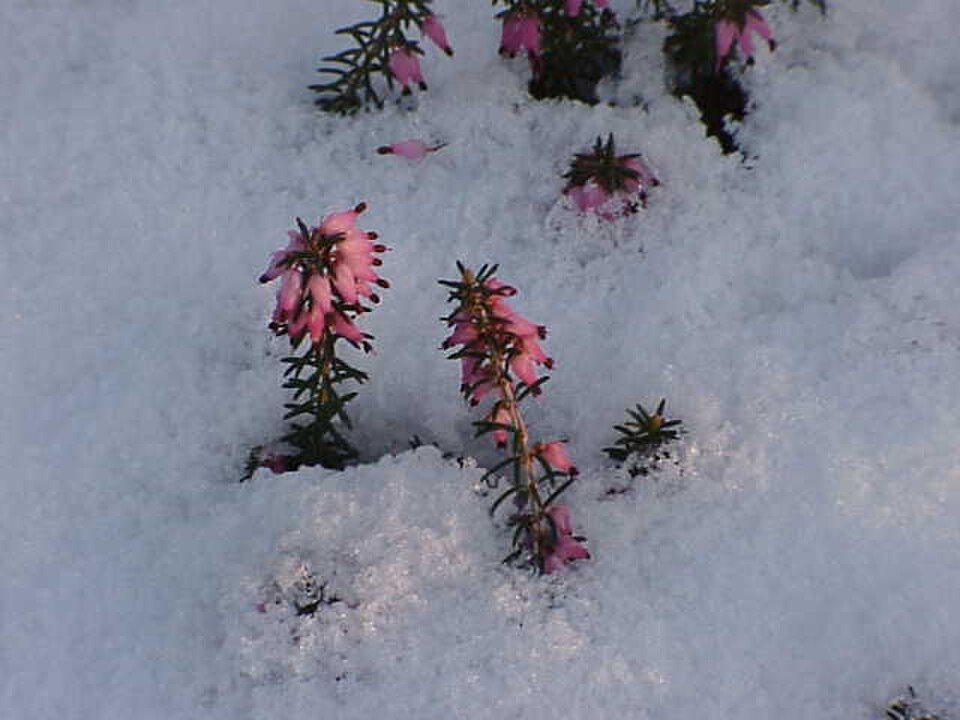
Erica carnea, commonly known as winter heath or spring heath, is an enchanting, low-growing evergreen shrub belonging to the expansive Ericaceae family, a group renowned for its heathland flora. This resilient species forms a dense, spreading mat, typically reaching a modest height of 15 to 30 cm (6 to 12 inches) and extending 30 to 60 cm (12 to 24 inches) in width. Its robust, mounding habit is supported by numerous slender, highly branched woody stems. The foliage is a distinctive feature, characterized by small, imbricate, needle-like leaves, usually arranged in whorls of four, displaying a vibrant, dark green color that persists throughout the year, providing continuous aesthetic appeal even under winter snow.
These leaves possess a tough, somewhat leathery texture, an adaptation reflecting its often harsh native environments. From late winter, typically January or February, through early spring, Erica carnea produces a profusion of small, urn-shaped to bell-shaped flowers. These delicate blooms, often hanging in racemes, exhibit a charming spectrum of colors, including soft whites, pale pinks, deeper rose, and magenta shades, depending on the cultivar. Each flower features four petals fused into a tube, surrounding prominent stamens that frequently extend beyond the corolla.
These nectar-rich blossoms serve as a vital early-season food source, attracting various pollinators, especially bees, which are crucial for local biodiversity and ecosystem health. The fruit is a small, inconspicuous capsule, containing numerous minute seeds, primarily dispersed by wind or water. Erica carnea is primarily indigenous to the mountainous regions of central and southeastern Europe, thriving in subalpine meadows, open woodlands, heathlands, and on rocky slopes, often colonizing disturbed sites where competition from larger plants is limited.
Trusted Scientific References
1. Authoritative external sources for Erica carnea
1.1 Wikipedia — Erica carnea
1.2 Kew POWO (Plants of the World Online)
1.3 PubMed — peer-reviewed research
1.4 NCBI Taxonomy Browser
1.5 GBIF — Global Biodiversity
1.1.Erica Carnea — Key Features
- ✓ <strong>Early Winter to Spring Blooms</strong> — Provides vibrant color when most plants are dormant.
- ✓ <strong>Evergreen Foliage</strong> — Offers year-round visual interest with needle-like, dark green leaves.
- ✓ <strong>Low</strong> — Growing Groundcover — Forms a dense, spreading mat, excellent for slopes and rock gardens.
- ✓ <strong>Cold Hardy</strong> — Exceptionally resilient in cold climates (USDA Zones 5-7).
- ✓ <strong>Pollinator Attractor</strong> — Nectar-rich flowers are a vital early food source for bees and other pollinators.
- ✓ <strong>Adaptable to Soil</strong> — Tolerates slightly alkaline soil, though prefers acidic, well-drained conditions.
- ✓ <strong>Deer Resistant</strong> — Generally not favored by deer, making it suitable for areas with wildlife.
- ✓ <strong>Urn</strong> — Shaped Flowers — Distinctive bell-shaped or urn-shaped flowers in various pink, white, and red hues.
- ✓ <strong>Low Maintenance</strong> — Requires minimal care once established, mainly spring pruning.
- ✓ <strong>European Native</strong> — Indigenous to mountainous regions of central and southeastern Europe.
1.2.Erica Carnea — Quick Summary
- ✓ Winter Heath (Erica carnea) is a hardy evergreen shrub valued for its early winter blooms.
- ✓ Traditionally used for its potential diuretic and anti-inflammatory properties.
- ✓ Rich in flavonoids, phenolic acids, and tannins, contributing to its antioxidant profile.
- ✓ Requires well-drained, acidic soil and full sun to partial shade for optimal growth.
- ✓ Primarily used in herbal infusions, decoctions, or topical preparations.
- ✓ Exercise caution during pregnancy, breastfeeding, and with pre-existing medical conditions.
2.Erica Carnea — Scientific Identity
3.Erica Carnea — Quick Facts
4.Erica Carnea — Appearance & Identification
5.Erica Carnea — Native Habitat
6.Erica Carnea — Water Requirements
- ✓ Soil Preference — Requires well-drained, acidic to neutral soil; tolerates slightly alkaline conditions but thrives in peat-rich, sandy loam.
- ✓ Light Requirements — Prefers full sun to partial shade; afternoon shade is beneficial in hot climates to prevent scorching.
- ✓ Watering — Needs consistent moisture, especially when young; established plants are moderately drought-tolerant but benefit from regular watering in dry spells.
- ✓ Pruning — Prune immediately after flowering in spring to encourage dense growth and prevent leggy, woody stems; cut back flowering spikes by half.
- ✓ Temperature and Hardiness — Extremely cold-hardy (USDA Zones 5-7), tolerating harsh winter conditions, ideal for winter interest gardens.
- ✓ Drainage — Critical for plant health; avoid heavy clay soils or areas with poor drainage to prevent root rot.
- ✓ Fertilization — Generally low-fertility requirements; a light application of an acid-loving plant fertilizer in spring can be beneficial.
- ✓ Propagation — Easily propagated by semi-hardwood cuttings taken in summer or by layering.
Reviewed by the Flora Medical Global Botanical Review Panel
Multi-disciplinary editorial group · Botany · Ethnobotany · Herbal-medicine literature
Who reviewed this: This page was checked by the Flora Medical Global Botanical Review Panel — an in-house editorial group of botany graduates, ethnobotany researchers, and horticulture practitioners who collectively maintain our 7,000+ plant encyclopedia. Meet the team.
Our 4-step verification process
1. Taxonomic verification
Scientific names and synonyms cross-checked against Kew POWO, World Flora Online, and The Plant List.
2. Phytochemical & medicinal cross-reference
Active compounds, traditional uses, and reported activities are cross-referenced with PubMed, USDA Dr. Duke's database, and peer-reviewed ethnobotanical literature.
3. Conservation & distribution check
Distribution, ecology, and conservation status confirmed against GBIF occurrence records and the IUCN Red List.
4. Editorial & safety review
Every entry passes an editorial pass for clarity, originality, and safety notices (toxicity, contraindications, dosage caveats) before publication.
Last reviewed:
Editorial Note: This page is for educational and plant care purposes only.
Written by: Flora Medical Global Editorial Team
Reviewed by: Flora Medical Global Botanical Review Panel
Last Updated: June 15, 2026







Erica Carnea — Comments & Community Reviews
Rate this plant