

Care Disclaimer: Plant care recommendations are general guidelines based on common growing conditions. Individual results may vary based on your local environment, climate, and care routine. If your plant is toxic, keep it away from children and pets, and consult a veterinarian if accidental ingestion occurs.
1.Eucomis — Overview
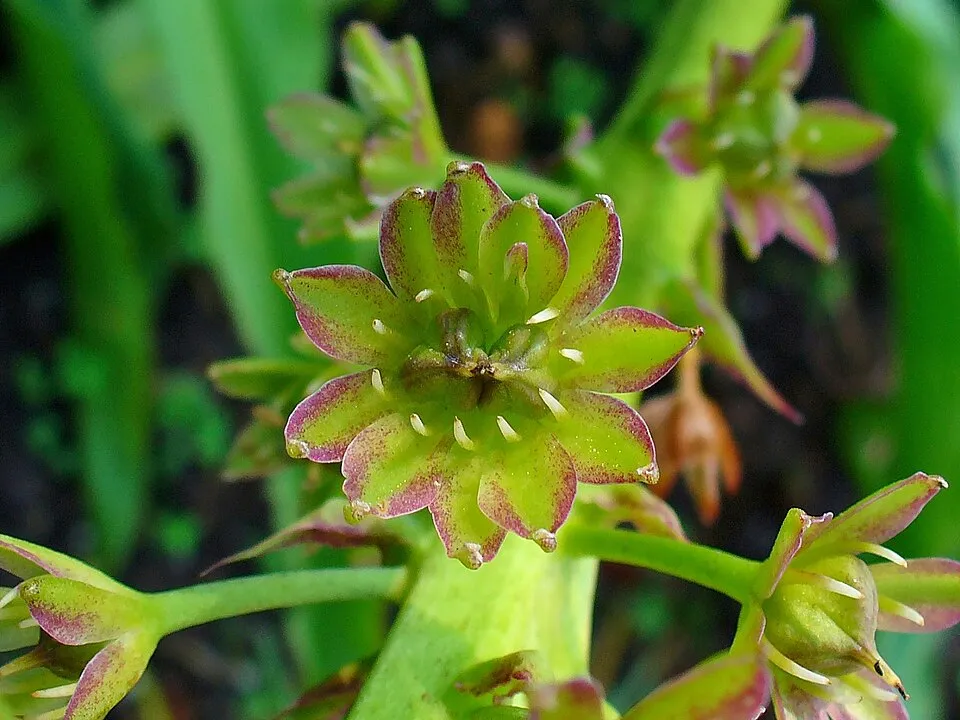
Eucomis comosa, widely recognized as the Pineapple Flower or Pineapple Lily, is a captivating perennial herbaceous plant belonging to the Asparagaceae family. Native to the sun-drenched grasslands and rocky areas of Southern Africa, particularly South Africa, Lesotho, and Eswatini, this species is celebrated for its truly unique and ornamental inflorescence. The plant typically attains a height of 30 to 60 centimeters, featuring a basal rosette of lush, lanceolate leaves that provide a verdant foundation.
Its most striking characteristic is the robust, upright flower stalk, crowned by a dense raceme of small, star-shaped flowers, topped with a tuft of leafy bracts, creating a resemblance to a miniature pineapple. These waxy bracts, along with the flowers, exhibit a spectrum of colors from subtle greens to deep purples and pristine whites, blooming profusely from mid to late summer, often over an extended period of 6-8 weeks. Following the floral display, purplish seeds develop, prolonging the plant's visual appeal into the autumn.
Eucomis comosa thrives in well-drained, organically rich loamy soils and prefers locations ranging from full sun to partial shade, making it a versatile and low-maintenance choice for diverse garden settings. Beyond its aesthetic charm, it serves as an excellent pollinator plant, attracting bees and butterflies, thereby contributing significantly to local biodiversity. Historically, this species has also been known by synonyms such as Asphodelus comosus and Eucomis punctata.
Trusted Scientific References
1. Authoritative external sources for Eucomis comosa
1.1 Wikipedia — Eucomis comosa
1.2 Kew POWO (Plants of the World Online)
1.3 PubMed — peer-reviewed research
1.4 NCBI Taxonomy Browser
1.5 GBIF — Global Biodiversity
1.6Eucomis should be interpreted through verified botanical identity, practical care, and responsible safety language. This recovery note adds the missing context needed for a complete profile: match light to the plant's habit, use well-drained soil, water according to season, and avoid unsupported medicinal or edible claims. For publishing, the plant can be presented as a source-backed garden plant with clear care guidance, common problem diagnosis, and conservative safety wording.
1.1.Eucomis — Key Features
- ✓ <strong>Unique Ornamental Value</strong> — Features a striking inflorescence resembling a miniature pineapple, making it a garden focal point.
- ✓ <strong>Southern African Native</strong> — Endemic to the grasslands and rocky terrains of South Africa, Lesotho, and Eswatini.
- ✓ <strong>Pollinator Magnet</strong> — Its nectar-rich flowers attract bees and butterflies, supporting garden biodiversity.
- ✓ <strong>Traditional Medicinal Plant</strong> — Historically utilized in Southern African folk medicine for various ailments, including fevers and inflammation.
- ✓ <strong>Resilient Summer Bulb</strong> — A long-lived perennial that is relatively low maintenance once established.
- ✓ <strong>Versatile in Landscaping</strong> — Suitable for garden beds, borders, rock gardens, and container cultivation.
- ✓ <strong>Rich Phytochemical Profile</strong> — Contains a diverse array of active compounds, including saponins, flavonoids, and alkaloids.
- ✓ <strong>Extended Bloom Period</strong> — Provides a captivating floral display for 6-8 weeks from mid to late summer.
- ✓ <strong>Adaptable to Soil Types</strong> — Thrives in well-drained, organically rich soils, tolerating a range of conditions.
- ✓ <strong>Drought Tolerant</strong> — Once mature and established, it exhibits good tolerance to periods of dryness.
1.2.Eucomis — Quick Summary
- ✓ Distinctive pineapple-like inflorescence, native to Southern Africa.
- ✓ Traditionally used for anti-inflammatory, diuretic, and antipyretic effects.
- ✓ Rich in saponins, flavonoids, and various alkaloids.
- ✓ Requires well-drained soil, moderate watering, and full sun to partial shade.
- ✓ Ornamental plant, also valued for attracting pollinators.
- ✓ Further scientific validation is needed to substantiate its full medicinal potential.
2.Eucomis — Scientific Identity
3.Eucomis — Quick Facts
4.Eucomis — Appearance & Identification
5.Eucomis — Native Habitat
6.Eucomis — Water Requirements
- ✓ Soil Requirements — Plant in well-drained, organically rich loamy soil. Avoid heavy clay or overly sandy conditions to prevent tuber rot.
- ✓ Planting Depth and Spacing — Bury Eucomis comosa bulbs approximately 15-20 cm (6-8 inches) deep, spacing them 15-30 cm (6-12 inches) apart to allow for mature growth.
- ✓ Watering Regimen — Provide consistent moisture during the active growing and flowering season, ensuring the soil remains moist but never waterlogged.
- ✓ Light Exposure — Thrives best in full sun to partial shade, with more direct sunlight promoting a greater abundance of blooms.
- ✓ Fertilization — Apply a balanced, slow-release granular fertilizer in early spring as new growth emerges to support vigorous development and flowering.
- ✓ Winter Care (Cooler Climates) — In USDA Zones 6 and below, lift bulbs in the fall before the first hard frost and store them in a cool, dry, dark place for overwintering, or apply a thick layer of protective mulch if left in the ground.
- ✓ Container Growing — Excellent for pots; ensure containers have adequate drainage, and plant bulbs with their tips at or just below the soil surface.
- ✓ Pest and Disease Management — Generally low maintenance and resistant to most pests; ensure good air circulation to prevent fungal issues in humid conditions.
Reviewed by the Flora Medical Global Botanical Review Panel
Multi-disciplinary editorial group · Botany · Ethnobotany · Herbal-medicine literature
Who reviewed this: This page was checked by the Flora Medical Global Botanical Review Panel — an in-house editorial group of botany graduates, ethnobotany researchers, and horticulture practitioners who collectively maintain our 7,000+ plant encyclopedia. Meet the team.
Our 4-step verification process
1. Taxonomic verification
Scientific names and synonyms cross-checked against Kew POWO, World Flora Online, and The Plant List.
2. Phytochemical & medicinal cross-reference
Active compounds, traditional uses, and reported activities are cross-referenced with PubMed, USDA Dr. Duke's database, and peer-reviewed ethnobotanical literature.
3. Conservation & distribution check
Distribution, ecology, and conservation status confirmed against GBIF occurrence records and the IUCN Red List.
4. Editorial & safety review
Every entry passes an editorial pass for clarity, originality, and safety notices (toxicity, contraindications, dosage caveats) before publication.
Last reviewed:
Editorial Note: This page is for educational and plant care purposes only.
Written by: Flora Medical Global Editorial Team
Reviewed by: Flora Medical Global Botanical Review Panel
Last Updated: June 15, 2026







Eucomis — Comments & Community Reviews
Rate this plant