

Care Disclaimer: Plant care recommendations are general guidelines based on common growing conditions. Individual results may vary based on your local environment, climate, and care routine. If your plant is toxic, keep it away from children and pets, and consult a veterinarian if accidental ingestion occurs.
1.Eucomis Comosa — Overview
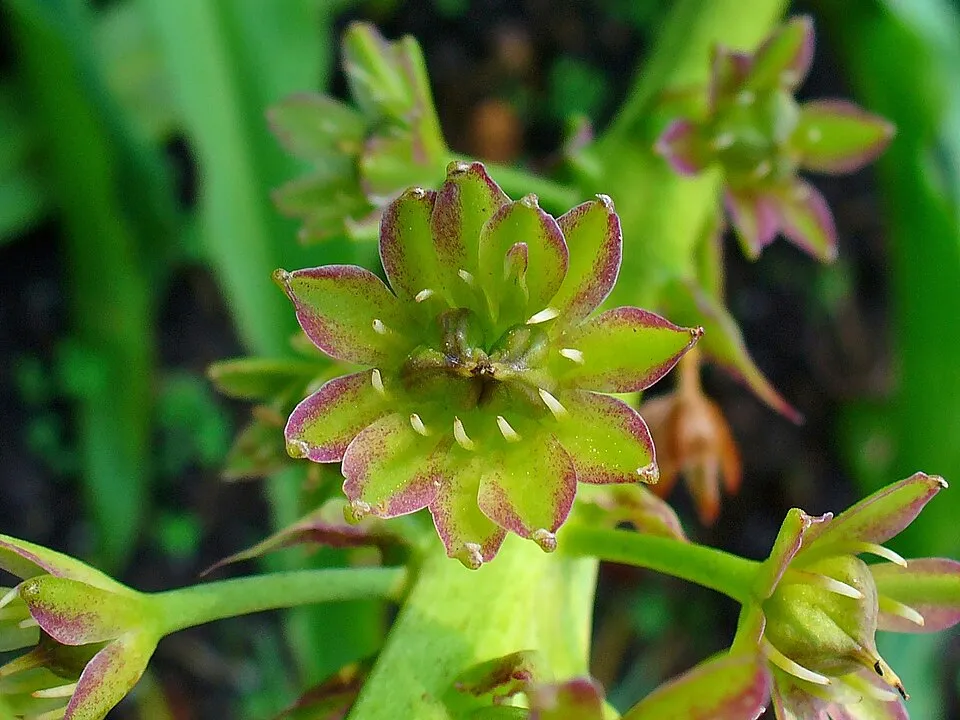
Eucomis comosa, commonly known as Pineapple Lily or King's Flower, is a distinctive perennial herbaceous bulb native to the grasslands and open woodlands of South Africa. This captivating plant belongs to the Asparagaceae family, specifically within the subfamily Scilloideae. It emerges from a subterranean bulb, developing a rosette of broad, strap-like basal leaves that can reach up to 60 cm in length, often with a subtle undulation or spotting depending on the cultivar. From the center of this rosette, a sturdy, upright flower stalk ascends, typically reaching heights of 0.6 to 1 meter.
The most striking feature is its dense, cylindrical inflorescence, crowned by a tuft of green bracts that strikingly resemble the top of a pineapple fruit, hence its popular common name. Small, star-shaped flowers, varying in color from creamy white to pink, purple, or greenish, bloom sequentially from the bottom upwards over a period of 6-8 weeks during late summer, usually starting in July. These nectar-rich blossoms are a magnet for pollinators, including bees and butterflies, playing a vital role in local ecosystems. Following successful pollination, the flowers give way to purplish seed pods, extending the plant's ornamental appeal into the autumn.
Eucomis comosa thrives in well-drained, organically rich soils and prefers full sun to partial shade, demonstrating notable resilience to various environmental conditions, making it a versatile and cherished ornamental in temperate gardens worldwide. Historically, it has also been known by synonyms such as Asphodelus comosus and Eucomis punctata.
Trusted Scientific References
1. Authoritative external sources for Eucomis Comosa
1.1 Wikipedia — Eucomis Comosa
1.2 Kew POWO (Plants of the World Online)
1.3 PubMed — peer-reviewed research
1.4 NCBI Taxonomy Browser
1.5 GBIF — Global Biodiversity
1.6Eucomis Comosa should be interpreted through verified botanical identity, practical care, and responsible safety language. This recovery note adds the missing context needed for a complete profile: match light to the plant's habit, use well-drained soil, water according to season, and avoid unsupported medicinal or edible claims. For publishing, the plant can be presented as a source-backed garden plant with clear care guidance, common problem diagnosis, and conservative safety wording.
1.1.Eucomis Comosa — Key Features
- ✓ <strong>Distinctive Pineapple</strong> — like Inflorescence — Crowned with a tuft of green bracts.
- ✓ <strong>Vibrant Summer Blooms</strong> — Flowers emerge sequentially from bottom to top.
- ✓ <strong>Pollinator Magnet</strong> — Attracts bees and butterflies, supporting biodiversity.
- ✓ <strong>Perennial Bulb</strong> — Returns year after year with proper care and overwintering.
- ✓ <strong>Adaptable Ornamental</strong> — Thrives in garden beds, borders, and containers.
- ✓ <strong>Low Maintenance</strong> — Relatively easy to grow once established in suitable conditions.
- ✓ <strong>Extended Ornamental Value</strong> — Purplish seed pods prolong visual interest post-flowering.
- ✓ <strong>Resilient Growth</strong> — Tolerates various environmental stresses with good drainage.
- ✓ <strong>South African Native</strong> — Originates from the diverse flora of Southern Africa.
- ✓ <strong>Traditional Medicinal Potential</strong> — Historically noted for various health-supporting properties.
1.2.Eucomis Comosa — Quick Summary
- ✓ Eucomis comosa, or Pineapple Lily, is a unique South African ornamental bulb.
- ✓ Renowned for its distinctive pineapple-like flower spike and vibrant blooms.
- ✓ Traditionally used for anti-inflammatory, digestive, and wound-healing benefits.
- ✓ Contains beneficial compounds like flavonoids, saponins, and alkaloids.
- ✓ Requires well-drained soil and moist conditions during summer growth.
- ✓ Exercise caution with internal use due to potential toxicity; consult experts.
2.Eucomis Comosa — Scientific Identity
3.Eucomis Comosa — Quick Facts
4.Eucomis Comosa — Appearance & Identification
5.Eucomis Comosa — Native Habitat
6.Eucomis Comosa — Water Requirements
- ✓ Soil Requirements — Prefers well-drained, organically rich soil with a slightly acidic to neutral pH, ensuring good aeration for bulb health.
- ✓ Planting Depth and Spacing — Plant bulbs approximately 8 inches (20 cm) deep and space them 6-12 inches (15-30 cm) apart to allow for mature growth.
- ✓ Watering — Keep the soil consistently moist, but not waterlogged, especially during the active growth and flowering periods in summer; reduce watering during dormancy.
- ✓ Light Exposure — Thrives in full sun to partial shade, with full sun generally promoting the most robust flowering and growth.
- ✓ Overwintering — In cooler climates (USDA Zone 6 and below), bulbs may need a thick layer of mulch for protection, or they can be lifted and stored indoors in a cool, dry place for winter.
- ✓ Container Growing — Excellent for containers, where the bulb tips can be planted just at the soil surface; containers should also be moved indoors or mulched in colder zones.
- ✓ Fertilization — Apply a balanced, slow-release granular fertilizer in spring as new growth emerges, or a liquid feed every 2-4 weeks during the growing season.
- ✓ Propagation — Primarily propagated by offsets (bulbils) that form around the mother bulb, or by seed, though seed propagation takes longer to reach flowering size.
Reviewed by the Flora Medical Global Botanical Review Panel
Multi-disciplinary editorial group · Botany · Ethnobotany · Herbal-medicine literature
Who reviewed this: This page was checked by the Flora Medical Global Botanical Review Panel — an in-house editorial group of botany graduates, ethnobotany researchers, and horticulture practitioners who collectively maintain our 7,000+ plant encyclopedia. Meet the team.
Our 4-step verification process
1. Taxonomic verification
Scientific names and synonyms cross-checked against Kew POWO, World Flora Online, and The Plant List.
2. Phytochemical & medicinal cross-reference
Active compounds, traditional uses, and reported activities are cross-referenced with PubMed, USDA Dr. Duke's database, and peer-reviewed ethnobotanical literature.
3. Conservation & distribution check
Distribution, ecology, and conservation status confirmed against GBIF occurrence records and the IUCN Red List.
4. Editorial & safety review
Every entry passes an editorial pass for clarity, originality, and safety notices (toxicity, contraindications, dosage caveats) before publication.
Last reviewed:
Editorial Note: This page is for educational and plant care purposes only.
Written by: Flora Medical Global Editorial Team
Reviewed by: Flora Medical Global Botanical Review Panel
Last Updated: June 15, 2026







Eucomis Comosa — Comments & Community Reviews
Rate this plant