
Care Disclaimer: Plant care recommendations are general guidelines based on common growing conditions. Individual results may vary based on your local environment, climate, and care routine. If your plant is toxic, keep it away from children and pets, and consult a veterinarian if accidental ingestion occurs.
1.Euphorbia Polychroma — Overview
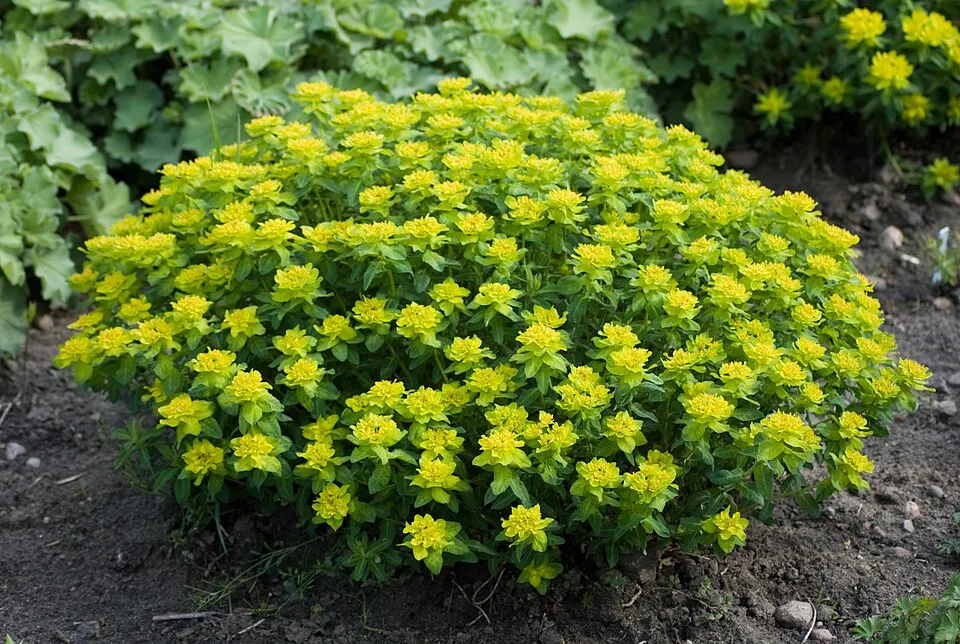
Euphorbia polychroma, widely recognized by its common name, Cushion Spurge, is a resilient perennial herbaceous plant belonging to the expansive Euphorbiaceae family. This species is indigenous to various regions across Central Asia and Europe, where it flourishes in habitats characterized by well-drained soils and ample sunlight, often found in rocky outcrops or open woodlands. The Cushion Spurge typically forms a compact, mounding habit, generally reaching an average height of 30 to 60 centimeters (12 to 24 inches) and spreading up to 60 centimeters (24 inches) wide, creating a dense, attractive mat. Its stems are erect and robust, presenting a vibrant green hue that can deepen to a reddish-bronze when exposed to intense solar radiation.
The leaves are simple, arranged spirally along the stems, exhibiting an ovate to lanceolate shape, measuring approximately 3 to 7 cm in length. They feature an entire, smooth margin, a glabrous surface, and a rich, deep green coloration, providing a lush backdrop for its striking inflorescences. The most distinctive feature of Euphorbia polychroma is its unique flowering structure. What appear to be bright yellow flowers are, in fact, showy bracts, known as cyathophylls, which encircle the true, inconspicuous cyathia (flower clusters).
These vibrant yellow bracts emerge profusely in early spring, creating a spectacular and long-lasting display that beautifully contrasts with the developing green foliage. This plant demonstrates notable drought tolerance once established and adapts well to a diverse range of soil conditions, though it exhibits a preference for sandy or loamy substrates with excellent drainage. Its ornamental appeal, coupled with its low-maintenance requirements, makes Euphorbia polychroma a popular choice for rock gardens, perennial borders, and as an effective ground cover. However, it is imperative to exercise caution, as the milky white latex (sap) produced by the plant is known to be a skin irritant and toxic if ingested.
Trusted Scientific References
1. Authoritative external sources for Euphorbia polychroma
1.1 Wikipedia — Euphorbia polychroma
1.2 Kew POWO (Plants of the World Online)
1.3 PubMed — peer-reviewed research
1.4 NCBI Taxonomy Browser
1.5 GBIF — Global Biodiversity
1.1.Euphorbia Polychroma — Key Features
- ✓ <strong>Striking Yellow Bracts</strong> — Features showy, bright yellow bracts in early spring that provide long-lasting ornamental appeal.
- ✓ <strong>Cushion</strong> — like Growth Habit — Forms a compact, rounded mound, typically 30-60 cm tall and wide, ideal for borders and ground cover.
- ✓ <strong>Milky White Latex</strong> — Contains a characteristic sticky, white sap that is highly irritating and toxic.
- ✓ <strong>Drought</strong> — Tolerant — Exhibits excellent resistance to dry conditions once established, suitable for xeriscaping.
- ✓ <strong>Full Sun to Partial Shade</strong> — Thrives in sunny locations but can tolerate some afternoon shade, especially in hot climates.
- ✓ <strong>Well</strong> — Drained Soil Preference — Requires sandy, loamy, or gravelly soils with good drainage to prevent root rot.
- ✓ <strong>Early Spring Bloom</strong> — Provides one of the earliest and most vibrant color displays in the spring garden.
- ✓ <strong>Deer and Rabbit Resistant</strong> — Generally unpalatable to deer and rabbits due due to its toxic sap.
- ✓ <strong>Evergreen to Semi</strong> — Evergreen Foliage — Deep green leaves often persist through milder winters, adding year-round interest.
- ✓ <strong>Easy Propagation by Division</strong> — Readily spreads and can be divided to create new plants, enhancing its garden utility.
1.2.Euphorbia Polychroma — Quick Summary
- ✓ Ornamental Perennial — Euphorbia polychroma is primarily valued for its vibrant yellow spring bracts and dense, mounding habit in gardens.
- ✓ Toxic Latex — The plant produces a milky white sap that is a severe skin and eye irritant and toxic if ingested.
- ✓ Low Maintenance — Drought-tolerant and adaptable to various well-drained soils, making it an easy-care landscape plant.
- ✓ European Native — Originates from Central Europe and parts of Asia, thriving in sunny, well-drained environments.
- ✓ Phytochemical Rich — Contains diterpenoids, flavonoids, and other compounds, contributing to its biological activity and toxicity.
- ✓ No Medicinal Use — Despite its phytochemicals, Euphorbia polychroma is not used medicinally due to its toxicity and irritant properties.
2.Euphorbia Polychroma — Scientific Identity
3.Euphorbia Polychroma — Quick Facts
4.Euphorbia Polychroma — Appearance & Identification
5.Euphorbia Polychroma — Native Habitat
6.Euphorbia Polychroma — Water Requirements
- ✓ Site Selection — Choose a location with full sun to partial shade, ensuring at least six hours of direct sunlight daily for optimal flowering and compact growth.
- ✓ Soil Requirements — Plant in well-drained soil; Euphorbia polychroma thrives in sandy, loamy, or even gravelly soils and is intolerant of heavy, waterlogged conditions.
- ✓ Watering — Once established, Cushion Spurge is highly drought-tolerant; water sparingly, especially during prolonged dry spells, allowing the soil to dry out completely between waterings.
- ✓ Propagation — Easily propagated by division in early spring or fall, carefully separating clumps, or by sowing seeds directly after the last frost.
- ✓ Fertilization — Generally low-maintenance, Euphorbia polychroma rarely requires fertilization; if growth is poor, a light application of balanced granular fertilizer in spring can be beneficial.
- ✓ Pruning — Prune back faded flower stems to the ground after blooming to encourage new growth and maintain a tidy appearance, always wearing gloves to avoid skin contact with the sap.
- ✓ Pest and Disease Resistance — This species is generally resistant to most pests and diseases, though root rot can occur in poorly drained soils.
- ✓ Winter Care — In colder climates, a light layer of mulch can protect roots, but established plants are quite hardy and typically overwinter well.
Reviewed by the Flora Medical Global Botanical Review Panel
Multi-disciplinary editorial group · Botany · Ethnobotany · Herbal-medicine literature
Who reviewed this: This page was checked by the Flora Medical Global Botanical Review Panel — an in-house editorial group of botany graduates, ethnobotany researchers, and horticulture practitioners who collectively maintain our 7,000+ plant encyclopedia. Meet the team.
Our 4-step verification process
1. Taxonomic verification
Scientific names and synonyms cross-checked against Kew POWO, World Flora Online, and The Plant List.
2. Phytochemical & medicinal cross-reference
Active compounds, traditional uses, and reported activities are cross-referenced with PubMed, USDA Dr. Duke's database, and peer-reviewed ethnobotanical literature.
3. Conservation & distribution check
Distribution, ecology, and conservation status confirmed against GBIF occurrence records and the IUCN Red List.
4. Editorial & safety review
Every entry passes an editorial pass for clarity, originality, and safety notices (toxicity, contraindications, dosage caveats) before publication.
Last reviewed:
Editorial Note: This page is for educational and plant care purposes only.
Written by: Flora Medical Global Editorial Team
Reviewed by: Flora Medical Global Botanical Review Panel
Last Updated: June 15, 2026







Euphorbia Polychroma — Comments & Community Reviews
Rate this plant