

Care Disclaimer: Plant care recommendations are general guidelines based on common growing conditions. Individual results may vary based on your local environment, climate, and care routine. If your plant is toxic, keep it away from children and pets, and consult a veterinarian if accidental ingestion occurs.
1.Felicia Amelloides — Overview
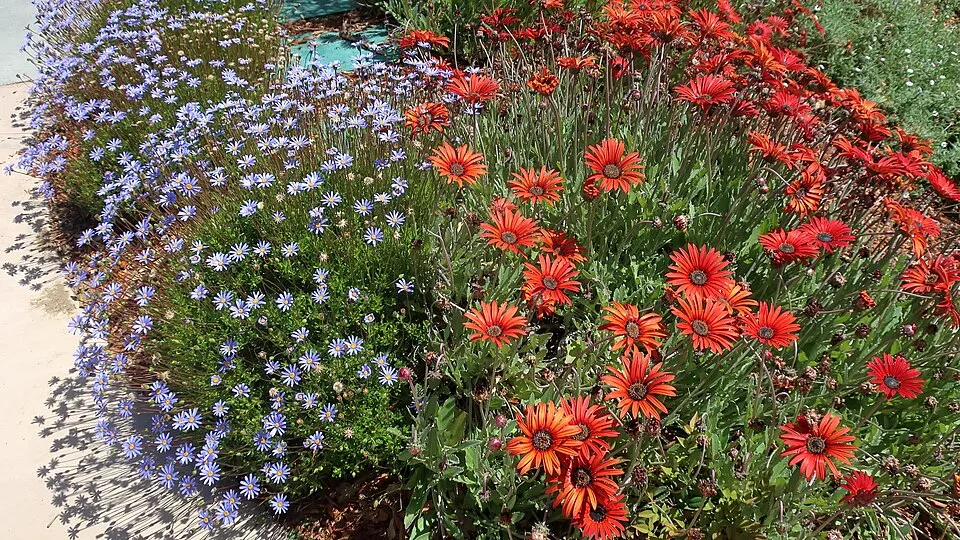
Felicia amelloides, commonly known as the Blue Daisy or Blue Marguerite, is a captivating perennial subshrub native to the coastal regions of South Africa, particularly the Western Cape. This charming member of the Asteraceae family typically forms dense mats of growth, reaching heights of 40-60 cm with a spread of similar dimensions. Its lanceolate to ovate leaves, often slightly hairy and tinted gray-green, measure approximately 5-10 cm in length, providing a lush backdrop for its striking blooms.
From autumn through spring, Felicia amelloides produces an abundance of vibrant, daisy-like flowers, each measuring 4-6 cm in diameter. These enchanting blossoms feature numerous violet-blue ray petals encircling a prominent, golden-yellow central disk composed of tiny florets. The erect, sturdy stems often develop a subtle reddish hue as they mature.
This species thrives in temperate climates, preferring well-drained, sandy soils and flourishing in full sun to partial shade. Widely cultivated in gardens across Europe and North America, its ornamental appeal is undeniable, creating visually appealing borders and serving as a focal point with its continuous display of colorful blooms. Beyond its aesthetic qualities, traditional herbal practices, particularly in regions where it was introduced, have recognized Felicia amelloides for its gentle medicinal properties, especially concerning digestive and hepatic support.
Trusted Scientific References
1. Authoritative external sources for Felicia Amelloides
1.1 Wikipedia — Felicia Amelloides
1.2 Kew POWO (Plants of the World Online)
1.3 PubMed — peer-reviewed research
1.4 NCBI Taxonomy Browser
1.5 GBIF — Global Biodiversity
1.6Felicia Amelloides should be interpreted through verified botanical identity, practical care, and responsible safety language. This recovery note adds the missing context needed for a complete profile: match light to the plant's habit, use well-drained soil, water according to season, and avoid unsupported medicinal or edible claims. For publishing, the plant can be presented as a source-backed garden plant with clear care guidance, common problem diagnosis, and conservative safety wording.
1.1.Felicia Amelloides — Key Features
- ✓ <strong>Botanical Name</strong> — Felicia amelloides, also known as Blue Daisy or Blue Marguerite.
- ✓ <strong>Family</strong> — Belongs to the large and diverse Asteraceae family.
- ✓ <strong>Native Range</strong> — Indigenous to the Western Cape of South Africa.
- ✓ <strong>Ornamental Value</strong> — Highly prized for its continuous display of vibrant violet-blue, daisy-like flowers.
- ✓ <strong>Medicinal Properties</strong> — Recognized for its traditional use in liver support and digestive health.
- ✓ <strong>Bioactive Compounds</strong> — Rich in inulin, sesquiterpene lactones, and powerful antioxidants like hydroxycinnamic acids.
- ✓ <strong>Traditional Systems</strong> — Incorporated into local folk medicine, influenced by Ayurvedic and Unani practices in some regions.
- ✓ <strong>Cultivation</strong> — A relatively easy-to-grow perennial, thriving in well-drained soils and full sun.
- ✓ <strong>Common Uses</strong> — Primarily consumed as herbal infusions, powdered extracts, or tinctures.
- ✓ <strong>SEO Relevance</strong> — Sought after for 'Felicia amelloides benefits', 'Blue Daisy uses', and 'Kasni herb for liver'.
1.2.Felicia Amelloides — Quick Summary
- ✓ Felicia amelloides, or Blue Daisy, is a South African perennial from the Asteraceae family.
- ✓ Traditionally valued for its liver-supporting and digestive aid properties, similar to chicory.
- ✓ Contains inulin, sesquiterpene lactones, and hydroxycinnamic acids for its therapeutic effects.
- ✓ Known for its antioxidant, mild diuretic, and anti-inflammatory potential.
- ✓ Used as infusions, powders, or tinctures, primarily for digestive and hepatic wellness.
- ✓ Requires caution for pregnant women, those with gallstones, and individuals with digestive sensitivities.
2.Felicia Amelloides — Scientific Identity
3.Felicia Amelloides — Quick Facts
4.Felicia Amelloides — Appearance & Identification
5.Felicia Amelloides — Native Habitat
6.Felicia Amelloides — Water Requirements
- ✓ Climate Preference — Thrives best in temperate to Mediterranean-like climates, tolerant of mild coastal conditions.
- ✓ Soil Requirements — Prefers well-drained, sandy soils with a slightly acidic to neutral pH (6.0-7.0).
- ✓ Light Exposure — Requires full sun to partial shade, with full sun promoting more abundant flowering.
- ✓ Watering — Needs moderate watering, allowing the soil to dry out slightly between waterings; avoid waterlogging.
- ✓ Propagation — Easily propagated from seeds, cuttings, or by division of established clumps in spring.
- ✓ Harvesting — Petals are best harvested in the early morning when phytochemical levels are optimal, then shade-dried.
- ✓ Fertilization — Benefits from organic compost or a balanced slow-release fertilizer during the growing season.
- ✓ Pest Management — Generally resistant to most pests, but watch for aphids and powdery mildew in humid conditions.
Reviewed by the Flora Medical Global Botanical Review Panel
Multi-disciplinary editorial group · Botany · Ethnobotany · Herbal-medicine literature
Who reviewed this: This page was checked by the Flora Medical Global Botanical Review Panel — an in-house editorial group of botany graduates, ethnobotany researchers, and horticulture practitioners who collectively maintain our 7,000+ plant encyclopedia. Meet the team.
Our 4-step verification process
1. Taxonomic verification
Scientific names and synonyms cross-checked against Kew POWO, World Flora Online, and The Plant List.
2. Phytochemical & medicinal cross-reference
Active compounds, traditional uses, and reported activities are cross-referenced with PubMed, USDA Dr. Duke's database, and peer-reviewed ethnobotanical literature.
3. Conservation & distribution check
Distribution, ecology, and conservation status confirmed against GBIF occurrence records and the IUCN Red List.
4. Editorial & safety review
Every entry passes an editorial pass for clarity, originality, and safety notices (toxicity, contraindications, dosage caveats) before publication.
Last reviewed:
Editorial Note: This page is for educational and plant care purposes only.
Written by: Flora Medical Global Editorial Team
Reviewed by: Flora Medical Global Botanical Review Panel
Last Updated: June 15, 2026







Felicia Amelloides — Comments & Community Reviews
Rate this plant