
Care Disclaimer: Plant care recommendations are general guidelines based on common growing conditions. Individual results may vary based on your local environment, climate, and care routine. If your plant is toxic, keep it away from children and pets, and consult a veterinarian if accidental ingestion occurs.
1.Flowering Quince — Overview
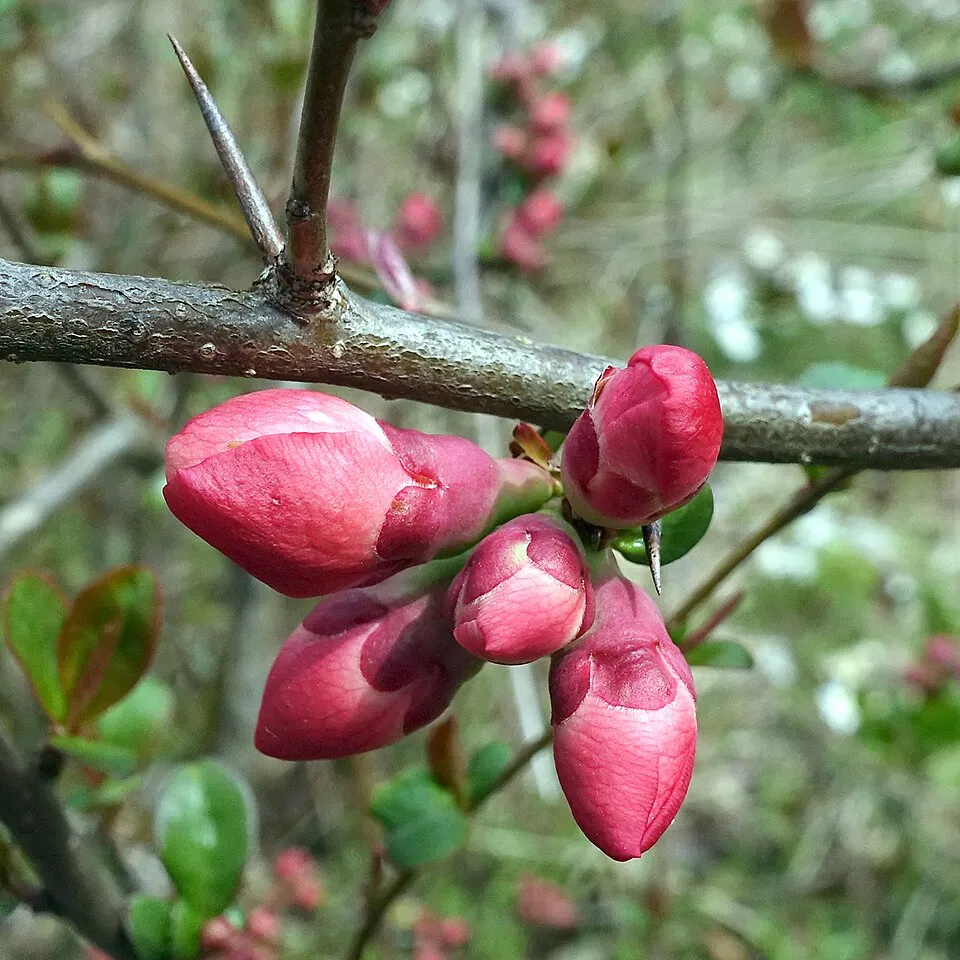
Flowering Quince, scientifically known as Chaenomeles speciosa, is a distinguished deciduous shrub belonging to the expansive Rosaceae family. This resilient plant typically attains a height of 3 to 6 feet (0.9 to 1.8 meters), forming a dense, multi-stemmed structure. Its foliage consists of glossy, dark green, ovate leaves, which are characteristically serrated along their margins and measure between 2 to 4 inches in length.
The most striking feature of Flowering Quince is its profusion of vibrant blossoms, which emerge in early spring before the leaves fully unfurl. These showy, five-petaled flowers present a captivating spectrum of colors, from pristine white and delicate pinks to intense deep reds and oranges, each blossom spanning approximately 1 to 2 inches in diameter. Following the floral display, the shrub produces small, hard, aromatic fruits known as quinces, which mature to a yellowish-green hue.
The bark is woody, possessing a rough, often fissured texture that ranges from light grayish to brownish, adding ornamental interest, particularly during the dormant winter months.
Native to the temperate regions of East Asia, primarily China, Chaenomeles speciosa is widely cultivated globally and flourishes in USDA hardiness zones 4 to 9. It exhibits remarkable adaptability to a diverse range of soil conditions, including sandy, clay, and loamy types, though it performs optimally in well-drained, fertile substrates.
While tolerant of poor drainage, consistent moisture and good aeration are preferred for robust growth. This versatile shrub is commonly utilized in landscaping for informal hedges, barrier plantings, or as a striking accent plant, contributing both aesthetic beauty and ecological benefits by supporting local pollinators and fostering biodiversity in garden ecosystems.
Trusted Scientific References
1. Authoritative external sources for Chaenomeles speciosa
1.1 Wikipedia — Chaenomeles speciosa
1.2 Kew POWO (Plants of the World Online)
1.3 PubMed — peer-reviewed research
1.4 NCBI Taxonomy Browser
1.5 GBIF — Global Biodiversity
1.1.Flowering Quince — Key Features
- ✓ <strong>Deciduous shrub with a multi</strong> — stemmed growth habit.
- ✓ <strong>Produces vibrant white,</strong> — Produces vibrant white, pink, or red flowers in early spring.
- ✓ <strong>Bears hard, aromatic, yellowish</strong> — green fruits (quinces).
- ✓ <strong>Leaves are glossy,</strong> — Leaves are glossy, dark green, ovate, and serrated.
- ✓ <strong>Native to China</strong> — Native to China and widely cultivated in temperate regions.
- ✓ <strong>Known for its</strong> — Known for its adaptability to various soil types and moderate drought tolerance.
- ✓ <strong>Valued in traditional medicine for anti</strong> — inflammatory and pain-relieving properties.
- ✓ <strong>Rich source of</strong> — Rich source of triterpenoid acids, flavonoids, and Vitamin C.
- ✓ <strong>Supports local pollinators</strong> — Supports local pollinators and enhances garden biodiversity.
- ✓ <strong>Can be used</strong> — Can be used for hedges, accent planting, or as a specimen shrub.
1.2.Flowering Quince — Quick Summary
- ✓ Flowering Quince (Chaenomeles speciosa) is a versatile Rosaceae shrub with ornamental and medicinal value.
- ✓ Traditionally used in TCM for rheumatism, digestive issues, and muscle relaxation.
- ✓ Rich in triterpenoids, phenolic acids, flavonoids, and Vitamin C, offering antioxidant and anti-inflammatory benefits.
- ✓ Exhibits potential antimicrobial, hepatoprotective, and antitumor activities.
- ✓ Cultivated for its vibrant early spring flowers and aromatic, tart fruits.
- ✓ Requires careful consideration for dosage and potential interactions, especially during pregnancy.
2.Flowering Quince — Scientific Identity
3.Flowering Quince — Quick Facts
4.Flowering Quince — Appearance & Identification
5.Flowering Quince — Native Habitat
6.Flowering Quince — Water Requirements
- ✓ Site Selection — Plant in a location with full sun to partial shade; full sun promotes more abundant flowering and fruiting.
- ✓ Soil Requirements — Prefers well-drained, fertile soil, but is highly adaptable to a variety of soil types including sandy, clay, and loamy.
- ✓ Watering — Water regularly, especially during dry periods and for newly planted shrubs, to establish a strong root system.
- ✓ Fertilization — Apply a balanced, slow-release fertilizer in early spring to support vigorous growth and flowering.
- ✓ Pruning — Prune after flowering to maintain shape, remove dead or crossing branches, and encourage new growth for future blooms.
- ✓ Propagation — Can be propagated by seeds (requires stratification), softwood cuttings in summer, or by division of suckers.
- ✓ Hardiness — Thrives in USDA hardiness zones 4 to 9, tolerating a wide range of temperatures.
- ✓ Pest and Disease Control — Generally resistant to most pests and diseases, but monitor for common issues like leaf spot or scale insects.
Reviewed by the Flora Medical Global Botanical Review Panel
Multi-disciplinary editorial group · Botany · Ethnobotany · Herbal-medicine literature
Who reviewed this: This page was checked by the Flora Medical Global Botanical Review Panel — an in-house editorial group of botany graduates, ethnobotany researchers, and horticulture practitioners who collectively maintain our 7,000+ plant encyclopedia. Meet the team.
Our 4-step verification process
1. Taxonomic verification
Scientific names and synonyms cross-checked against Kew POWO, World Flora Online, and The Plant List.
2. Phytochemical & medicinal cross-reference
Active compounds, traditional uses, and reported activities are cross-referenced with PubMed, USDA Dr. Duke's database, and peer-reviewed ethnobotanical literature.
3. Conservation & distribution check
Distribution, ecology, and conservation status confirmed against GBIF occurrence records and the IUCN Red List.
4. Editorial & safety review
Every entry passes an editorial pass for clarity, originality, and safety notices (toxicity, contraindications, dosage caveats) before publication.
Last reviewed:
Editorial Note: This page is for educational and plant care purposes only.
Written by: Flora Medical Global Editorial Team
Reviewed by: Flora Medical Global Botanical Review Panel
Last Updated: June 15, 2026







Flowering Quince — Comments & Community Reviews
Rate this plant