
Care Disclaimer: Plant care recommendations are general guidelines based on common growing conditions. Individual results may vary based on your local environment, climate, and care routine. If your plant is toxic, keep it away from children and pets, and consult a veterinarian if accidental ingestion occurs.
1.Forsythia — Overview
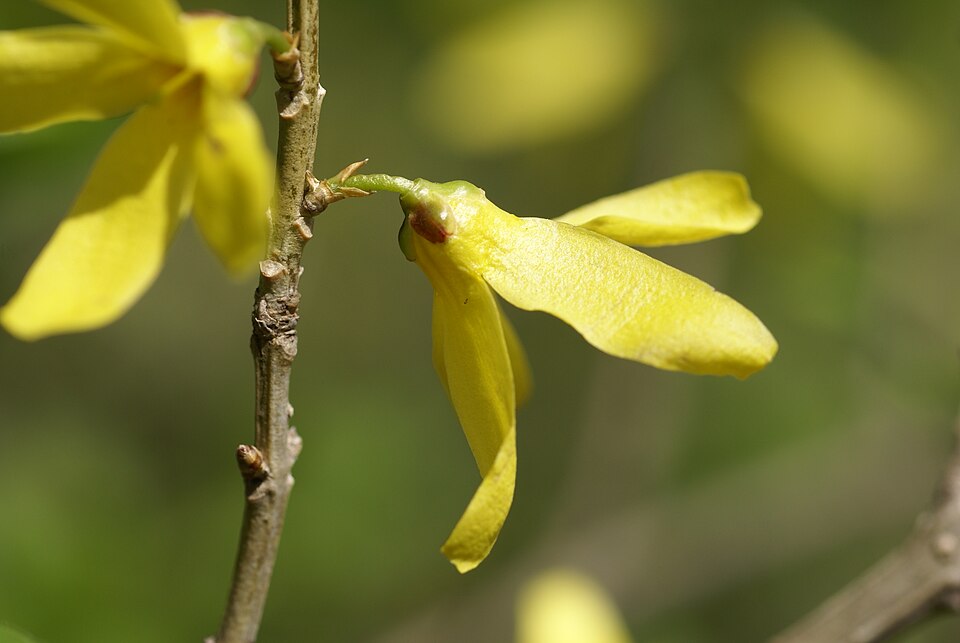
Forsythia viridissima, commonly known as green forsythia or golden bells, is a captivating deciduous shrub belonging to the Oleaceae family. Indigenous to East Asia, particularly thriving across China, Korea, and Japan, this species typically reaches a height of 1 to 3 meters with an elegant, upright, and arching growth habit. Its slender stems often form a dense, attractive cluster.
The leaves are simple, ovate, and arranged oppositely along the stems, displaying a rich dark green hue that transitions to a cheerful yellow in autumn. The most striking characteristic of Forsythia viridissima is its profusion of bright, tubular yellow flowers, which emerge in early spring, often before the leaves unfurl. These vibrant blooms, appearing in clusters from March to May depending on the local climate, serve as a vivid harbinger of spring.
The plant is adaptable, preferring well-drained soils but tolerating a variety of soil types, including sandy and loamy conditions. Its resilience and early bloom make it a popular choice in landscape design, where it is valued for its aesthetic appeal and its role in attracting early pollinators like bees with its mild fragrance.
Trusted Scientific References
1. Authoritative external sources for Forsythia viridissima
1.1 Wikipedia — Forsythia viridissima
1.2 Kew POWO (Plants of the World Online)
1.3 PubMed — peer-reviewed research
1.4 NCBI Taxonomy Browser
1.5 GBIF — Global Biodiversity
1.6Forsythia should be interpreted through verified botanical identity, practical care, and responsible safety language. This recovery note adds the missing context needed for a complete profile: match light to the plant's habit, use well-drained soil, water according to season, and avoid unsupported medicinal or edible claims. For publishing, the plant can be presented as a source-backed garden plant with clear care guidance, common problem diagnosis, and conservative safety wording.
1.7Forsythia (Forsythia viridissima) is maintained in this recovery file as a complete garden profile with practical care, safety, and identification context. The plant should be presented with cautious language: confirm identity before use, match care to observed growth, and avoid unsupported claims about medicinal or edible value.
1.1.Forsythia — Key Features
- ✓ <strong>Early Spring Blooms</strong> — Distinctive bright yellow flowers appear profusely before the leaves, signaling the arrival of spring.
- ✓ <strong>Ornamental Value</strong> — Widely cultivated globally for its striking aesthetic appeal in gardens and landscapes.
- ✓ <strong>Traditional Medicinal Herb</strong> — Holds significant historical importance in Traditional Chinese Medicine (TCM) and Unani.
- ✓ <strong>Anti</strong> — inflammatory Actions — Possesses compounds that traditionally and preclinically contribute to reducing inflammation.
- ✓ <strong>Antiviral & Antibacterial</strong> — Utilized for its traditional efficacy against various infectious agents, particularly in respiratory conditions.
- ✓ <strong>Rich in Bioactive Compounds</strong> — Contains a diverse array of phytochemicals, including forsythoside, lignans, and flavonoids.
- ✓ <strong>Adaptable Growth</strong> — Tolerates a broad spectrum of soil types and environmental conditions once established.
- ✓ <strong>Pollinator Attractor</strong> — Provides an early and vital nectar source for bees and other pollinators.
- ✓ <strong>East Asian Origin</strong> — Native to the regions of China, Korea, and Japan, where it has been cultivated for centuries.
- ✓ <strong>Potential Drug Interactions</strong> — Important consideration for individuals using anticoagulant or certain antibiotic medications.
1.2.Forsythia — Quick Summary
- ✓ Forsythia viridissima is a vibrant East Asian shrub celebrated for its early spring yellow blooms.
- ✓ Revered in Traditional Chinese Medicine for its anti-inflammatory, antiviral, and antibacterial properties.
- ✓ Rich in bioactive compounds like phenylethanoid glycosides, flavonoids, and lignans.
- ✓ Traditionally used for respiratory infections, fever, and various inflammatory conditions.
- ✓ Caution is advised due to potential interactions with blood-thinning medications and limited human safety data.
2.Forsythia — Scientific Identity
3.Forsythia — Quick Facts
4.Forsythia — Appearance & Identification
5.Forsythia — Native Habitat
6.Forsythia — Water Requirements
- ✓ Site Selection — For optimal flowering and vigorous growth, plant Forsythia viridissima in a location receiving full sun to partial shade, ideally with at least six hours of direct sunlight daily.
- ✓ Soil Requirements — This adaptable shrub thrives in well-drained soil but is tolerant of a wide range of soil types, including sandy, loamy, and clayey soils, provided they are not waterlogged.
- ✓ Watering — While establishing, regular watering is essential; once mature, it exhibits good drought tolerance, requiring less frequent irrigation.
- ✓ Fertilization — Apply a balanced, slow-release granular fertilizer in early spring before new growth appears to support robust flowering and overall plant health, especially in nutrient-poor soils.
- ✓ Pruning — Prune immediately after the spring flowering period to maintain its desired shape, control size, and encourage the development of new flower buds for the following season, removing about one-third of the oldest stems.
- ✓ Propagation — Easily propagated through softwood cuttings taken in early summer or hardwood cuttings in late fall, allowing for simple expansion of plantings.
- ✓ Pests and Diseases — Generally robust and resistant to most common pests and diseases, though occasional issues like leaf spot or root rot can occur in overly wet conditions.
Reviewed by the Flora Medical Global Botanical Review Panel
Multi-disciplinary editorial group · Botany · Ethnobotany · Herbal-medicine literature
Who reviewed this: This page was checked by the Flora Medical Global Botanical Review Panel — an in-house editorial group of botany graduates, ethnobotany researchers, and horticulture practitioners who collectively maintain our 7,000+ plant encyclopedia. Meet the team.
Our 4-step verification process
1. Taxonomic verification
Scientific names and synonyms cross-checked against Kew POWO, World Flora Online, and The Plant List.
2. Phytochemical & medicinal cross-reference
Active compounds, traditional uses, and reported activities are cross-referenced with PubMed, USDA Dr. Duke's database, and peer-reviewed ethnobotanical literature.
3. Conservation & distribution check
Distribution, ecology, and conservation status confirmed against GBIF occurrence records and the IUCN Red List.
4. Editorial & safety review
Every entry passes an editorial pass for clarity, originality, and safety notices (toxicity, contraindications, dosage caveats) before publication.
Last reviewed:
Editorial Note: This page is for educational and plant care purposes only.
Written by: Flora Medical Global Editorial Team
Reviewed by: Flora Medical Global Botanical Review Panel
Last Updated: June 15, 2026







Forsythia — Comments & Community Reviews
Rate this plant