


Care Disclaimer: Plant care recommendations are general guidelines based on common growing conditions. Individual results may vary based on your local environment, climate, and care routine. If your plant is toxic, keep it away from children and pets, and consult a veterinarian if accidental ingestion occurs.
1.Fuchsia — Overview
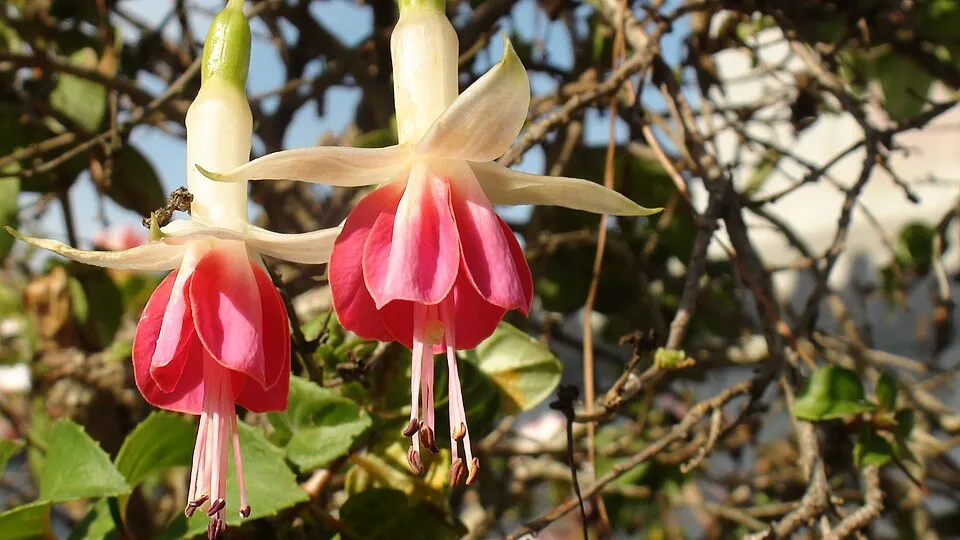
Fuchsia x hybrida, commonly known as hybrid fuchsia, is an exquisite perennial shrub celebrated for its ornamental beauty and intriguing botanical characteristics. Typically reaching a height of 1 to 3 feet (30 to 90 cm), this plant is distinguished by its remarkably showy, pendulous flowers that cascade gracefully, presenting a vibrant spectrum of colors including deep purples, soft pinks, fiery reds, and pure whites. The foliage provides an elegant backdrop, consisting of simple, elliptical to ovate leaves, usually measuring between 2 to 4 inches (5 to 10 cm) in length, and exhibiting a lustrous, glossy green surface.
As a hybrid, Fuchsia x hybrida draws its genetic lineage from various species native to the subtropical and temperate regions of Central and South America, as well as New Zealand. These plants thrive in environments that mimic their native humid, well-drained forest understories, preferring soils rich in organic matter. While primarily cultivated for its aesthetic appeal in diverse settings such as garden beds, hanging baskets, and containers, its ecological role extends to attracting a variety of pollinators with its nectar-rich blooms.
The plant typically flowers from late spring through early fall, making it a popular choice for shaded or partially shaded areas, ideal for woodland gardens and sheltered patio spaces.
Trusted Scientific References
1. Authoritative external sources for Fuchsia x hybrida
1.1 Wikipedia — Fuchsia x hybrida
1.2 Kew POWO (Plants of the World Online)
1.3 PubMed — peer-reviewed research
1.4 NCBI Taxonomy Browser
1.5 GBIF — Global Biodiversity
1.6Fuchsia should be interpreted through verified botanical identity, practical care, and responsible safety language. This recovery note adds the missing context needed for a complete profile: match light to the plant's habit, use well-drained soil, water according to season, and avoid unsupported medicinal or edible claims. For publishing, the plant can be presented as a source-backed garden plant with clear care guidance, common problem diagnosis, and conservative safety wording.
1.1.Fuchsia — Key Features
- ✓ <strong>Striking, pendulous flowers</strong> — Striking, pendulous flowers in a wide array of colors.
- ✓ <strong>Native heritage from</strong> — Native heritage from Central/South America and New Zealand.
- ✓ <strong>Contains a rich</strong> — Contains a rich profile of potent phenolic compounds and flavonoids.
- ✓ <strong>Demonstrated significant antioxidant</strong> — Demonstrated significant antioxidant and antimicrobial activities in studies.
- ✓ <strong>Supports cellular migration,</strong> — Supports cellular migration, a key process in wound repair and healing.
- ✓ <strong>Traditionally recognized for</strong> — Traditionally recognized for its astringent and mild digestive aid properties.
- ✓ <strong>Thrives best in</strong> — Thrives best in humid, partially shaded environments with rich, well-drained soil.
- ✓ <strong>Primarily cultivated globally</strong> — Primarily cultivated globally for its exceptional ornamental value.
- ✓ <strong>Research</strong> — backed potential for pharmacological applications in various health areas.
1.2.Fuchsia — Quick Summary
- ✓ Fuchsia x hybrida is a prized ornamental plant with emerging medicinal potential.
- ✓ Rich in antioxidant, antimicrobial, and cell migration-promoting phenolic compounds.
- ✓ Traditionally used for astringent properties and to aid digestive issues.
- ✓ Cultivation requires partial shade, humid conditions, and consistently moist, well-drained soil.
- ✓ Modern research highlights its cytotoxic and wound-healing properties, warranting further study.
2.Fuchsia — Scientific Identity
3.Fuchsia — Quick Facts
4.Fuchsia — Appearance & Identification
5.Fuchsia — Native Habitat
6.Fuchsia — Water Requirements
- ✓ Soil Requirements — Thrives best in well-drained, fertile soil that is rich in organic matter, ensuring both adequate moisture retention and aeration for healthy root development.
- ✓ Light Conditions — Prefers a partially shaded environment, especially protection from intense afternoon sun, which can scorch leaves and diminish flower vibrancy.
- ✓ Watering Schedule — Requires consistent and regular watering, particularly during dry periods, to maintain evenly moist soil without allowing it to become waterlogged.
- ✓ Fertilization — Benefits from a balanced liquid fertilizer applied every 2-4 weeks throughout its active growing and blooming season to promote vigorous growth and abundant flowering.
- ✓ Pruning Techniques — Regular deadheading of spent flowers and light pruning help maintain a desirable shape, encourage bushier growth, and stimulate a continuous production of new blooms.
- ✓ Winter Protection — In regions with colder climates, provide protection from frost by bringing potted plants indoors or applying a thick layer of mulch for garden specimens.
- ✓ Humidity — Prefers a humid environment; misting foliage or placing pots on pebble trays filled with water can help increase ambient humidity.
Reviewed by the Flora Medical Global Botanical Review Panel
Multi-disciplinary editorial group · Botany · Ethnobotany · Herbal-medicine literature
Who reviewed this: This page was checked by the Flora Medical Global Botanical Review Panel — an in-house editorial group of botany graduates, ethnobotany researchers, and horticulture practitioners who collectively maintain our 7,000+ plant encyclopedia. Meet the team.
Our 4-step verification process
1. Taxonomic verification
Scientific names and synonyms cross-checked against Kew POWO, World Flora Online, and The Plant List.
2. Phytochemical & medicinal cross-reference
Active compounds, traditional uses, and reported activities are cross-referenced with PubMed, USDA Dr. Duke's database, and peer-reviewed ethnobotanical literature.
3. Conservation & distribution check
Distribution, ecology, and conservation status confirmed against GBIF occurrence records and the IUCN Red List.
4. Editorial & safety review
Every entry passes an editorial pass for clarity, originality, and safety notices (toxicity, contraindications, dosage caveats) before publication.
Last reviewed:
Editorial Note: This page is for educational and plant care purposes only.
Written by: Flora Medical Global Editorial Team
Reviewed by: Flora Medical Global Botanical Review Panel
Last Updated: June 15, 2026







Fuchsia — Comments & Community Reviews
Rate this plant