
Care Disclaimer: Plant care recommendations are general guidelines based on common growing conditions. Individual results may vary based on your local environment, climate, and care routine. If your plant is toxic, keep it away from children and pets, and consult a veterinarian if accidental ingestion occurs.
1.Glaucium — Overview
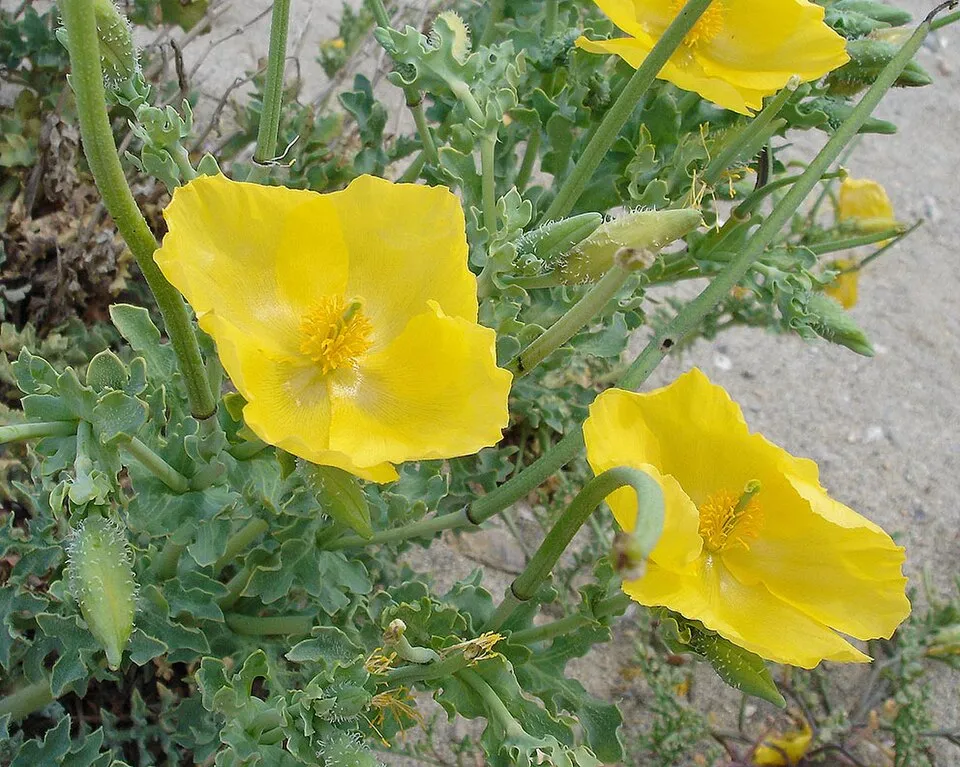
Glaucium flavum, commonly recognized as the Yellow Horned Poppy or Sea Poppy, is a striking biennial or short-lived perennial belonging to the Papaveraceae family. This resilient plant is indigenous to the coastal regions of Europe, North Africa, and parts of Asia, where it thrives in challenging sandy, stony habitats such as beaches, cliffs, and shingle banks. Typically growing to a height of 30-90 cm, it features distinctive glaucous, or blue-green, deeply lobed leaves that are somewhat fleshy and often form a basal rosette in its juvenile stage.
Its vibrant, cup-shaped flowers, which range in color from golden-yellow to orange and measure 5-7 cm across, bloom profusely from late spring through late summer. The plant's most notable characteristic, and the source of its common name, is its remarkably long, slender, horn-shaped seed pods, which can extend up to 30 cm in length. All parts of Glaucium flavum exude a characteristic yellow or orange latex when broken, indicating its rich alkaloid content.
While prized for its ornamental value in some gardens, it has naturalized in various regions, including parts of North America, where it can sometimes be considered invasive.
Trusted Scientific References
1. Authoritative external sources for Glaucium flavum
1.1 Wikipedia — Glaucium flavum
1.2 Kew POWO (Plants of the World Online)
1.3 PubMed — peer-reviewed research
1.4 NCBI Taxonomy Browser
1.5 GBIF — Global Biodiversity
1.6Glaucium should be interpreted through verified botanical identity, practical care, and responsible safety language. This recovery note adds the missing context needed for a complete profile: match light to the plant's habit, use well-drained soil, water according to season, and avoid unsupported medicinal or edible claims. For publishing, the plant can be presented as a source-backed garden plant with clear care guidance, common problem diagnosis, and conservative safety wording.
1.7Glaucium (Glaucium flavum) is maintained in this recovery file as a complete garden profile with practical care, safety, and identification context. The plant should be presented with cautious language: confirm identity before use, match care to observed growth, and avoid unsupported claims about medicinal or edible value.
1.1.Glaucium — Key Features
- ✓ <strong>Botanical Name</strong> — Glaucium flavum.
- ✓ <strong>Common Names</strong> — Yellow Horned Poppy, Sea Poppy.
- ✓ <strong>Family</strong> — Papaveraceae (Poppy Family).
- ✓ <strong>Native Region</strong> — Coasts of Europe, North Africa, parts of Asia.
- ✓ <strong>Active Compounds</strong> — Primarily isoquinoline alkaloids, including glaucine, protopine, and chelerythrine.
- ✓ <strong>Traditional Uses</strong> — Expectorant, antitussive, antispasmodic for respiratory ailments.
- ✓ <strong>Distinctive Morphology</strong> — Glaucous blue-green leaves, bright yellow to orange cup-shaped flowers, and long horn-shaped seed pods.
- ✓ <strong>Habitat Preference</strong> — Thrives in sandy, stony, well-drained coastal environments.
- ✓ <strong>Toxicity Level</strong> — High; all parts are considered toxic and not suitable for unsupervised internal use.
- ✓ <strong>Potential Applications</strong> — Bronchodilator, cough suppressant, anti-inflammatory, and analgesic properties.
1.2.Glaucium — Quick Summary
- ✓ Glaucium flavum, the Yellow Horned Poppy, is a coastal plant known for its striking appearance and unique horn-shaped seed pods.
- ✓ It is rich in potent isoquinoline alkaloids, with glaucine, protopine, and sanguinarine being key active compounds.
- ✓ Traditionally, it has been used as an expectorant, antitussive, and bronchodilator for various respiratory conditions.
- ✓ Modern research acknowledges its anti-inflammatory, analgesic, and potential antimicrobial properties.
- ✓ The plant possesses significant toxicity, making unsupervised internal use highly dangerous and strongly discouraged.
- ✓ Due to its potent pharmacological activity and toxicity, any medicinal application requires extreme caution and strict professional guidance.
2.Glaucium — Scientific Identity
3.Glaucium — Quick Facts
4.Glaucium — Appearance & Identification
5.Glaucium — Native Habitat
6.Glaucium — Water Requirements
- ✓ Propagation — Glaucium flavum is most reliably propagated from seed.
- ✓ Sowing Time — Seeds can be sown directly outdoors in either spring or autumn, or started indoors in pots for earlier establishment.
- ✓ Light Requirements — The plant thrives best in full sun exposure, mimicking its natural open coastal habitats.
- ✓ Soil Preference — It requires well-drained, sandy, or gravelly soil, and is highly tolerant of poor or lean soil conditions.
- ✓ Water Needs — Once established, the Yellow Horned Poppy is remarkably drought tolerant and needs minimal supplemental watering.
- ✓ Hardiness Zone — It is generally hardy across USDA Hardiness Zones 5 to 10.
- ✓ Transplanting — Poppies, including Glaucium flavum, can be sensitive to root disturbance, so direct sowing or using biodegradable pots is recommended.
- ✓ Self-seeding — This species readily self-seeds in favorable environments, which can lead to its naturalization and spread.
Reviewed by the Flora Medical Global Botanical Review Panel
Multi-disciplinary editorial group · Botany · Ethnobotany · Herbal-medicine literature
Who reviewed this: This page was checked by the Flora Medical Global Botanical Review Panel — an in-house editorial group of botany graduates, ethnobotany researchers, and horticulture practitioners who collectively maintain our 7,000+ plant encyclopedia. Meet the team.
Our 4-step verification process
1. Taxonomic verification
Scientific names and synonyms cross-checked against Kew POWO, World Flora Online, and The Plant List.
2. Phytochemical & medicinal cross-reference
Active compounds, traditional uses, and reported activities are cross-referenced with PubMed, USDA Dr. Duke's database, and peer-reviewed ethnobotanical literature.
3. Conservation & distribution check
Distribution, ecology, and conservation status confirmed against GBIF occurrence records and the IUCN Red List.
4. Editorial & safety review
Every entry passes an editorial pass for clarity, originality, and safety notices (toxicity, contraindications, dosage caveats) before publication.
Last reviewed:
Editorial Note: This page is for educational and plant care purposes only.
Written by: Flora Medical Global Editorial Team
Reviewed by: Flora Medical Global Botanical Review Panel
Last Updated: June 15, 2026







Glaucium — Comments & Community Reviews
Rate this plant