


Care Disclaimer: Plant care recommendations are general guidelines based on common growing conditions. Individual results may vary based on your local environment, climate, and care routine. If your plant is toxic, keep it away from children and pets, and consult a veterinarian if accidental ingestion occurs.
1.Glebionis Segetum — Overview
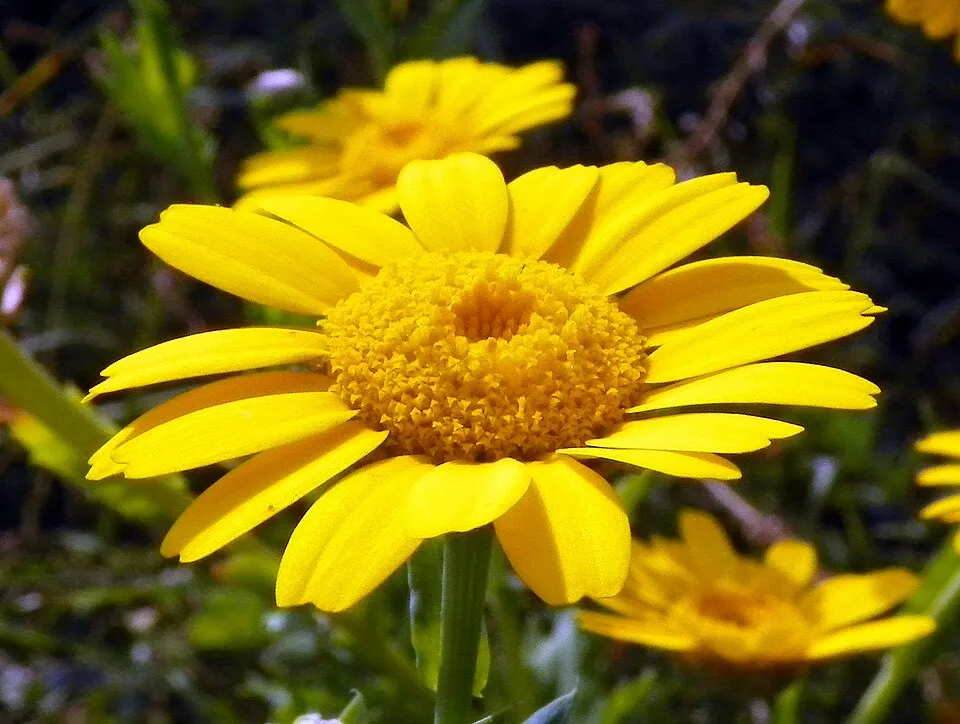
Glebionis segetum, commonly known as Corn Marigold or Corn Daisy, is a striking annual herbaceous plant belonging to the Asteraceae family, which also includes daisies and sunflowers. Native to the eastern Mediterranean region, its range has significantly expanded through human agricultural activity, becoming naturalized across western and northern Europe, parts of Asia, and even North America. This vibrant species typically grows upright, reaching heights of 30 to 80 cm, with distinctive deeply lobed, glaucous green leaves that are spirally arranged along the stem.
Its most notable feature is its bright yellow, daisy-like flower heads, known as capitula, which measure between 3.5 and 5.5 cm in diameter. These capitula consist of a ring of brilliant yellow ray florets surrounding a dense center of disc florets. Historically, Glebionis segetum was a ubiquitous sight in European cornfields, thriving as a persistent agricultural weed, hence its common name.
Despite its past reputation as a weed, it is now often cultivated as an ornamental plant in gardens, cherished for its cheerful appearance and significant ecological value. It blooms profusely from early summer into autumn, providing a rich source of nectar and pollen, making it highly attractive to a diverse array of pollinators, including bees, butterflies, and various beetle species, thereby contributing significantly to local biodiversity. In some regions, like the UK, its wild populations have declined, leading to its inclusion on conservation lists.
Trusted Scientific References
1. Authoritative external sources for Glebionis Segetum
1.1 Wikipedia — Glebionis Segetum
1.2 Kew POWO (Plants of the World Online)
1.3 PubMed — peer-reviewed research
1.4 NCBI Taxonomy Browser
1.5 GBIF — Global Biodiversity
1.6Glebionis Segetum should be interpreted through verified botanical identity, practical care, and responsible safety language. This recovery note adds the missing context needed for a complete profile: match light to the plant's habit, use well-drained soil, water according to season, and avoid unsupported medicinal or edible claims. For publishing, the plant can be presented as a source-backed garden plant with clear care guidance, common problem diagnosis, and conservative safety wording.
1.1.Glebionis Segetum — Key Features
- ✓ <strong>Botanical Name</strong> — Glebionis segetum (syn. Chrysanthemum segetum), commonly known as Corn Marigold.
- ✓ <strong>Family</strong> — Asteraceae, sharing characteristics with daisies and sunflowers.
- ✓ <strong>Distinctive Flowers</strong> — Bright yellow, daisy-like capitula, 3.5-5.5 cm in diameter.
- ✓ <strong>Growth Habit</strong> — Upright annual herbaceous plant, typically reaching 30-80 cm in height.
- ✓ <strong>Ecological Value</strong> — High nectar and pollen producer, vital for attracting bees, butterflies, and beetles.
- ✓ <strong>Traditional Uses</strong> — Historically used as a mild diuretic and for soothing minor skin irritations.
- ✓ <strong>Key Constituents</strong> — Contains significant levels of flavonoids (e.g., luteolin, apigenin) and carotenoids.
- ✓ <strong>Habitat</strong> — Native to the Mediterranean, widely naturalized across Europe and other continents, thriving in disturbed soils.
- ✓ <strong>Conservation Status</strong> — Listed as 'amber' in some regions (e.g., UK) due to declining wild populations.
- ✓ <strong>Cultivation</strong> — Easy to grow in full sun with well-drained soil, readily self-seeds.
1.2.Glebionis Segetum — Quick Summary
- ✓ Corn Marigold (Glebionis segetum) is a vibrant annual from the Asteraceae family, known for its bright yellow flowers.
- ✓ Historically a cornfield weed, now valued ornamentally and ecologically for attracting pollinators.
- ✓ Traditional uses include a mild diuretic and topical application for minor skin irritations.
- ✓ Rich in beneficial phytochemicals like flavonoids and carotenoids, offering antioxidant potential.
- ✓ Cultivates easily in full sun and well-drained soils, often self-seeding.
- ✓ Use with caution; consult a healthcare professional due to limited scientific validation and potential allergic reactions.
2.Glebionis Segetum — Scientific Identity
3.Glebionis Segetum — Quick Facts
4.Glebionis Segetum — Appearance & Identification
5.Glebionis Segetum — Native Habitat
6.Glebionis Segetum — Water Requirements
- ✓ Climate and Soil — Glebionis segetum thrives in full sun exposure but can tolerate part shade; it prefers well-drained, even poor, sandy or chalky soils, demonstrating adaptability.
- ✓ Sowing Seeds — Direct sow seeds outdoors in early spring (March to May) after the last frost; scatter them lightly on the soil surface and cover with a thin layer of fine soil.
- ✓ Watering — Requires moderate watering, particularly during dry spells, to establish seedlings; mature plants are relatively drought-tolerant but benefit from consistent moisture.
- ✓ Fertilization — Generally, no fertilization is needed as the plant is adapted to poor soils; excessive nutrients can lead to lush foliage at the expense of flower production.
- ✓ Pests and Diseases — Corn Marigold is relatively robust and typically not prone to serious pest infestations or major plant diseases, making it low-maintenance.
- ✓ Propagation — Primarily propagated by seed; it readily self-seeds in favorable conditions, ensuring continuous blooms in subsequent years and can act as a short-lived biennial in mild climates.
- ✓ Maintenance — Deadheading spent flowers can encourage a longer blooming period, though many gardeners allow it to go to seed for natural propagation.
- ✓ Weed Management — As it can be invasive in some agricultural settings, careful hand-pulling is recommended for removal, ensuring minimal soil disturbance.
Reviewed by the Flora Medical Global Botanical Review Panel
Multi-disciplinary editorial group · Botany · Ethnobotany · Herbal-medicine literature
Who reviewed this: This page was checked by the Flora Medical Global Botanical Review Panel — an in-house editorial group of botany graduates, ethnobotany researchers, and horticulture practitioners who collectively maintain our 7,000+ plant encyclopedia. Meet the team.
Our 4-step verification process
1. Taxonomic verification
Scientific names and synonyms cross-checked against Kew POWO, World Flora Online, and The Plant List.
2. Phytochemical & medicinal cross-reference
Active compounds, traditional uses, and reported activities are cross-referenced with PubMed, USDA Dr. Duke's database, and peer-reviewed ethnobotanical literature.
3. Conservation & distribution check
Distribution, ecology, and conservation status confirmed against GBIF occurrence records and the IUCN Red List.
4. Editorial & safety review
Every entry passes an editorial pass for clarity, originality, and safety notices (toxicity, contraindications, dosage caveats) before publication.
Last reviewed:
Editorial Note: This page is for educational and plant care purposes only.
Written by: Flora Medical Global Editorial Team
Reviewed by: Flora Medical Global Botanical Review Panel
Last Updated: June 15, 2026







Glebionis Segetum — Comments & Community Reviews
Rate this plant