


Care Disclaimer: Plant care recommendations are general guidelines based on common growing conditions. Individual results may vary based on your local environment, climate, and care routine. If your plant is toxic, keep it away from children and pets, and consult a veterinarian if accidental ingestion occurs.
1.Gnaphalium Obtusifolium — Overview
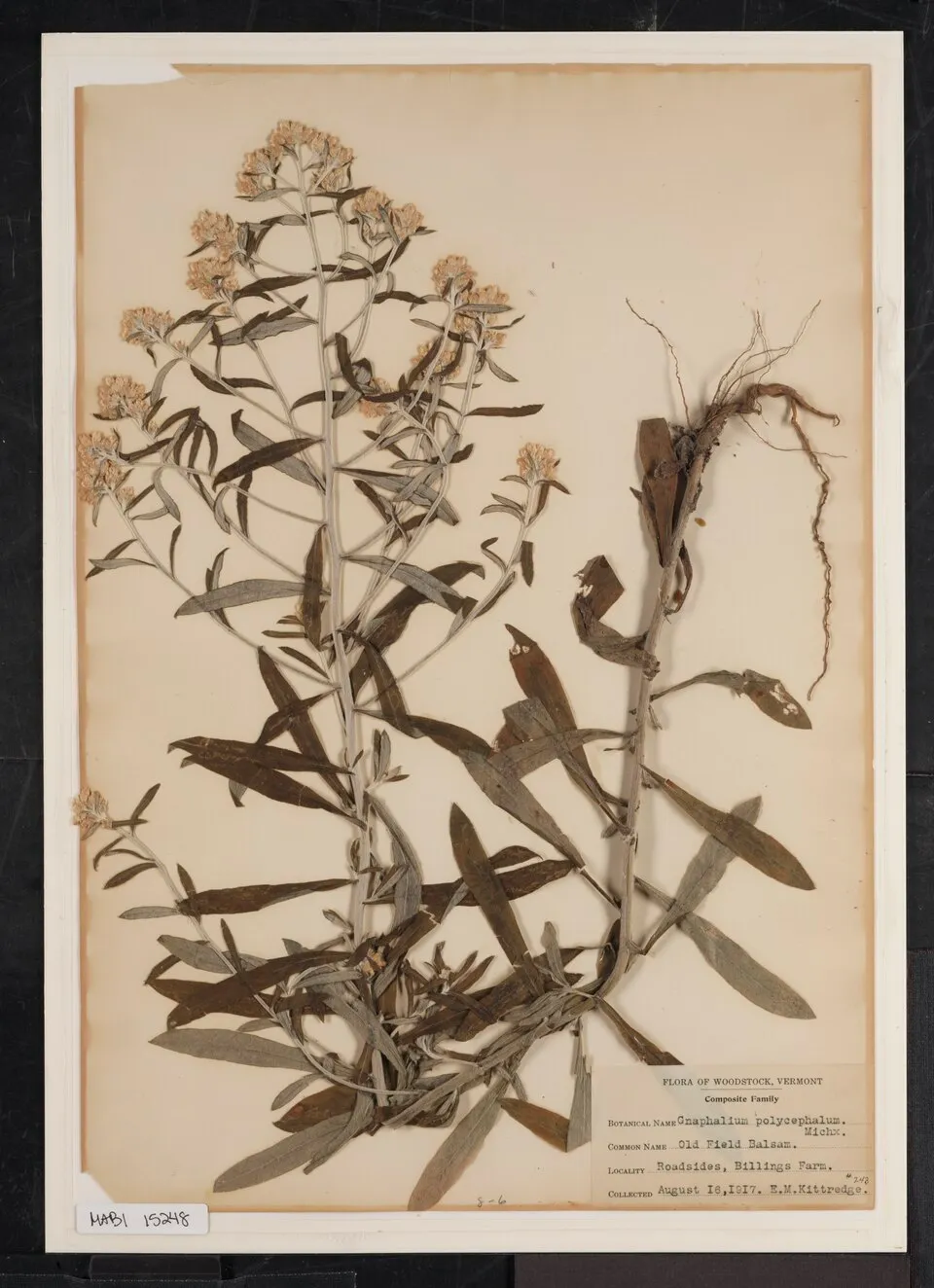
Gnaphalium obtusifolium, commonly known as Sweet Everlasting or Fragrant Cudweed, is an aromatic herbaceous plant native to a wide range of habitats across eastern North America, extending from Canada to the Gulf Coast. This resilient species thrives in open, often disturbed environments such as sun-drenched fields, roadsides, clearings, and sandy pine barrens, demonstrating a preference for well-drained, somewhat infertile soils. It is typically an annual or biennial, though it can sometimes persist as a short-lived perennial, belonging to the expansive Asteraceae family. Characteristically, Sweet Everlasting produces erect, slender stems that can grow to impressive heights of 1 to 3 feet (0.3 to 0.9 meters). The plant features a distinctive basal rosette of leaves, from which the main stem emerges, bearing alternately arranged sessile leaves that lack a stalk and attach directly to the stem.
These leaves are oblanceolate to spatulate in shape, gradually tapering towards the base and featuring an obtuse or rounded apex, which is the origin of its specific epithet 'obtusifolium'. Both the stems and leaves are enveloped in a dense, soft, woolly indumentum, giving the plant a silvery-white, felt-like texture. This thick covering of hairs is a crucial xerophytic adaptation, effectively minimizing water loss through transpiration, enabling the plant to thrive in dry or exposed conditions. A prominent feature of Gnaphalium obtusifolium is its sweet, herbaceous, and slightly camphoraceous fragrance, which becomes particularly noticeable when the leaves are crushed—a characteristic that contributes to its evocative common name. The plant blooms from mid-summer through early fall, producing terminal clusters of small, bell-shaped flower heads, or capitula.
These inconspicuous flower heads are composed of numerous tiny florets, with absent or very small ray florets and fertile disk florets. The involucre, which encases the base of each flower head, consists of imbricated, dry, papery bracts that range in color from whitish to pale yellowish. These persistent bracts retain their form and color long after the flowering period, lending the plant its 'everlasting' quality, even into the winter months.
Trusted Scientific References
1. Authoritative external sources for Gnaphalium Obtusifolium
1.1 Wikipedia — Gnaphalium Obtusifolium
1.2 Kew POWO (Plants of the World Online)
1.3 PubMed — peer-reviewed research
1.4 NCBI Taxonomy Browser
1.5 GBIF — Global Biodiversity
1.1.Gnaphalium Obtusifolium — Key Features
- ✓ <strong>Native to Eastern North America</strong> — Indigenous to a broad region, adapted to local ecosystems.
- ✓ <strong>Aromatic Foliage</strong> — Emits a distinct sweet, herbaceous, and camphoraceous fragrance, especially when crushed.
- ✓ <strong>Woolly, Silvery Appearance</strong> — Stems and leaves are covered in dense, white, felt-like hairs, providing a unique aesthetic.
- ✓ <strong>Drought</strong> — Tolerant — Highly resilient in dry conditions due to adaptations like its woolly indumentum.
- ✓ <strong>Pollinator Plant</strong> — Attracts various beneficial insects and butterflies, contributing to local biodiversity.
- ✓ <strong>Traditional Medicinal History</strong> — Long history of use in Native American and American folk medicine for various ailments.
- ✓ <strong>Asteraceae Family</strong> — Belongs to the large daisy family, sharing characteristics with many other medicinal plants.
- ✓ <strong>Everlasting Flowers</strong> — Its dry, papery bracts persist after flowering, giving it an 'everlasting' quality for floral arrangements.
- ✓ <strong>Low Maintenance</strong> — Easy to grow in suitable conditions, requiring minimal care.
- ✓ <strong>Adaptable Habitat</strong> — Found in diverse open, disturbed habitats, showcasing its ecological flexibility.
1.2.Gnaphalium Obtusifolium — Quick Summary
- ✓ Sweet Everlasting is an aromatic native plant of eastern North America, known for its woolly, silvery foliage.
- ✓ Traditionally used for respiratory ailments, inflammation, pain, and wound healing.
- ✓ Contains beneficial compounds like flavonoids, sesquiterpenes, and volatile oils.
- ✓ Thrives in full sun and well-drained soils, highly drought-tolerant and low maintenance.
- ✓ Common preparations include teas, tinctures, poultices, and essential oil applications.
- ✓ Caution advised for individuals with Asteraceae allergies, pregnant/nursing women, and those on medication.
2.Gnaphalium Obtusifolium — Scientific Identity
3.Gnaphalium Obtusifolium — Quick Facts
4.Gnaphalium Obtusifolium — Appearance & Identification
5.Gnaphalium Obtusifolium — Native Habitat
6.Gnaphalium Obtusifolium — Water Requirements
- ✓ Site Selection — Prefers full sun exposure (at least 6 hours daily) and well-drained soil; tolerates poor, sandy, or rocky soils.
- ✓ Propagation — Primarily propagated by seeds, which can be direct-sown in fall or early spring, or started indoors 6-8 weeks before the last frost.
- ✓ Soil Requirements — Thrives in average to lean soil fertility; excessive richness can lead to leggy growth. pH preference is typically neutral to slightly acidic.
- ✓ Watering — Once established, Sweet Everlasting is highly drought-tolerant and requires minimal supplemental watering; overwatering should be avoided.
- ✓ Spacing — Space plants approximately 12-18 inches (30-45 cm) apart to allow for mature growth and good air circulation.
- ✓ Maintenance — Low maintenance; generally does not require fertilization. Deadheading spent flowers can encourage a tidier appearance but is not necessary for plant health.
- ✓ Pest and Disease — Generally resistant to most common pests and diseases, making it a robust and easy-to-grow native plant.
- ✓ Self-seeding — It readily self-seeds in favorable conditions, which can lead to its natural spread in garden or wild settings.
Reviewed by the Flora Medical Global Botanical Review Panel
Multi-disciplinary editorial group · Botany · Ethnobotany · Herbal-medicine literature
Who reviewed this: This page was checked by the Flora Medical Global Botanical Review Panel — an in-house editorial group of botany graduates, ethnobotany researchers, and horticulture practitioners who collectively maintain our 7,000+ plant encyclopedia. Meet the team.
Our 4-step verification process
1. Taxonomic verification
Scientific names and synonyms cross-checked against Kew POWO, World Flora Online, and The Plant List.
2. Phytochemical & medicinal cross-reference
Active compounds, traditional uses, and reported activities are cross-referenced with PubMed, USDA Dr. Duke's database, and peer-reviewed ethnobotanical literature.
3. Conservation & distribution check
Distribution, ecology, and conservation status confirmed against GBIF occurrence records and the IUCN Red List.
4. Editorial & safety review
Every entry passes an editorial pass for clarity, originality, and safety notices (toxicity, contraindications, dosage caveats) before publication.
Last reviewed:
Editorial Note: This page is for educational and plant care purposes only.
Written by: Flora Medical Global Editorial Team
Reviewed by: Flora Medical Global Botanical Review Panel
Last Updated: June 15, 2026







Gnaphalium Obtusifolium — Comments & Community Reviews
Rate this plant