


Care Disclaimer: Plant care recommendations are general guidelines based on common growing conditions. Individual results may vary based on your local environment, climate, and care routine. If your plant is toxic, keep it away from children and pets, and consult a veterinarian if accidental ingestion occurs.
1.Grevillea Robusta Garden — Overview
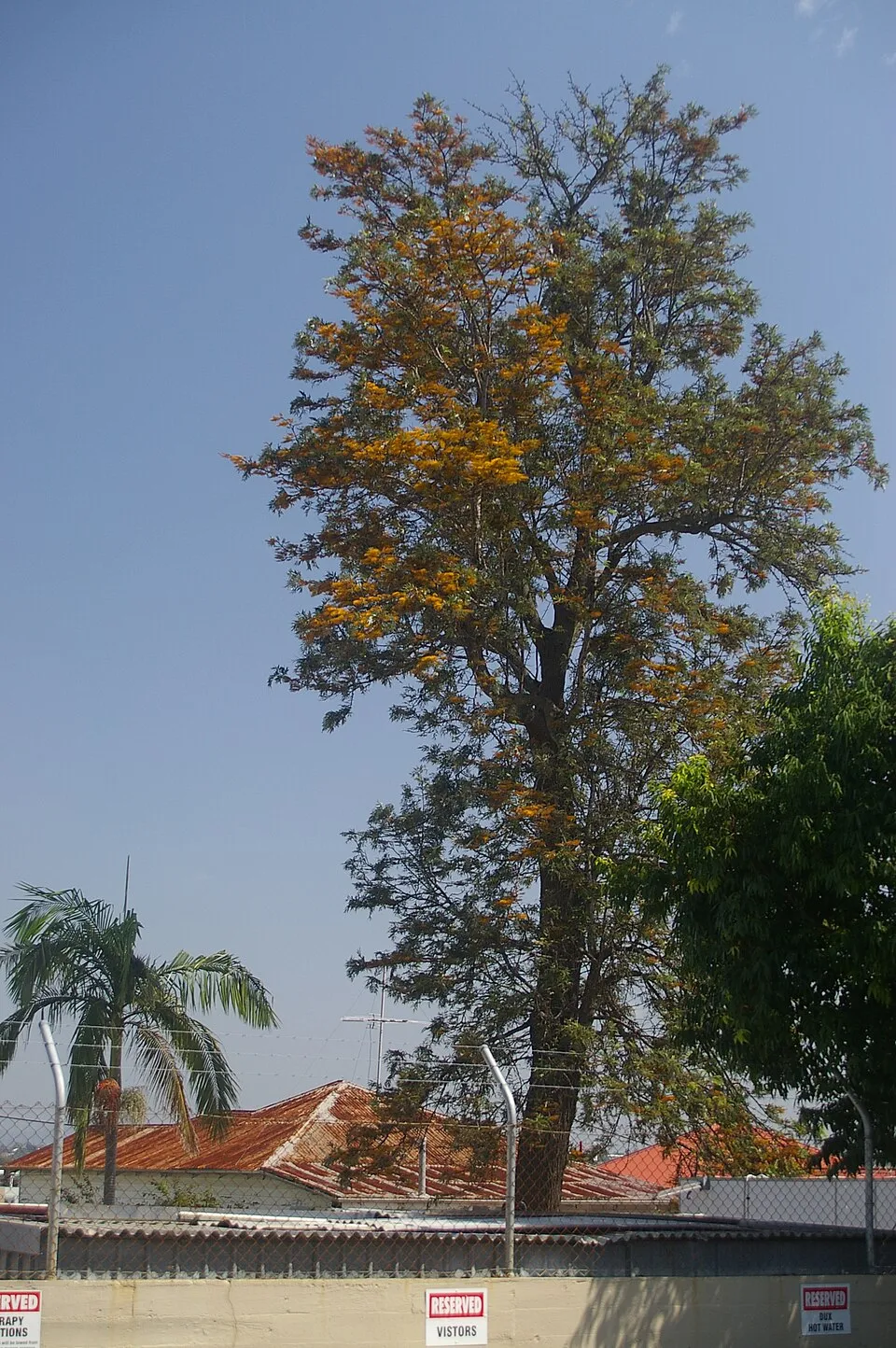
Grevillea robusta, widely recognized as the Silky Oak or Australian Silver Oak, is an impressive evergreen tree indigenous to the subtropical coastal regions of eastern Australia, particularly New South Wales and Queensland. As a prominent member of the diverse Proteaceae family, it stands out for its exceptionally rapid growth rate, distinctive fern-like foliage, and its spectacular, vibrant golden-orange floral display. Mature specimens typically attain heights of 15 to 30 meters, with some individuals surpassing 40 meters under optimal environmental conditions, establishing a commanding presence in the landscape. The tree's aesthetic appeal is largely attributed to its unique leaves, which are deeply pinnately lobed, resembling large ferns, and can measure between 15 and 30 cm in length. The upper surface of these leaves is a lustrous, dark green, providing a striking contrast to the underside, which is densely covered in fine, silvery-white hairs.
This characteristic pubescence is responsible for the common names "silky" and "silver" oak, creating a mesmerizing shimmering effect as the foliage sways in the wind. Its striking flowers emerge in spring and early summer, arranged in dense, one-sided racemes, each inflorescence appearing like a brilliant brush. Individual flowers are approximately 2 cm long, featuring a prominent, curved style that contributes to their unique appearance. The coloration ranges from bright golden yellow to deep orange, serving as a powerful attractant for a wide array of nectar-feeding birds and insects, playing a vital ecological role. Following flowering, the tree produces woody, boat-shaped follicles, each containing 2-4 winged seeds.
Grevillea robusta demonstrates remarkable adaptability, thriving in a broad spectrum of soil types, from sandy to heavy clay, and exhibits significant drought tolerance once established, although it prefers well-drained conditions. Its robust nature and ornamental beauty have led to its widespread cultivation globally in parks, gardens, and urban avenues. However, its vigorous and extensive root system necessitates careful placement in urban settings, as it can potentially compromise pavements and structural foundations. Beyond its horticultural value, the wood of the Silky Oak is moderately hard, durable, and possesses an attractive grain, making it suitable for fine furniture, cabinetry, and various construction applications. Trusted Scientific References Authoritative external sources for ...[CURRENT TEXT EXISTS: 2668 chars]
1.1.Grevillea Robusta Garden — Key Features
- ✓ <strong>Native to Eastern</strong> — Native to Eastern Australia, particularly Queensland and New South Wales.
- ✓ <strong>Fast</strong> — growing evergreen tree, reaching significant heights of 15-40 meters.
- ✓ <strong>Distinctive deeply lobed, fern</strong> — like leaves with silvery undersides.
- ✓ <strong>Produces spectacular golden</strong> — orange, brush-like flower racemes in spring and summer.
- ✓ <strong>Highly adaptable to</strong> — Highly adaptable to various soil types and exhibits excellent drought tolerance once mature.
- ✓ <strong>Wood is moderately</strong> — Wood is moderately hard, durable, and attractive, used for furniture and construction.
- ✓ <strong>Widely cultivated globally</strong> — Widely cultivated globally as an ornamental, shade, and agroforestry tree.
- ✓ <strong>Contains skin</strong> — irritating resorcinols, causing contact dermatitis upon exposure.
- ✓ <strong>Features an aggressive</strong> — Features an aggressive root system that can be problematic near structures.
- ✓ <strong>Attracts a variety of nectar</strong> — feeding birds and insects, supporting local biodiversity.
1.2.Grevillea Robusta Garden — Quick Summary
- ✓ Grevillea robusta, or Silky Oak, is a large, ornamental evergreen tree native to eastern Australia.
- ✓ Renowned for its rapid growth, fern-like foliage, and striking golden-orange flowers.
- ✓ Contains toxic resorcinols (pentadecylresorcinol, tridecylresorcinol) that cause contact dermatitis.
- ✓ Primarily cultivated worldwide for its aesthetic appeal, shade, and valuable timber.
- ✓ Internal medicinal use is not recommended due to its toxicity and lack of traditional herbal application.
- ✓ Handling requires protective measures to prevent skin irritation and allergic reactions.
2.Grevillea Robusta Garden — Scientific Identity
3.Grevillea Robusta Garden — Quick Facts
4.Grevillea Robusta Garden — Appearance & Identification
5.Grevillea Robusta Garden — Native Habitat
6.Grevillea Robusta Garden — Water Requirements
- ✓ Climate Preference — Thrives in subtropical and warm temperate climates (USDA Zones 9-11), intolerant of severe frosts, though it can become semi-deciduous in light frost.
- ✓ Soil Requirements — Adaptable to a wide range of well-drained soils, including sandy loams to heavier clays, but prefers slightly acidic to neutral pH.
- ✓ Sunlight Exposure — Requires full sun exposure for optimal growth and flowering; partial shade can lead to leggy growth and reduced bloom production.
- ✓ Watering Needs — Young trees require regular watering to establish, but mature Grevillea robusta is highly drought-tolerant and needs minimal irrigation.
- ✓ Propagation — Primarily propagated by seed, which germinates readily; semi-hardwood cuttings can also be used, or grafting for specific cultivars.
- ✓ Fertilization — Benefits from low-phosphorus fertilizers, as plants in the Proteaceae family are sensitive to high phosphorus levels, which can cause toxicity.
- ✓ Pruning — Generally requires minimal pruning, mainly for shaping, removing dead or damaged branches, or managing its size and aggressive root system.
- ✓ Pest and Disease Resistance — Highly resistant to most common pests and diseases, contributing to its low maintenance requirements in many landscapes.
Reviewed by the Flora Medical Global Botanical Review Panel
Multi-disciplinary editorial group · Botany · Ethnobotany · Herbal-medicine literature
Who reviewed this: This page was checked by the Flora Medical Global Botanical Review Panel — an in-house editorial group of botany graduates, ethnobotany researchers, and horticulture practitioners who collectively maintain our 7,000+ plant encyclopedia. Meet the team.
Our 4-step verification process
1. Taxonomic verification
Scientific names and synonyms cross-checked against Kew POWO, World Flora Online, and The Plant List.
2. Phytochemical & medicinal cross-reference
Active compounds, traditional uses, and reported activities are cross-referenced with PubMed, USDA Dr. Duke's database, and peer-reviewed ethnobotanical literature.
3. Conservation & distribution check
Distribution, ecology, and conservation status confirmed against GBIF occurrence records and the IUCN Red List.
4. Editorial & safety review
Every entry passes an editorial pass for clarity, originality, and safety notices (toxicity, contraindications, dosage caveats) before publication.
Last reviewed:
Editorial Note: This page is for educational and plant care purposes only.
Written by: Flora Medical Global Editorial Team
Reviewed by: Flora Medical Global Botanical Review Panel
Last Updated: June 15, 2026







Grevillea Robusta Garden — Comments & Community Reviews
Rate this plant