
Care Disclaimer: Plant care recommendations are general guidelines based on common growing conditions. Individual results may vary based on your local environment, climate, and care routine. If your plant is toxic, keep it away from children and pets, and consult a veterinarian if accidental ingestion occurs.
1.Halesia Carolina — Overview
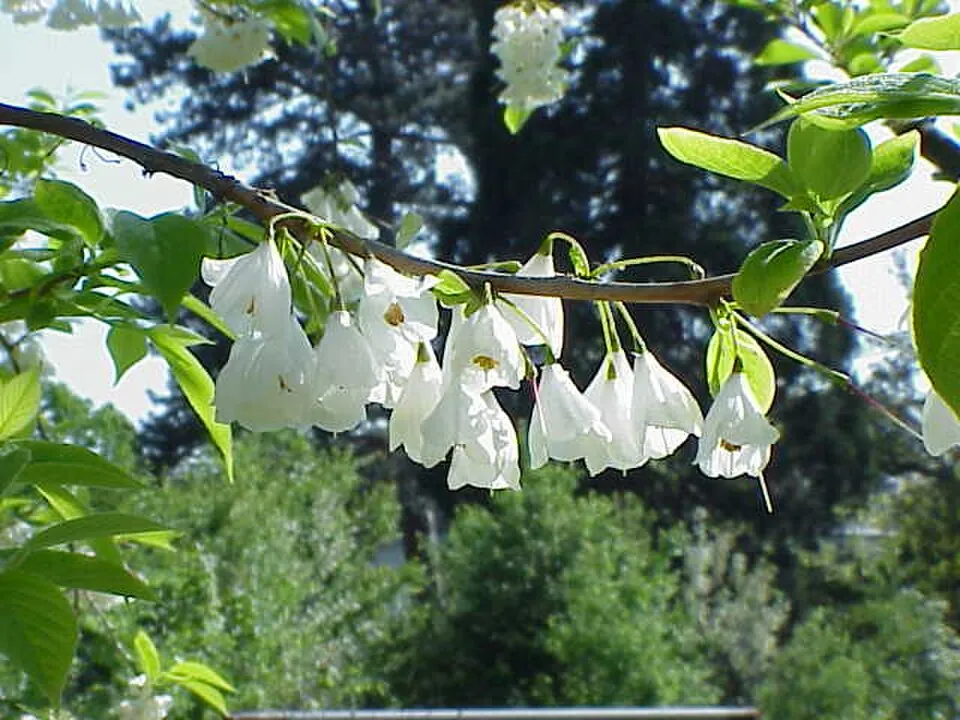
Halesia carolina, commonly known as the Carolina silverbell, is a graceful deciduous tree native to the southeastern United States, belonging to the Styracaceae family. It typically matures to a height of 30-50 feet with a moderate spread, forming an elegant, often multi-stemmed crown. Its most distinctive feature is the profusion of pendulous, bell-shaped flowers that emerge in early to mid-spring, usually white but occasionally pale pink, adorning the branches before or concurrently with the unfurling leaves. These charming blossoms, approximately 1-1.5 inches long, possess a delicate fragrance and are a significant attractant for early-season pollinators like bees.
The leaves are simple, alternate, ovate to oblong with finely serrated margins, measuring 3-6 inches in length, presenting a vibrant dark green throughout the growing season. In autumn, the foliage transforms into a soft, attractive yellow, contributing to seasonal landscape interest. Following the bloom, unique 4-winged, dry drupe fruits develop, resembling small urns or bells, which mature in fall and often persist into winter, providing additional visual appeal and sustenance for wildlife. This species thrives in moist, well-drained, acidic to neutral soils and prefers partial shade but can adapt to full sun conditions if consistent moisture is maintained.
Its relatively slow growth rate and manageable size make the Carolina silverbell an excellent choice for diverse landscape applications, from specimen plantings in residential gardens to naturalized settings and urban green spaces. The bark is smooth and light gray on younger trees, gradually developing shallow fissures and a darker hue with age.
Trusted Scientific References
1. Authoritative external sources for Halesia carolina
1.1 Wikipedia — Halesia carolina
1.2 Kew POWO (Plants of the World Online)
1.3 PubMed — peer-reviewed research
1.4 NCBI Taxonomy Browser
1.5 GBIF — Global Biodiversity
1.6Halesia Carolina should be interpreted through verified botanical identity, practical care, and responsible safety language. This recovery note adds the missing context needed for a complete profile: match light to the plant's habit, use well-drained soil, water according to season, and avoid unsupported medicinal or edible claims. For publishing, the plant can be presented as a source-backed garden plant with clear care guidance, common problem diagnosis, and conservative safety wording.
1.1.Halesia Carolina — Key Features
- ✓ <strong>Native to Southeastern United States</strong> — Thrives in its natural habitat.
- ✓ <strong>Stunning Spring Blooms</strong> — Pendulous, white to pale pink, bell-shaped flowers.
- ✓ <strong>Attractive Fall Foliage</strong> — Leaves turn a lovely yellow in autumn.
- ✓ <strong>Unique 4</strong> — Winged Fruit — Dry drupes that persist into winter.
- ✓ <strong>Pollinator Friendly</strong> — Flowers provide nectar for bees and other insects.
- ✓ <strong>Moderate Growth Rate</strong> — Reaches 30-50 feet tall, manageable size.
- ✓ <strong>Adaptable to Soil Conditions</strong> — Prefers moist, well-drained, acidic to neutral soils.
- ✓ <strong>Partial Shade to Full Sun</strong> — Tolerates varying light conditions with adequate moisture.
- ✓ <strong>Low Maintenance</strong> — Generally pest and disease resistant.
- ✓ <strong>Ornamental Value</strong> — Excellent as a specimen tree or in woodland gardens.
1.2.Halesia Carolina — Quick Summary
- ✓ Deciduous tree native to the southeastern United States.
- ✓ Renowned for its abundant, bell-shaped white flowers in spring.
- ✓ Provides ecological benefits by attracting pollinators and wildlife.
- ✓ Low maintenance and adaptable to various landscape settings.
- ✓ Exhibits attractive yellow fall foliage and persistent winged fruits.
- ✓ No documented traditional or modern medicinal uses for humans.
2.Halesia Carolina — Scientific Identity
3.Halesia Carolina — Quick Facts
4.Halesia Carolina — Appearance & Identification
5.Halesia Carolina — Native Habitat
6.Halesia Carolina — Water Requirements
- ✓ Site Selection — Choose a location with moist, well-drained, organically rich soil and protection from harsh afternoon sun for optimal growth.
- ✓ Soil Requirements — Prefers acidic to neutral pH (5.0-7.0); amend heavy clay or sandy soils with compost to improve drainage and fertility.
- ✓ Watering — Requires consistent moisture, especially during dry periods and in its establishment phase; avoid waterlogging.
- ✓ Light Exposure — Thrives in partial shade, mimicking its understory native habitat, but can tolerate full sun with adequate soil moisture.
- ✓ Planting — Dig a hole twice as wide as the root ball and just as deep; plant at the same level as it grew in the nursery pot.
- ✓ Pruning — Generally low maintenance; prune in late winter or early spring to remove dead, damaged, or crossing branches and to maintain desired shape.
- ✓ Fertilization — Apply a balanced, slow-release fertilizer in spring if soil tests indicate nutrient deficiencies, avoiding excessive nitrogen.
- ✓ Propagation — Can be propagated from fresh seeds (requiring stratification) or by softwood cuttings taken in early summer.
Reviewed by the Flora Medical Global Botanical Review Panel
Multi-disciplinary editorial group · Botany · Ethnobotany · Herbal-medicine literature
Who reviewed this: This page was checked by the Flora Medical Global Botanical Review Panel — an in-house editorial group of botany graduates, ethnobotany researchers, and horticulture practitioners who collectively maintain our 7,000+ plant encyclopedia. Meet the team.
Our 4-step verification process
1. Taxonomic verification
Scientific names and synonyms cross-checked against Kew POWO, World Flora Online, and The Plant List.
2. Phytochemical & medicinal cross-reference
Active compounds, traditional uses, and reported activities are cross-referenced with PubMed, USDA Dr. Duke's database, and peer-reviewed ethnobotanical literature.
3. Conservation & distribution check
Distribution, ecology, and conservation status confirmed against GBIF occurrence records and the IUCN Red List.
4. Editorial & safety review
Every entry passes an editorial pass for clarity, originality, and safety notices (toxicity, contraindications, dosage caveats) before publication.
Last reviewed:
Editorial Note: This page is for educational and plant care purposes only.
Written by: Flora Medical Global Editorial Team
Reviewed by: Flora Medical Global Botanical Review Panel
Last Updated: June 15, 2026







Halesia Carolina — Comments & Community Reviews
Rate this plant