
Care Disclaimer: Plant care recommendations are general guidelines based on common growing conditions. Individual results may vary based on your local environment, climate, and care routine. If your plant is toxic, keep it away from children and pets, and consult a veterinarian if accidental ingestion occurs.
1.Hedychium Garden — Overview
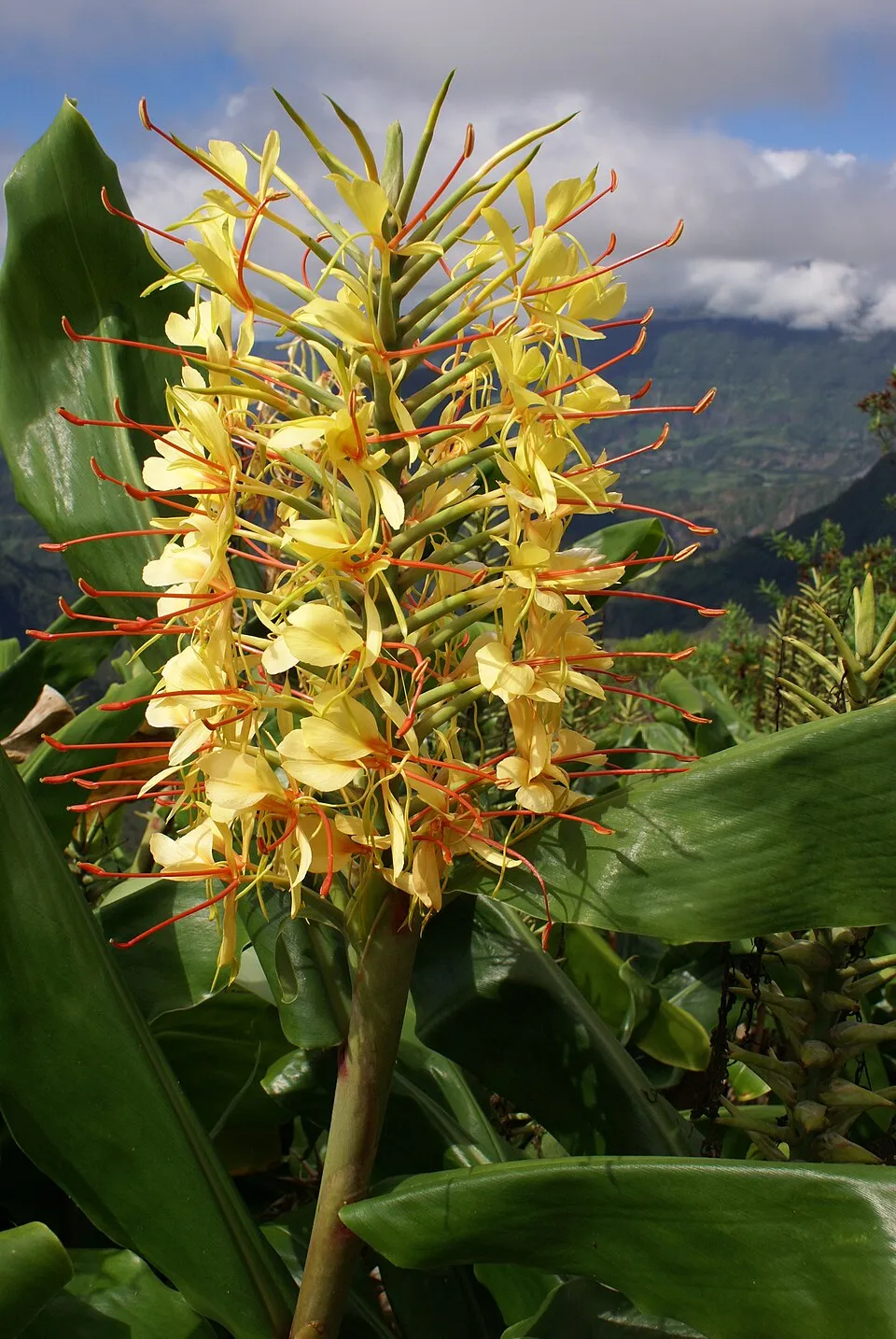
Hedychium gardnerianum, commonly known as Kahili ginger or Ginger Lily, is a striking herbaceous perennial belonging to the Zingiberaceae family, native to the moist tropical forests of the eastern Himalayas, encompassing regions of northern India, Nepal, and Bhutan. This species forms robust clumps of upright, leafy pseudostems that can reach impressive heights of 1.5 to 2.5 meters (5 to 8 feet) in optimal conditions. Its lanceolate to oblong leaves are glossy green on the upper surface, often with a powdery-white underside, and are arranged spirally along the stem, growing up to 60 cm (2 feet) long and 15 cm (6 inches) wide.
The plant is celebrated for its spectacular terminal inflorescences, which emerge in late summer to autumn. These erect, dense spikes, typically 45-60 cm (1.5-2 feet) tall, are densely packed with bright orange-red bracts. From these bracts, numerous pure white to pale yellow flowers unfurl, each featuring a prominent, long, bright orange-red stamen and a distinctive two-lobed, spoon-shaped labellum often tinged orange.
The flowers emit a strong, sweet, and spicy fragrance, reminiscent of jasmine or gardenia, making it a highly valued ornamental plant in tropical and subtropical gardens globally. After successful pollination, it produces thin-walled, three-valved orange capsules that split open to reveal small, sticky, shiny bright red seeds, which are dispersed by birds and mammals, contributing to its naturalization in areas like the Caribbean and Hawaii, where it can sometimes become an invasive species.
Trusted Scientific References
1. Authoritative external sources for Hedychium gardnerianum
1.1 Wikipedia — Hedychium gardnerianum
1.2 Kew POWO (Plants of the World Online)
1.3 PubMed — peer-reviewed research
1.4 NCBI Taxonomy Browser
1.5 GBIF — Global Biodiversity
1.6Hedychium Garden should be interpreted through verified botanical identity, practical care, and responsible safety language. This recovery note adds the missing context needed for a complete profile: match light to the plant's habit, use well-drained soil, water according to season, and avoid unsupported medicinal or edible claims. For publishing, the plant can be presented as a source-backed garden plant with clear care guidance, common problem diagnosis, and conservative safety wording.
1.1.Hedychium Garden — Key Features
- ✓ <strong>Botanical Family</strong> — Member of the Zingiberaceae (ginger) family.
- ✓ <strong>Native Range</strong> — Indigenous to the eastern Himalayas (India, Nepal, Bhutan).
- ✓ <strong>Distinctive Flowers</strong> — Features showy, fragrant yellow flowers with prominent orange-red stamens and a unique labellum.
- ✓ <strong>Rhizomatous Perennial</strong> — Grows from thick, underground rhizomes, forming dense clumps.
- ✓ <strong>Aromatic Qualities</strong> — Emits a strong, sweet, and spicy fragrance, highly prized in gardens.
- ✓ <strong>Medicinal Uses</strong> — Traditionally employed for anti-inflammatory, analgesic, and digestive support.
- ✓ <strong>Ornamental Value</strong> — Widely cultivated globally for its dramatic foliage and spectacular floral display.
- ✓ <strong>Invasive Potential</strong> — Recognized as an invasive species in some tropical and subtropical regions due to vigorous growth and seed dispersal.
- ✓ <strong>Pseudostems</strong> — Produces tall, upright pseudostems formed by clasping leaf bases.
- ✓ <strong>Adaptable Growth</strong> — Can be grown in containers in cooler climates and overwintered indoors.
1.2.Hedychium Garden — Quick Summary
- ✓ Hedychium gardnerianum is a fragrant, ornamental perennial from the Himalayas, known for its showy yellow and red flowers.
- ✓ Its rhizomes are traditionally valued for anti-inflammatory, analgesic, and digestive properties.
- ✓ Key active compounds include diarylheptanoids, essential oils, and sesquiterpenes.
- ✓ Cultivated for its dramatic appearance, it requires warm, humid conditions and can be grown in containers.
- ✓ Caution is advised for pregnant individuals, those on blood thinners, and against its invasive potential in certain ecosystems.
2.Hedychium Garden — Scientific Identity
3.Hedychium Garden — Quick Facts
4.Hedychium Garden — Appearance & Identification
5.Hedychium Garden — Native Habitat
6.Hedychium Garden — Water Requirements
- ✓ Climate — Thrives in warm, humid tropical and subtropical climates (USDA Zones 8-11), requiring protection from frost in colder regions.
- ✓ Light — Prefers partial shade to full sun; full sun is often beneficial in cooler climates for optimal blooming, while partial shade is better in intense tropical sun.
- ✓ Soil — Requires rich, consistently moist, well-drained soil with a slightly acidic to neutral pH, enriched with organic matter.
- ✓ Watering — Needs plentiful and regular watering throughout the growing season, but avoid waterlogging; tolerates short periods of drought.
- ✓ Fertilization — Fertilize regularly during the active growing season (spring to late summer) with a balanced, slow-release granular fertilizer or liquid feed.
- ✓ Container Culture — In non-tropical zones, grow in large, sturdy containers to accommodate its vigorous rhizomatous growth, bringing indoors before the first frost.
- ✓ Propagation — Easily propagated by division of rhizomes in spring, ensuring each section has one or more growing tips; can also be grown from seed, though flowering takes several years.
- ✓ Overwintering — In cold climates, cut back foliage after frost, lift rhizomes, and store dormant in a cool, frost-free place, or overwinter potted plants indoors in a bright location.
Reviewed by the Flora Medical Global Botanical Review Panel
Multi-disciplinary editorial group · Botany · Ethnobotany · Herbal-medicine literature
Who reviewed this: This page was checked by the Flora Medical Global Botanical Review Panel — an in-house editorial group of botany graduates, ethnobotany researchers, and horticulture practitioners who collectively maintain our 7,000+ plant encyclopedia. Meet the team.
Our 4-step verification process
1. Taxonomic verification
Scientific names and synonyms cross-checked against Kew POWO, World Flora Online, and The Plant List.
2. Phytochemical & medicinal cross-reference
Active compounds, traditional uses, and reported activities are cross-referenced with PubMed, USDA Dr. Duke's database, and peer-reviewed ethnobotanical literature.
3. Conservation & distribution check
Distribution, ecology, and conservation status confirmed against GBIF occurrence records and the IUCN Red List.
4. Editorial & safety review
Every entry passes an editorial pass for clarity, originality, and safety notices (toxicity, contraindications, dosage caveats) before publication.
Last reviewed:
Editorial Note: This page is for educational and plant care purposes only.
Written by: Flora Medical Global Editorial Team
Reviewed by: Flora Medical Global Botanical Review Panel
Last Updated: June 15, 2026







Hedychium Garden — Comments & Community Reviews
Rate this plant