

Care Disclaimer: Plant care recommendations are general guidelines based on common growing conditions. Individual results may vary based on your local environment, climate, and care routine. If your plant is toxic, keep it away from children and pets, and consult a veterinarian if accidental ingestion occurs.
1.Hesperaloe Parviflora — Overview
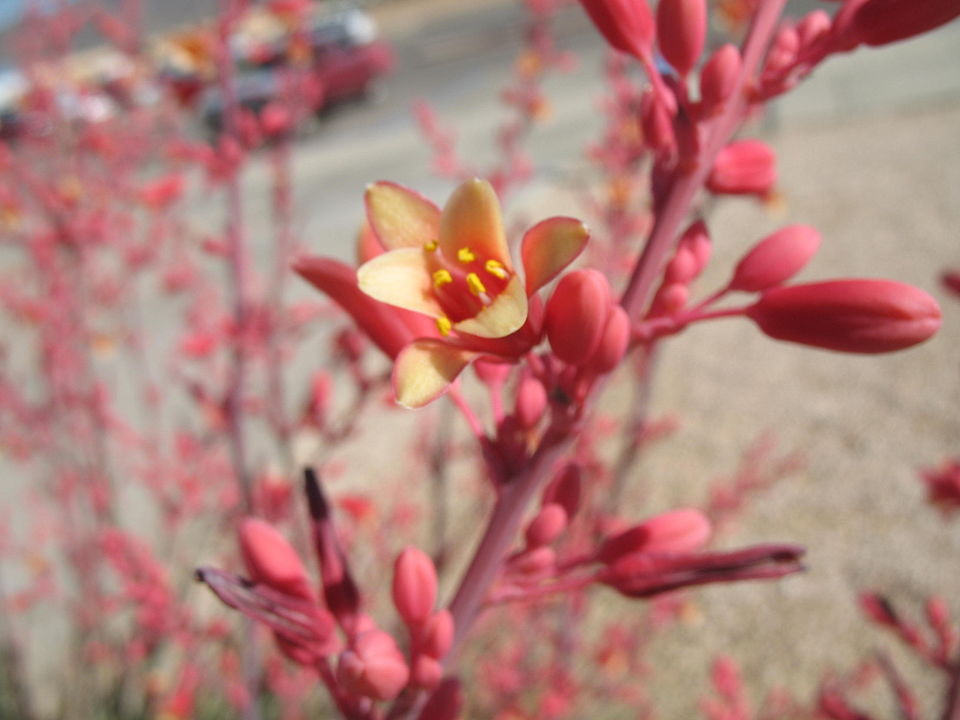
Hesperaloe parviflora, commonly recognized as Red Yucca or Hummingbird Yucca, is a distinctive succulent originating from the Chihuahuan Desert, spanning northern Mexico and the southwestern United States. Despite its common appellation, it is not a true Yucca but belongs to the genus Hesperaloe within the Asparagaceae family, a classification that highlights its unique botanical identity.
This remarkably resilient plant is celebrated for its exceptional drought tolerance, striking ornamental appeal, and the prolonged, vibrant floral display it produces, making it a staple in arid and xeriscape landscapes.
Morphologically, Hesperaloe parviflora forms an elegant rosette of long, narrow, strap-like, blue-green leaves, which typically reach a height of 3 to 4 feet and spread to a similar width. The foliage often acquires a reddish or purplish tint, particularly under cold temperatures or drought conditions, adding to its visual interest.
Unlike many true yuccas, its leaf margins are smooth or only finely serrated, lacking the sharp, terminal spines, thus presenting a safer option for gardens frequented by children or pets. The overall growth habit is fountain-like, contributing an architectural grace to its surroundings.
The plant's most captivating feature is its impressive, towering flower spikes, which ascend from the center of the rosette to heights of 5 to 8 feet. These inflorescences are adorned with numerous tubular, pendulous flowers, typically showcasing shades of coral-red or orange-red, though cultivated varieties may exhibit pink, yellow, or white blooms.
The flowering period is notably extended, often commencing in late spring and persisting through fall, providing a continuous, rich source of nectar that is highly attractive to hummingbirds, bees, and various other pollinators, hence its "Hummingbird Yucca" moniker. These densely clustered flowers create a dramatic visual spectacle against the backdrop of its evergreen foliage.
Trusted Scientific References
1. Authoritative external sources for Hesperaloe Parviflora
1.1 Wikipedia — Hesperaloe Parviflora
1.2 Kew POWO (Plants of the World Online)
1.3 PubMed — peer-reviewed research
1.4 NCBI Taxonomy Browser
1.5 GBIF — Global Biodiversity
1.1.Hesperaloe Parviflora — Key Features
- ✓ <strong>Drought</strong> — Tolerant — Exceptional ability to withstand prolonged dry periods, ideal for arid landscapes.
- ✓ <strong>Low</strong> — Maintenance — Requires minimal care once established, including infrequent watering and light pruning.
- ✓ <strong>Hummingbird Attractor</strong> — Its vibrant, tubular flowers are a continuous and favored nectar source for hummingbirds.
- ✓ <strong>Architectural Foliage</strong> — Forms an elegant rosette of strap-like, blue-green leaves, providing year-round structure.
- ✓ <strong>Long Blooming Season</strong> — Produces flower spikes from late spring through fall, offering extended visual appeal.
- ✓ <strong>Deer</strong> — Resistant — Naturally unpalatable to deer, making it suitable for gardens in areas with deer activity.
- ✓ <strong>Heat and Cold Tolerant</strong> — Resilient across USDA zones 5-10, enduring extreme temperatures.
- ✓ <strong>Non</strong> — Spiky Leaves — Lacks the sharp, spiky tips of true Yuccas, making it safer for families and pets.
- ✓ <strong>Xeriscape Essential</strong> — A cornerstone plant for water-wise and sustainable garden designs.
- ✓ <strong>Evergreen Perennial</strong> — Provides consistent green interest throughout the year.
1.2.Hesperaloe Parviflora — Quick Summary
- ✓ Hesperaloe parviflora, or Red Yucca, is a striking, drought-tolerant succulent native to the Chihuahuan Desert.
- ✓ Known for its architectural, fountain-like form and long-lasting coral-red flower spikes that attract hummingbirds.
- ✓ Not a true Yucca, it belongs to the Asparagaceae family and is highly valued for xeriscaping and low-maintenance gardens.
- ✓ Requires full sun and well-drained soil, thriving in arid conditions with minimal watering once established.
- ✓ Primarily an ornamental and ecological plant; no significant documented traditional or modern medicinal uses.
- ✓ Generally considered safe for humans and pets, with low toxicity and deer resistance.
2.Hesperaloe Parviflora — Scientific Identity
3.Hesperaloe Parviflora — Quick Facts
4.Hesperaloe Parviflora — Appearance & Identification
5.Hesperaloe Parviflora — Native Habitat
6.Hesperaloe Parviflora — Water Requirements
- Hesperaloe parviflora, or Red Yucca, is exceptionally low-maintenance and thrives in conditions mimicking its native Chihuahuan Desert habitat.
- ✓ Site Selection — Choose a location receiving at least 6 hours of direct sunlight daily; full sun ensures robust growth and prolific flowering.
- ✓ Soil Requirements — Prefers well-drained soil; highly adaptable to rocky, sandy, or lean soils, but proper drainage is critical to prevent root rot.
- ✓ Planting Procedure — Dig a hole twice as wide as the root ball and just as deep; position the plant so the top of the root ball is level with the surrounding soil.
- ✓ Spacing — For mass plantings or borders, space plants approximately 3 feet apart to accommodate their mature width of 3 to 4 feet, allowing for offset development.
- ✓ Watering Regimen — Water thoroughly after planting for establishment; once established, it is highly drought-tolerant, requiring infrequent deep watering (every 2-3 weeks in dry climates, less in temperate areas). Avoid overwatering.
- ✓ Fertilization — Minimal feeding is needed; a light application of a balanced, slow-release fertilizer in early spring can encourage healthy growth and blooming.
- ✓ Pruning — Pruning is generally minimal, focusing on removing spent flower stalks at their base and trimming away any dead or damaged leaves to maintain a tidy appearance.
- ✓ Hardiness Zones — Resilient in USDA zones 5-10, capable of tolerating both extreme heat and significant cold.
Reviewed by the Flora Medical Global Botanical Review Panel
Multi-disciplinary editorial group · Botany · Ethnobotany · Herbal-medicine literature
Who reviewed this: This page was checked by the Flora Medical Global Botanical Review Panel — an in-house editorial group of botany graduates, ethnobotany researchers, and horticulture practitioners who collectively maintain our 7,000+ plant encyclopedia. Meet the team.
Our 4-step verification process
1. Taxonomic verification
Scientific names and synonyms cross-checked against Kew POWO, World Flora Online, and The Plant List.
2. Phytochemical & medicinal cross-reference
Active compounds, traditional uses, and reported activities are cross-referenced with PubMed, USDA Dr. Duke's database, and peer-reviewed ethnobotanical literature.
3. Conservation & distribution check
Distribution, ecology, and conservation status confirmed against GBIF occurrence records and the IUCN Red List.
4. Editorial & safety review
Every entry passes an editorial pass for clarity, originality, and safety notices (toxicity, contraindications, dosage caveats) before publication.
Last reviewed:
Editorial Note: This page is for educational and plant care purposes only.
Written by: Flora Medical Global Editorial Team
Reviewed by: Flora Medical Global Botanical Review Panel
Last Updated: June 15, 2026







Hesperaloe Parviflora — Comments & Community Reviews
Rate this plant