


Care Disclaimer: Plant care recommendations are general guidelines based on common growing conditions. Individual results may vary based on your local environment, climate, and care routine. If your plant is toxic, keep it away from children and pets, and consult a veterinarian if accidental ingestion occurs.
1.Holly — Overview
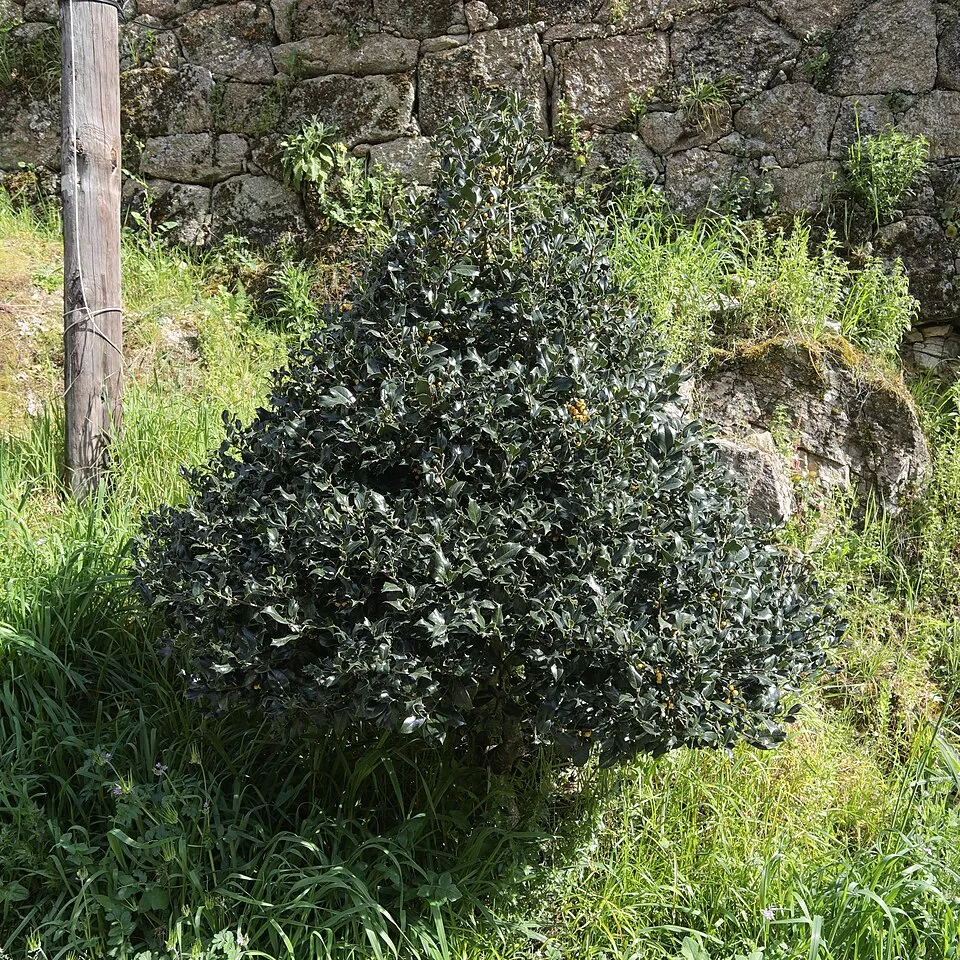
Ilex aquifolium, widely recognized as the common holly, European holly, or English holly, is a distinguished species of flowering plant belonging to the family Aquifoliaceae. This iconic evergreen tree or shrub is indigenous to western and southern Europe, including the Azores, and extends into northwestern Africa. It is instantly identifiable by its striking glossy, dark green, and notably leathery leaves, which typically present an ovate or elliptical shape with sharply spiny margins. These spines, while contributing to its distinctive aesthetic, primarily function as a robust deterrent against herbivores, safeguarding the plant from grazing. The growth habit of Ilex aquifolium is remarkably variable, ranging from a dense, compact shrub to a majestic, towering tree that can reach impressive heights of up to 25 meters (82 feet) with a trunk diameter of up to 1 meter (3.3 feet).
The bark is characteristically smooth and grey in its younger stages, gradually developing fissures and a rougher texture with advancing age. Holly is a dioecious species, meaning that its male and female flowers are borne on separate individual plants. The small, often inconspicuous flowers, which bloom in late spring and early summer, are typically white or greenish-white and arranged in cymose clusters. These flowers are primarily pollinated by insects, particularly bees and flies. However, the true visual spectacle of Ilex aquifolium emerges in autumn and persists through winter with the development of its vibrant berries.
These are bright red, spherical drupes, generally measuring between 6-10 mm in diameter. Female plants, provided they are pollinated by a nearby male specimen, produce a profusion of these eye-catching berries, which remain on the branches throughout the winter, serving as a crucial food source for various bird species and other wildlife. The wood of the holly tree is prized for being hard, white, and fine-grained, and has been historically utilized in intricate inlay work, carving, and the fabrication of small, specialized articles. It is critical to note that despite their attractive appearance, the leaves and berries of Ilex aquifolium are toxic if ingested in substantial quantities, particularly to humans and pets, primarily due to the presence of triterpenoid saponins and other compounds. Trusted Scientific References Authoritative external sources for Ilex aquifolium : Wikipedia — Ilex aquifolium Kew POWO (Plants of the World Online) PubMed — peer-revie ...[CURRENT TEXT EXISTS: 2561 chars]
1.1.Holly — Key Features
- ✓ <strong>Iconic Evergreen Foliage</strong> — Distinctive glossy, dark green, leathery leaves with characteristic sharp, spiny margins.
- ✓ <strong>Striking Winter Berries</strong> — Abundant, bright red, globular drupes produced by female plants, providing visual appeal and wildlife food throughout winter.
- ✓ <strong>Dioecious Reproduction</strong> — Requires separate male and female plants in proximity for successful pollination and subsequent fruit set.
- ✓ <strong>Native European Distribution</strong> — Indigenous to Western and Southern Europe, the Azores, and northwestern Africa.
- ✓ <strong>High Ornamental Value</strong> — Widely prized for its aesthetic contributions to landscape design, used for hedging, screening, and as specimen plants.
- ✓ <strong>Hard, Fine</strong> — Grained Wood — Historically utilized for intricate carving, inlay work, and the manufacture of specialized small articles.
- ✓ <strong>Wildlife Food Source</strong> — Its persistent winter berries serve as a crucial food supply for various bird species and other wildlife.
- ✓ <strong>Contains Toxic Saponins</strong> — The primary chemical constituents, triterpenoid saponins, are responsible for the plant's toxicity upon ingestion.
- ✓ <strong>Adaptable Growth Habit</strong> — Exhibits a versatile growth form, ranging from a dense, bushy shrub to a tall, stately tree.
- ✓ <strong>Low Maintenance Once Established</strong> — Relatively easy to cultivate and care for in suitable environmental conditions.
1.2.Holly — Quick Summary
- ✓ Ilex aquifolium, or European Holly, is an evergreen tree or shrub recognized by its glossy, spiny leaves and vibrant red winter berries.
- ✓ All components of the plant, especially the berries, are toxic if ingested due to the presence of triterpenoid saponins.
- ✓ Historically, it was used in folk medicine as an emetic, purgative, and for fevers, but these practices are dangerous and not recommended today.
- ✓ Primarily valued as an ornamental plant for landscaping and its hard, fine-grained wood is used in crafting.
- ✓ Requires full sun to partial shade, well-draining acidic soil, and both male and female plants for successful berry production.
- ✓ Ingestion can lead to severe gastrointestinal distress and other serious symptoms; immediate medical attention is essential.
2.Holly — Scientific Identity
3.Holly — Quick Facts
4.Holly — Appearance & Identification
5.Holly — Native Habitat
6.Holly — Water Requirements
- ✓ Site Selection — Choose a location offering full sun to partial shade; full sun promotes the most abundant berry production for Ilex aquifolium.
- ✓ Soil Requirements — Holly thrives in rich, consistently well-draining soil with a slightly acidic pH, ideally between 5.0 and 6.5.
- ✓ Planting Procedure — Dig a planting hole that is twice as wide as the root ball and slightly deeper, ensuring the top of the root ball is level with or slightly above the surrounding soil.
- ✓ Watering Regimen — Maintain evenly moist soil, especially during the plant's establishment phase; avoid waterlogging to prevent the development of root rot.
- ✓ Fertilization Schedule — Apply a slow-release fertilizer specifically formulated for acid-loving trees and shrubs in early spring and again in the fall to support vigorous growth.
- ✓ Pruning Practices — Generally, Ilex aquifolium requires minimal pruning; focus on removing any dead, diseased, or crossing branches and light shaping to maintain its natural form, ideally performed in late winter or early spring.
- ✓ Pollination Needs — As a dioecious species, both male and female Holly plants must be grown in relatively close proximity to ensure successful pollination and the subsequent production of berries on female plants.
- ✓ Container Growing — Holly can be successfully cultivated in large containers, provided they have adequate drainage holes and are filled with a high-quality, all-purpose potting mix.
Reviewed by the Flora Medical Global Botanical Review Panel
Multi-disciplinary editorial group · Botany · Ethnobotany · Herbal-medicine literature
Who reviewed this: This page was checked by the Flora Medical Global Botanical Review Panel — an in-house editorial group of botany graduates, ethnobotany researchers, and horticulture practitioners who collectively maintain our 7,000+ plant encyclopedia. Meet the team.
Our 4-step verification process
1. Taxonomic verification
Scientific names and synonyms cross-checked against Kew POWO, World Flora Online, and The Plant List.
2. Phytochemical & medicinal cross-reference
Active compounds, traditional uses, and reported activities are cross-referenced with PubMed, USDA Dr. Duke's database, and peer-reviewed ethnobotanical literature.
3. Conservation & distribution check
Distribution, ecology, and conservation status confirmed against GBIF occurrence records and the IUCN Red List.
4. Editorial & safety review
Every entry passes an editorial pass for clarity, originality, and safety notices (toxicity, contraindications, dosage caveats) before publication.
Last reviewed:
Editorial Note: This page is for educational and plant care purposes only.
Written by: Flora Medical Global Editorial Team
Reviewed by: Flora Medical Global Botanical Review Panel
Last Updated: June 15, 2026







Holly — Comments & Community Reviews
Rate this plant