
Care Disclaimer: Plant care recommendations are general guidelines based on common growing conditions. Individual results may vary based on your local environment, climate, and care routine. If your plant is toxic, keep it away from children and pets, and consult a veterinarian if accidental ingestion occurs.
1.Hosta Sum and Substance — Overview
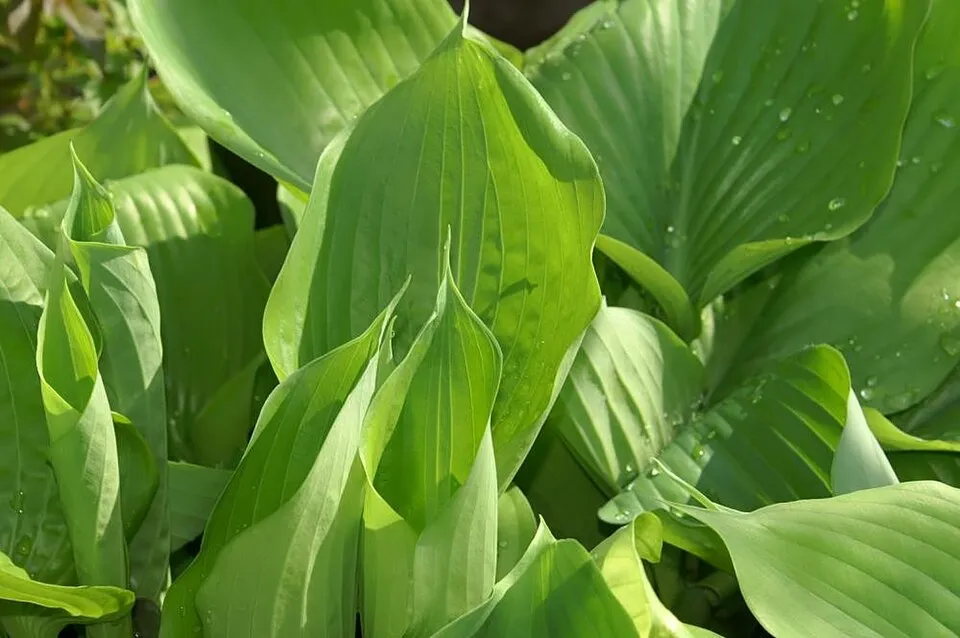
Hosta 'Sum and Substance' stands as a truly iconic and highly coveted cultivar within the genus Hosta, celebrated for its remarkable, colossal stature and visually arresting foliage. This herbaceous perennial asserts a dramatic presence in garden landscapes, characterized by its massive, deeply veined, heart-shaped to broadly ovate leaves that unfurl in hues ranging from vibrant chartreuse to a rich, luminous gold. These impressive leaves can effortlessly exceed a foot in both length and width, contributing to a lush, architectural aesthetic.
Emerging in spring with a brighter yellow-green, the foliage color deepens and intensifies to a richer gold as the growing season progresses, particularly when exposed to some morning sunlight. During mid to late summer, robust, tall scapes ascend from the dense, mounded form, showcasing delicate, bell-shaped flowers in shades of lavender to near-white, which are known to attract hummingbirds. Beyond its immense ornamental appeal, 'Sum and Substance' is highly valued for its exceptional vigor, robust growth, and notable resistance to common Hosta pests and diseases, ensuring its longevity and reliability as a cornerstone in shade garden designs.
Its imposing size and sturdy nature make it an ideal focal point, an effective groundcover for expansive areas, or a magnificent specimen plant in a tranquil woodland setting. Despite its grand scale, this cultivar maintains an inherent grace, offering continuous beauty from the spring thaw until the arrival of the first hard frost. Taxonomically, Hosta belongs to the family Asparagaceae, though historically it was placed in Funkiaceae or Liliaceae.
Trusted Scientific References
1. Authoritative external sources for Hosta Sum and Substance
1.1 Wikipedia — Hosta Sum and Substance
1.2 Kew POWO (Plants of the World Online)
1.3 PubMed — peer-reviewed research
1.4 NCBI Taxonomy Browser
1.5 GBIF — Global Biodiversity
1.6Hosta Sum and Substance should be interpreted through verified botanical identity, practical care, and responsible safety language. This recovery note adds the missing context needed for a complete profile: match light to the plant's habit, use well-drained soil, water according to season, and avoid unsupported medicinal or edible claims. For publishing, the plant can be presented as a source-backed garden plant with clear care guidance, common problem diagnosis, and conservative safety wording.
1.1.Hosta Sum and Substance — Key Features
- ✓ <strong>Massive, broadly ovate,</strong> — Massive, broadly ovate, deeply corrugated leaves, often exceeding 16 inches in length.
- ✓ <strong>Foliage color transitions</strong> — Foliage color transitions from bright chartreuse to rich gold, intensifying with some morning sun.
- ✓ <strong>Produces tall, sturdy</strong> — Produces tall, sturdy scapes bearing delicate lavender to near-white, bell-shaped flowers.
- ✓ <strong>Exhibits exceptional vigor</strong> — Exhibits exceptional vigor and a robust, mounded growth habit, reaching up to 3 feet tall and 6 feet wide.
- ✓ <strong>Known for good</strong> — Known for good resistance to common Hosta pests, including slugs.
- ✓ <strong>An award</strong> — winning cultivar, notably American Hosta Growers' Association Hosta of the Year 2004.
- ✓ <strong>Hardy in a</strong> — Hardy in a wide range of climates, typically USDA Zones 3 through 9.
- ✓ <strong>Prefers partial to</strong> — Prefers partial to full shade conditions but tolerates a few hours of morning sun for best color.
- ✓ <strong>Non</strong> — native to North America, but widely cultivated globally as a premier ornamental shade perennial.
- ✓ <strong>Contains toxic saponins,</strong> — Contains toxic saponins, making all plant parts harmful if ingested by humans or pets.
1.2.Hosta Sum and Substance — Quick Summary
- ✓ Colossal ornamental Hosta cultivar celebrated for its striking chartreuse to gold foliage.
- ✓ Prized for its massive size, exceptional vigor, and architectural presence in shade gardens.
- ✓ Contains saponins, rendering all parts of the plant toxic if ingested by humans or animals.
- ✓ No known medicinal benefits or traditional therapeutic uses for humans; strictly ornamental.
- ✓ Thrives in partial to full shade with moist, well-drained, organic-rich soil and consistent watering.
- ✓ Ideal as a focal point, specimen plant, or large-scale groundcover in appropriate landscape designs.
2.Hosta Sum and Substance — Scientific Identity
3.Hosta Sum and Substance — Quick Facts
4.Hosta Sum and Substance — Appearance & Identification
5.Hosta Sum and Substance — Native Habitat
6.Hosta Sum and Substance — Water Requirements
- ✓ Soil Requirements — Thrives in rich, moist, well-drained, highly organic soils with a pH between 5.5 and 7.5; sandy loam is preferred over heavy clay for optimal root aeration.
- ✓ Light Conditions — Prefers partial to full shade, with beneficial morning sun exposure to intensify its chartreuse to gold leaf coloration; strictly avoid hot afternoon sun to prevent leaf scorch.
- ✓ Water Needs — Requires consistent soil moisture, especially during the active growing season; allow the top layer of soil to dry out slightly between waterings to encourage healthy root development.
- ✓ Fertilization — Benefits from an annual application of a balanced slow-release granular fertilizer in early spring, or a light liquid feed; avoid excessive nitrogen application in the fall to prepare for dormancy.
- ✓ Pest and Disease Management — Monitor diligently for slugs and snails, which can cause characteristic holes in leaves; implement good garden sanitation and apply slug bait as needed; protect against rodents like mice and voles.
- ✓ Winter Care — In colder USDA zones, apply a protective layer of finely shredded organic mulch to prevent winter heaving; ensure all dormant hosta foliage is removed in late fall to eliminate overwintering sites for pests.
- ✓ Propagation — Easily propagated through division in early spring or early fall, ensuring each separated section contains at least three 'eyes' or growth points for vigorous establishment.
- ✓ Spacing — Given its mature size of 3 feet tall and 5-6 feet wide, provide ample spacing (at least 5 feet) between plants to ensure good air circulation and allow for full development.
Reviewed by the Flora Medical Global Botanical Review Panel
Multi-disciplinary editorial group · Botany · Ethnobotany · Herbal-medicine literature
Who reviewed this: This page was checked by the Flora Medical Global Botanical Review Panel — an in-house editorial group of botany graduates, ethnobotany researchers, and horticulture practitioners who collectively maintain our 7,000+ plant encyclopedia. Meet the team.
Our 4-step verification process
1. Taxonomic verification
Scientific names and synonyms cross-checked against Kew POWO, World Flora Online, and The Plant List.
2. Phytochemical & medicinal cross-reference
Active compounds, traditional uses, and reported activities are cross-referenced with PubMed, USDA Dr. Duke's database, and peer-reviewed ethnobotanical literature.
3. Conservation & distribution check
Distribution, ecology, and conservation status confirmed against GBIF occurrence records and the IUCN Red List.
4. Editorial & safety review
Every entry passes an editorial pass for clarity, originality, and safety notices (toxicity, contraindications, dosage caveats) before publication.
Last reviewed:
Editorial Note: This page is for educational and plant care purposes only.
Written by: Flora Medical Global Editorial Team
Reviewed by: Flora Medical Global Botanical Review Panel
Last Updated: June 15, 2026







Hosta Sum and Substance — Comments & Community Reviews
Rate this plant