


Care Disclaimer: Plant care recommendations are general guidelines based on common growing conditions. Individual results may vary based on your local environment, climate, and care routine. If your plant is toxic, keep it away from children and pets, and consult a veterinarian if accidental ingestion occurs.
1.Illicium Anisatum — Overview
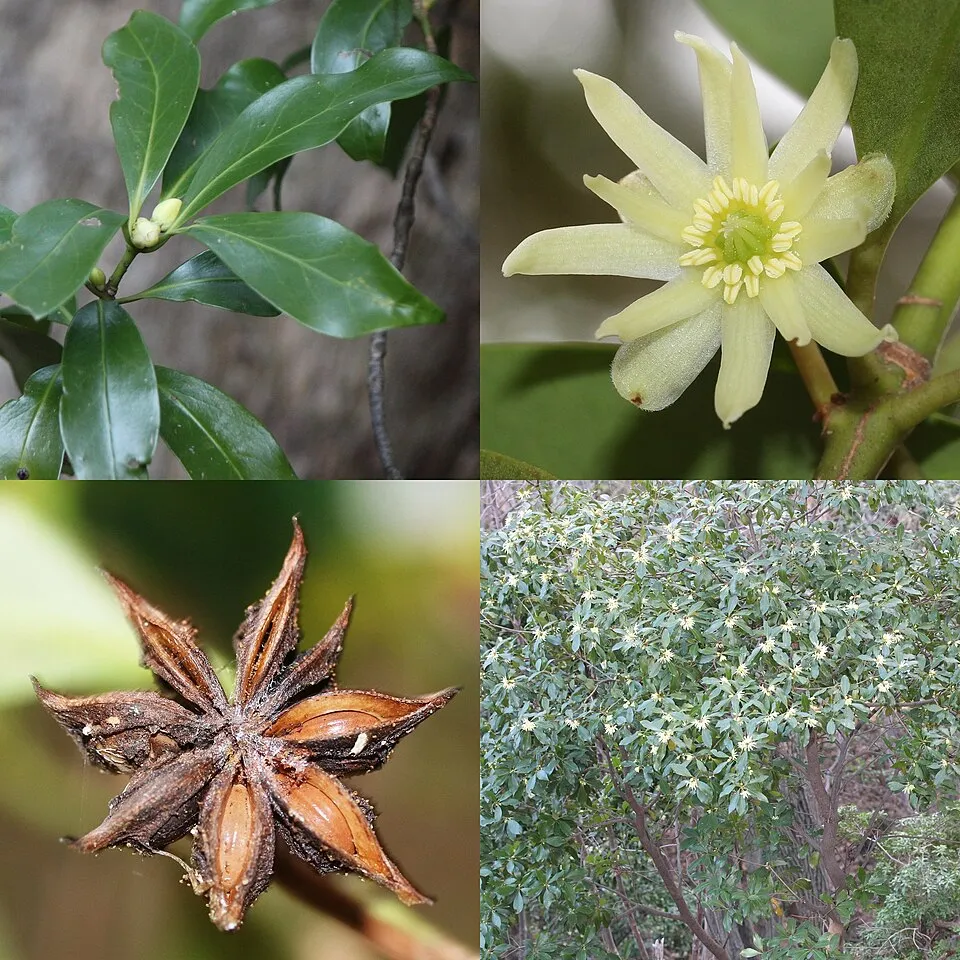
Illicium anisatum, commonly known as Japanese star anise or Shikimi, is an evergreen perennial shrub or small tree native to East Asia, primarily Japan, Korea, Taiwan, and parts of China, where it thrives in temperate to subtropical forests. Belonging to the family Schisandraceae, this plant typically attains a height of 1.5 to 4 meters, forming a dense, rounded canopy. Its bark is initially light brown, gradually developing a scaly or flaky, grayish texture with age.
The foliage consists of lustrous, dark green, lanceolate to oblanceolate leaves, approximately 7 to 15 cm long, arranged alternately. When crushed, these leaves emit a faint, anise-like fragrance, a characteristic that often leads to its dangerous confusion with the culinary Illicium verum.
In early to mid-spring, Illicium anisatum produces small, solitary or clustered pale yellow to greenish-yellow flowers, distinguished by their star-like morphology with numerous petals. Following pollination, it develops woody, star-shaped fruit pods, typically brown, composed of several distinct follicles spirally arranged, each containing a single glossy, brown seed.
This species prefers moist, well-drained, acidic to neutral soils and thrives in shaded or partially shaded forest understories, benefiting from dappled sunlight and consistent humidity. A crucial taxonomic distinction must be made between Illicium anisatum and Illicium verum, the true star anise, as the former is highly toxic and potentially fatal if ingested.
Trusted Scientific References
1. Authoritative external sources for Illicium anisatum
1.1 Wikipedia — Illicium anisatum
1.2 Kew POWO (Plants of the World Online)
1.3 PubMed — peer-reviewed research
1.4 NCBI Taxonomy Browser
1.5 GBIF — Global Biodiversity
1.6Illicium Anisatum should be interpreted through verified botanical identity, practical care, and responsible safety language. This recovery note adds the missing context needed for a complete profile: match light to the plant's habit, use well-drained soil, water according to season, and avoid unsupported medicinal or edible claims. For publishing, the plant can be presented as a source-backed garden plant with clear care guidance, common problem diagnosis, and conservative safety wording.
1.1.Illicium Anisatum — Key Features
- ✓ <strong>Highly Toxic Species</strong> — Contains potent neurotoxins, making it fatal if ingested by humans or animals.
- ✓ <strong>Evergreen Shrub/Small Tree</strong> — Maintains lustrous dark green foliage year-round, providing continuous visual interest.
- ✓ <strong>Star</strong> — Shaped Fruit Pods — Distinctive woody brown fruits, similar in shape to edible star anise but highly poisonous.
- ✓ <strong>Anise</strong> — Scented Leaves — Crushed leaves emit a faint anise-like aroma, often leading to dangerous confusion with culinary star anise.
- ✓ <strong>Pale Yellow to Greenish Flowers</strong> — Small, star-like flowers appearing in early to mid-spring, contrasting with the reddish flowers of Illicium verum.
- ✓ <strong>Native to East Asia</strong> — Naturally found in temperate to subtropical regions of Japan, Korea, Taiwan, and parts of China.
- ✓ <strong>Ornamental Plant</strong> — Valued primarily for its aesthetic appeal in gardens and landscapes, not for medicinal or culinary use.
- ✓ <strong>Crucial Identification</strong> — Requires careful and accurate distinction from the non-toxic, culinary Illicium verum to prevent poisoning.
- ✓ <strong>Contains Anisatin</strong> — A primary neurotoxin responsible for its severe toxicity and central nervous system effects.
- ✓ <strong>Prefers Shaded, Moist Conditions</strong> — Thrives as an understory plant in well-drained, acidic to neutral soils with consistent humidity.
1.2.Illicium Anisatum — Quick Summary
- ✓ Highly Toxic Plant — Japanese star anise (Illicium anisatum) is severely poisonous if ingested, causing neurological and gastrointestinal distress.
- ✓ Distinct from Edible Star Anise — Crucially different from Illicium verum, the culinary spice, despite similar appearance and common name, posing a significant risk of misidentification.
- ✓ Aromatic but Not for Consumption — Possesses an anise-like aroma, valued for external aromatic uses like potpourri and incense, never for internal consumption.
- ✓ Ornamental Value — Cultivated primarily as an attractive evergreen shrub or small tree for its unique foliage, flowers, and distinctive fruit pods in landscaping.
- ✓ Neurotoxic Compounds — Contains potent neurotoxins like Anisatin, Shikimin, and Illicinone, responsible for its severe health risks upon ingestion.
- ✓ Caution is Paramount — Requires strict identification and handling precautions to prevent accidental poisoning, especially with children and pets, due to its fatal potential.
2.Illicium Anisatum — Scientific Identity
3.Illicium Anisatum — Quick Facts
4.Illicium Anisatum — Appearance & Identification
5.Illicium Anisatum — Native Habitat
6.Illicium Anisatum — Water Requirements
- ✓ Climate Preference — Thrives in subtropical to warm temperate climates, ideally USDA zones 7-9, requiring protection from hard frosts, especially when young.
- ✓ Light Requirements — Prefers dappled shade to partial shade, particularly in the afternoon, mimicking its natural understory habitat; direct, intense sunlight can scorch leaves.
- ✓ Soil Conditions — Requires rich, loamy, well-draining soil with a slightly acidic to neutral pH (6.0-7.5); incorporating organic matter like compost is highly beneficial.
- ✓ Watering — Maintain consistently moist soil, especially during warmer months, but strictly avoid waterlogging; reduce watering frequency in winter as the plant's metabolic activity slows.
- ✓ Protection from Wind — Benefits significantly from sheltered locations, as strong, dry winds can damage its lustrous foliage and overall structural integrity.
- ✓ Pruning — Minimal pruning is needed, primarily for shaping, maintaining size, or removing dead/diseased branches; best done in late winter or early spring before new growth emerges.
- ✓ Propagation — Can be propagated from seeds, though germination can be slow and erratic, or more reliably from semi-hardwood cuttings taken in summer for faster establishment.
- ✓ Container Growth — Suitable for container cultivation in colder regions, allowing plants to be moved indoors or into a greenhouse during winter to protect against freezing temperatures.
Reviewed by the Flora Medical Global Botanical Review Panel
Multi-disciplinary editorial group · Botany · Ethnobotany · Herbal-medicine literature
Who reviewed this: This page was checked by the Flora Medical Global Botanical Review Panel — an in-house editorial group of botany graduates, ethnobotany researchers, and horticulture practitioners who collectively maintain our 7,000+ plant encyclopedia. Meet the team.
Our 4-step verification process
1. Taxonomic verification
Scientific names and synonyms cross-checked against Kew POWO, World Flora Online, and The Plant List.
2. Phytochemical & medicinal cross-reference
Active compounds, traditional uses, and reported activities are cross-referenced with PubMed, USDA Dr. Duke's database, and peer-reviewed ethnobotanical literature.
3. Conservation & distribution check
Distribution, ecology, and conservation status confirmed against GBIF occurrence records and the IUCN Red List.
4. Editorial & safety review
Every entry passes an editorial pass for clarity, originality, and safety notices (toxicity, contraindications, dosage caveats) before publication.
Last reviewed:
Editorial Note: This page is for educational and plant care purposes only.
Written by: Flora Medical Global Editorial Team
Reviewed by: Flora Medical Global Botanical Review Panel
Last Updated: June 15, 2026







Illicium Anisatum — Comments & Community Reviews
Rate this plant