
Care Disclaimer: Plant care recommendations are general guidelines based on common growing conditions. Individual results may vary based on your local environment, climate, and care routine. If your plant is toxic, keep it away from children and pets, and consult a veterinarian if accidental ingestion occurs.
1.Inula Helenium — Overview
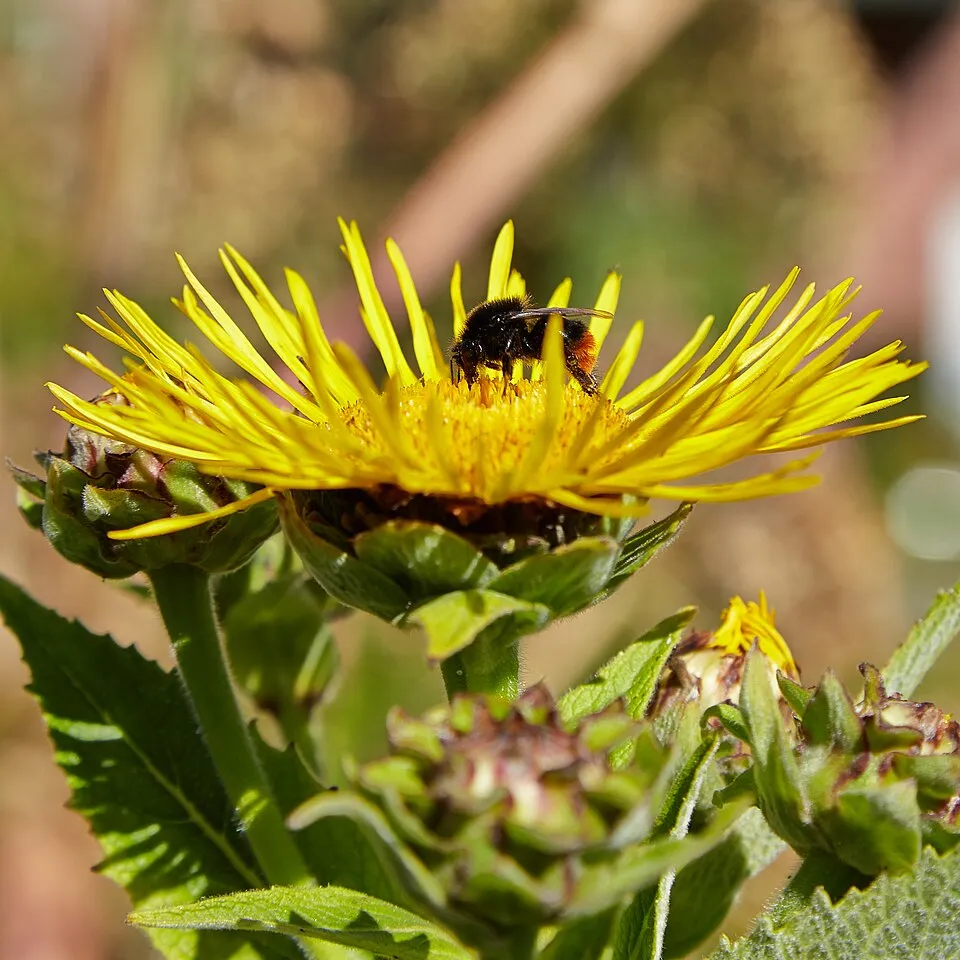
Inula helenium, universally recognized as elecampane, is a commanding perennial herbaceous plant belonging to the Asteraceae family. This impressive species is characterized by its substantial, broad, ovate leaves, which can reach lengths of up to 60 cm and feature a distinctive hairy texture on their undersides. During the period from mid-summer through early autumn, the plant proudly displays large, daisy-like flower heads, typically measuring 5-8 cm in diameter.
These striking inflorescences are composed of vibrant yellow ray florets encircling a dense central disc of yellow tubular florets. Below ground, Inula helenium develops a robust and fleshy root system, forming a thick rhizome that is highly valued and frequently harvested for its significant medicinal and occasional culinary applications. Native to expansive regions of Europe and Asia, elecampane has successfully naturalized across various other parts of the world, thriving in diverse habitats such as damp meadows, pastures, and along the edges of roadsides.
Its unique morphological characteristics and profound historical utility have solidified its status as an important species within both the realm of traditional herbalism and contemporary botanical gardens. Other common names include horse heal, scabwort, velvet dock, elfwort, elfdock, and wild sunflower, reflecting its varied cultural associations and appearance.
Trusted Scientific References
1. Authoritative external sources for Inula Helenium
1.1 Wikipedia — Inula Helenium
1.2 Kew POWO (Plants of the World Online)
1.3 PubMed — peer-reviewed research
1.4 NCBI Taxonomy Browser
1.5 GBIF — Global Biodiversity
1.6Inula Helenium should be interpreted through verified botanical identity, practical care, and responsible safety language. This recovery note adds the missing context needed for a complete profile: match light to the plant's habit, use well-drained soil, water according to season, and avoid unsupported medicinal or edible claims. For publishing, the plant can be presented as a source-backed garden plant with clear care guidance, common problem diagnosis, and conservative safety wording.
1.1.Inula Helenium — Key Features
- ✓ <strong>Large, distinctive daisy</strong> — like yellow flowers that bloom in late summer.
- ✓ <strong>Robust and fleshy</strong> — Robust and fleshy rhizome, the primary part used in herbal medicine.
- ✓ <strong>Contains significant levels</strong> — Contains significant levels of sesquiterpene lactones, including alantolactone.
- ✓ <strong>High concentration of</strong> — High concentration of inulin, a prebiotic fructan, in its root.
- ✓ <strong>Historically revered for</strong> — Historically revered for its expectorant and antimicrobial properties.
- ✓ <strong>Native to Europe</strong> — Native to Europe and Asia, now naturalized in many temperate regions.
- ✓ <strong>Hardy perennial, relatively</strong> — Hardy perennial, relatively easy to cultivate in suitable conditions.
- ✓ <strong>Traditionally used as</strong> — Traditionally used as a digestive bitter and immune system supporter.
- ✓ <strong>Characterized by large,</strong> — Characterized by large, ovate leaves that are hairy on the underside.
- ✓ <strong>Known by various</strong> — Known by various common names, including horse heal and elfwort.
1.2.Inula Helenium — Quick Summary
- ✓ Potent respiratory expectorant, particularly for coughs and bronchitis.
- ✓ Rich in beneficial compounds like alantolactone, isoalantolactone, and inulin.
- ✓ Historically used across various traditional medicine systems for lung and digestive health.
- ✓ A striking perennial with large yellow flowers and a robust, medicinally valued root.
- ✓ Requires careful consideration regarding allergies, pregnancy, and potential drug interactions.
2.Inula Helenium — Scientific Identity
3.Inula Helenium — Quick Facts
4.Inula Helenium — Appearance & Identification
5.Inula Helenium — Native Habitat
6.Inula Helenium — Water Requirements
- ✓ Propagation — Elecampane can be easily propagated from seeds sown indoors in early spring or directly outdoors after the last frost, or by root division in the fall.
- ✓ Soil Requirements — It thrives in moist, well-drained soil that is rich in organic matter, tolerating a range of soil types but preferring fertile conditions.
- ✓ Light Conditions — The plant performs best in full sun to partial shade, adapting well to various light exposures but favoring adequate sunlight for robust growth.
- ✓ Watering Regimen — Consistent moisture is crucial; water regularly to keep the soil moist but not waterlogged, especially during dry spells.
- ✓ Spacing for Growth — Allow ample space for mature plants, which can reach heights of 3-6 feet and spread 2-3 feet wide, to ensure proper air circulation and development.
- ✓ Fertilization — While not strictly necessary, applying a top-dressing of organic compost in the spring will significantly benefit plant vigor, particularly if harvesting the roots.
- ✓ Root Harvesting — Roots are typically harvested in the fall of the second or third year of growth, when their medicinal potency is highest, after the foliage has died back.
- ✓ Hardiness — As a hardy perennial, elecampane is resilient to cold temperatures and can overwinter in many temperate climates, returning year after year.
Reviewed by the Flora Medical Global Botanical Review Panel
Multi-disciplinary editorial group · Botany · Ethnobotany · Herbal-medicine literature
Who reviewed this: This page was checked by the Flora Medical Global Botanical Review Panel — an in-house editorial group of botany graduates, ethnobotany researchers, and horticulture practitioners who collectively maintain our 7,000+ plant encyclopedia. Meet the team.
Our 4-step verification process
1. Taxonomic verification
Scientific names and synonyms cross-checked against Kew POWO, World Flora Online, and The Plant List.
2. Phytochemical & medicinal cross-reference
Active compounds, traditional uses, and reported activities are cross-referenced with PubMed, USDA Dr. Duke's database, and peer-reviewed ethnobotanical literature.
3. Conservation & distribution check
Distribution, ecology, and conservation status confirmed against GBIF occurrence records and the IUCN Red List.
4. Editorial & safety review
Every entry passes an editorial pass for clarity, originality, and safety notices (toxicity, contraindications, dosage caveats) before publication.
Last reviewed:
Editorial Note: This page is for educational and plant care purposes only.
Written by: Flora Medical Global Editorial Team
Reviewed by: Flora Medical Global Botanical Review Panel
Last Updated: June 15, 2026







Inula Helenium — Comments & Community Reviews
Rate this plant