
Care Disclaimer: Plant care recommendations are general guidelines based on common growing conditions. Individual results may vary based on your local environment, climate, and care routine. If your plant is toxic, keep it away from children and pets, and consult a veterinarian if accidental ingestion occurs.
1.Inula Magnifica — Overview
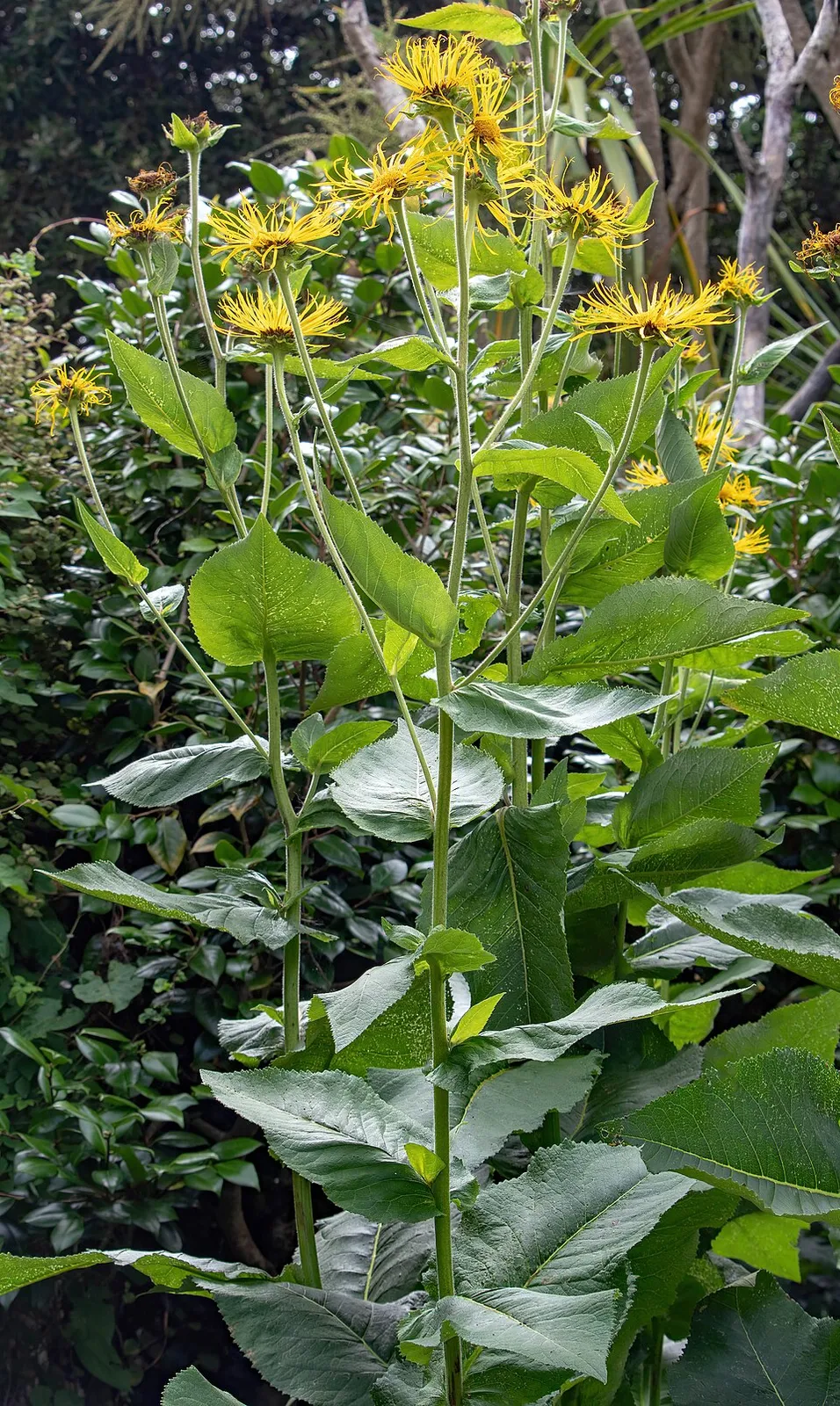
Inula Magnifica, commonly known as Giant Fleabane, Magnificent Elecampane, or Showy Elecampane, is a truly majestic herbaceous perennial belonging to the Asteraceae (Compositae) family. Native to the mountainous regions of the Caucasus and eastern Turkey, this imposing plant commands attention with its remarkable stature, typically reaching heights of 1.5 to 2.5 meters (5 to 8 feet) and spreading up to 90 cm (3 feet) wide. Its basal foliage forms a bold, lush clump of large, rough-textured, ovate to lanceolate leaves, which can measure up to 90 cm (3 feet) in length, providing significant architectural interest even before flowering.
In mid to late summer, Inula Magnifica erupts with an abundance of spectacular, solitary, daisy-like flowers. These enormous blooms, often 10-15 cm (4-6 inches) across, feature vibrant golden-yellow ray florets gracefully radiating from a prominent central disc. The tall, branching purplish stems, clad with hairy ovate leaves, support these showy flower clusters, creating a dynamic visual display that quivers and shimmers in the wind.
Beyond its ornamental appeal, its robust nature and ability to thrive in moist, fertile soils make it a standout specimen for various garden settings, attracting a wealth of pollinators like bees and butterflies, thereby contributing significantly to local biodiversity.
Trusted Scientific References
1. Authoritative external sources for Inula Magnifica
1.1 Wikipedia — Inula Magnifica
1.2 Kew POWO (Plants of the World Online)
1.3 PubMed — peer-reviewed research
1.4 NCBI Taxonomy Browser
1.5 GBIF — Global Biodiversity
1.6Inula Magnifica should be interpreted through verified botanical identity, practical care, and responsible safety language. This recovery note adds the missing context needed for a complete profile: match light to the plant's habit, use well-drained soil, water according to season, and avoid unsupported medicinal or edible claims. For publishing, the plant can be presented as a source-backed garden plant with clear care guidance, common problem diagnosis, and conservative safety wording.
1.1.Inula Magnifica — Key Features
- ✓ <strong>Majestic Stature</strong> — Reaches impressive heights of 1.5 to 2.5 meters (5 to 8 feet), providing significant vertical interest.
- ✓ <strong>Striking Blooms</strong> — Produces enormous, solitary, golden-yellow daisy-like flowers up to 15 cm (6 inches) across.
- ✓ <strong>Pollinator Attractor</strong> — Actively draws bees and butterflies, contributing to garden biodiversity and ecosystem health.
- ✓ <strong>Architectural Interest</strong> — Its imposing size and bold foliage offer a strong structural element in garden designs.
- ✓ <strong>Moisture Loving</strong> — Thrives in consistently moist to even boggy soil conditions, making it suitable for damp areas.
- ✓ <strong>Low Maintenance</strong> — Generally trouble-free and robust once established in suitable growing conditions.
- ✓ <strong>Asteraceae Family</strong> — Belongs to the large and diverse daisy family, known for many medicinal and ornamental species.
- ✓ <strong>Traditional Genus Uses</strong> — Related species, like Elecampane, are traditionally used for respiratory and anti-parasitic benefits.
- ✓ <strong>Pharmacologically Active Compounds</strong> — Contains important phytochemicals such as sesquiterpene lactones and inulin.
- ✓ <strong>Cold Hardy</strong> — Tolerates a wide range of climates, hardy in USDA zones 5-8.
1.2.Inula Magnifica — Quick Summary
- ✓ Majestic perennial reaching 1.5-2.5 meters with large golden-yellow flowers.
- ✓ Part of the Inula genus, known for traditional respiratory, digestive, and anti-parasitic uses.
- ✓ Contains active compounds such as sesquiterpene lactones, inulin, and flavonoids.
- ✓ Exhibits potential expectorant, anti-inflammatory, anthelmintic, and antimicrobial properties.
- ✓ Requires full sun and consistently moist, fertile soil for optimal growth.
- ✓ Use with caution; consult a healthcare professional, especially during pregnancy or for allergies.
2.Inula Magnifica — Scientific Identity
3.Inula Magnifica — Quick Facts
4.Inula Magnifica — Appearance & Identification
5.Inula Magnifica — Native Habitat
6.Inula Magnifica — Water Requirements
- ✓ Site Selection — Thrives in full sun exposure, ensuring robust growth and abundant flowering.
- ✓ Soil Requirements — Prefers deep, fertile, consistently moist soils; tolerates boggy conditions and a wide pH range (acid, alkaline, neutral).
- ✓ Watering — Requires average to high water needs, especially during dry periods, to maintain soil moisture.
- ✓ Propagation — Can be propagated by seed sown in spring or as soon as ripe in autumn, or by division of established clumps in early spring or fall.
- ✓ Maintenance — Cut back old stems and spent foliage in late autumn or early winter as the plant dies back; staking may be necessary for taller specimens.
- ✓ Pest and Disease — Generally trouble-free, but monitor for powdery mildew, particularly in humid conditions.
- ✓ Hardiness — Hardy in USDA zones 5-8 and heat zones 5-8, making it suitable for temperate climates.
- ✓ Spacing — Allow ample space, approximately 36 inches (90 cm) between plants, to accommodate its mature spread and prevent overcrowding.
Reviewed by the Flora Medical Global Botanical Review Panel
Multi-disciplinary editorial group · Botany · Ethnobotany · Herbal-medicine literature
Who reviewed this: This page was checked by the Flora Medical Global Botanical Review Panel — an in-house editorial group of botany graduates, ethnobotany researchers, and horticulture practitioners who collectively maintain our 7,000+ plant encyclopedia. Meet the team.
Our 4-step verification process
1. Taxonomic verification
Scientific names and synonyms cross-checked against Kew POWO, World Flora Online, and The Plant List.
2. Phytochemical & medicinal cross-reference
Active compounds, traditional uses, and reported activities are cross-referenced with PubMed, USDA Dr. Duke's database, and peer-reviewed ethnobotanical literature.
3. Conservation & distribution check
Distribution, ecology, and conservation status confirmed against GBIF occurrence records and the IUCN Red List.
4. Editorial & safety review
Every entry passes an editorial pass for clarity, originality, and safety notices (toxicity, contraindications, dosage caveats) before publication.
Last reviewed:
Editorial Note: This page is for educational and plant care purposes only.
Written by: Flora Medical Global Editorial Team
Reviewed by: Flora Medical Global Botanical Review Panel
Last Updated: June 15, 2026







Inula Magnifica — Comments & Community Reviews
Rate this plant