


Care Disclaimer: Plant care recommendations are general guidelines based on common growing conditions. Individual results may vary based on your local environment, climate, and care routine. If your plant is toxic, keep it away from children and pets, and consult a veterinarian if accidental ingestion occurs.
1.Koelreuteria Paniculata — Overview
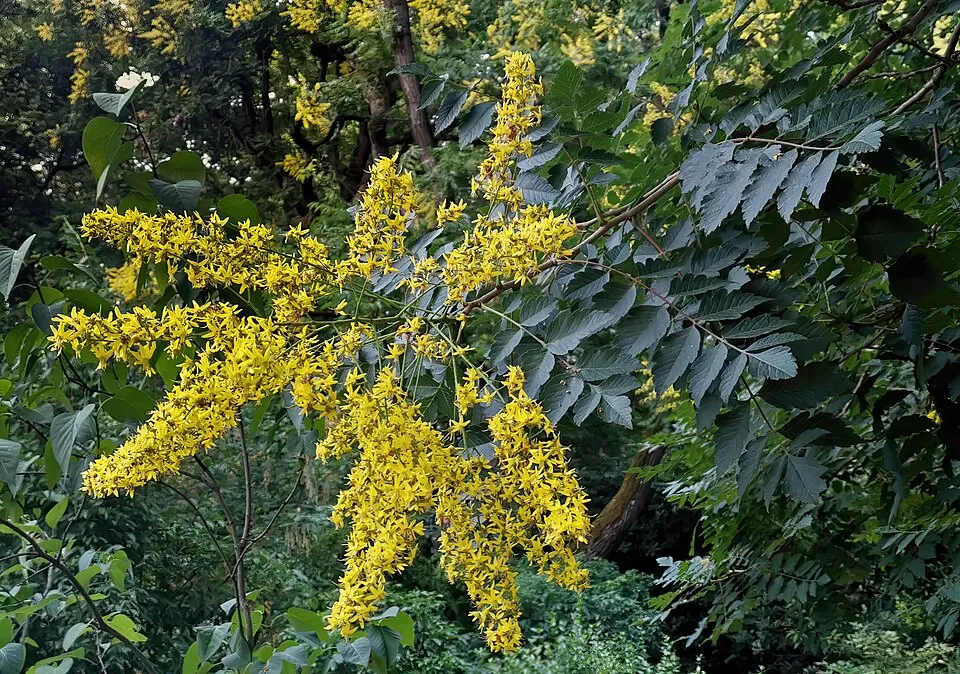
Koelreuteria paniculata, commonly known as the Golden Rain Tree, is an elegant deciduous tree belonging to the Sapindaceae family. Native to East Asia, particularly China and Korea, it is celebrated for its remarkable ornamental value. This medium-sized tree typically reaches heights of 20-40 feet (6-12 meters) with a comparable spread, forming an open, spreading canopy.
Its distinctive pinnately compound leaves unfurl with a reddish tint in spring, mature to a vibrant green in summer, and transform into a striking yellow in autumn, offering seasonal interest. The tree's most captivating feature is its profusion of bright yellow, panicle-like flowers that bloom in mid to late summer, a period when few other trees are in full display. These showy floral clusters are followed by unique, papery, bladder-like seed pods, resembling small lanterns, which mature from green to a striking pinkish-bronze and persist through fall and into winter.
Koelreuteria paniculata is highly adaptable, thriving in full sun and well-drained soils, exhibiting considerable drought tolerance once established. Its resilience to urban environments, including pollution, makes it a favored choice for street plantings, parks, and home gardens globally.
Trusted Scientific References
1. Authoritative external sources for Koelreuteria paniculata
1.1 Wikipedia — Koelreuteria paniculata
1.2 Kew POWO (Plants of the World Online)
1.3 PubMed — peer-reviewed research
1.4 NCBI Taxonomy Browser
1.5 GBIF — Global Biodiversity
1.6Koelreuteria Paniculata should be interpreted through verified botanical identity, practical care, and responsible safety language. This recovery note adds the missing context needed for a complete profile: match light to the plant's habit, use well-drained soil, water according to season, and avoid unsupported medicinal or edible claims. For publishing, the plant can be presented as a source-backed garden plant with clear care guidance, common problem diagnosis, and conservative safety wording.
1.1.Koelreuteria Paniculata — Key Features
- ✓ <strong>Striking Mid</strong> — to-Late Summer Yellow Flowers — A unique bloom time.
- ✓ <strong>Distinctive Papery Seed Pods</strong> — Lantern-like, maturing pinkish-bronze.
- ✓ <strong>Ornamental Deciduous Tree</strong> — Provides year-round interest.
- ✓ <strong>Adaptable to Urban Conditions</strong> — Tolerates pollution and various soils.
- ✓ <strong>Drought Tolerant</strong> — Once established, requires minimal watering.
- ✓ <strong>Fall Foliage</strong> — Leaves turn brilliant yellow in autumn.
- ✓ <strong>Traditional Chinese Medicine Plant</strong> — Various parts have historical uses.
- ✓ <strong>Rich in Bioactive Compounds</strong> — Flavonoids, saponins, tannins.
- ✓ <strong>Low Maintenance</strong> — Requires minimal pruning and care.
- ✓ <strong>Moderate Size</strong> — Ideal for gardens and street trees, typically 20-40 ft tall.
1.2.Koelreuteria Paniculata — Quick Summary
- ✓ Golden Rain Tree (Koelreuteria paniculata) is an ornamental deciduous tree.
- ✓ Known for its vibrant yellow flowers and papery, lantern-like seed pods.
- ✓ Traditionally used in TCM for anti-inflammatory, analgesic, and ophthalmic purposes.
- ✓ Rich in flavonoids, saponins, and tannins, contributing to its medicinal properties.
- ✓ Internal use, especially of seeds, is highly cautioned due to potential toxicity.
- ✓ Thrives in full sun, well-drained soil, and is drought-tolerant once established.
2.Koelreuteria Paniculata — Scientific Identity
3.Koelreuteria Paniculata — Quick Facts
4.Koelreuteria Paniculata — Appearance & Identification
5.Koelreuteria Paniculata — Native Habitat
6.Koelreuteria Paniculata — Water Requirements
- ✓ Sun Exposure — Thrives in full sun, requiring at least 6 hours of direct sunlight daily for optimal growth and flowering.
- ✓ Soil Requirements — Prefers well-drained soil but is adaptable to a range of soil types, including sandy, loamy, and clayey, as long as waterlogging is avoided.
- ✓ Watering — Drought-tolerant once established; young trees need regular watering to establish a strong root system.
- ✓ Hardiness Zones — Hardy in USDA Zones 5 to 9, tolerating temperatures as low as -20°F (-29°C).
- ✓ Pruning — Requires minimal pruning; primarily to remove dead, damaged, or poorly formed branches, best done in late winter or early spring.
- ✓ Fertilization — Benefits from a balanced, slow-release fertilizer application once a year in early spring, especially in nutrient-poor soils.
- ✓ Propagation — Can be propagated by seed, which often requires stratification, or by semi-hardwood cuttings.
Reviewed by the Flora Medical Global Botanical Review Panel
Multi-disciplinary editorial group · Botany · Ethnobotany · Herbal-medicine literature
Who reviewed this: This page was checked by the Flora Medical Global Botanical Review Panel — an in-house editorial group of botany graduates, ethnobotany researchers, and horticulture practitioners who collectively maintain our 7,000+ plant encyclopedia. Meet the team.
Our 4-step verification process
1. Taxonomic verification
Scientific names and synonyms cross-checked against Kew POWO, World Flora Online, and The Plant List.
2. Phytochemical & medicinal cross-reference
Active compounds, traditional uses, and reported activities are cross-referenced with PubMed, USDA Dr. Duke's database, and peer-reviewed ethnobotanical literature.
3. Conservation & distribution check
Distribution, ecology, and conservation status confirmed against GBIF occurrence records and the IUCN Red List.
4. Editorial & safety review
Every entry passes an editorial pass for clarity, originality, and safety notices (toxicity, contraindications, dosage caveats) before publication.
Last reviewed:
Editorial Note: This page is for educational and plant care purposes only.
Written by: Flora Medical Global Editorial Team
Reviewed by: Flora Medical Global Botanical Review Panel
Last Updated: June 15, 2026







Koelreuteria Paniculata — Comments & Community Reviews
Rate this plant