
Care Disclaimer: Plant care recommendations are general guidelines based on common growing conditions. Individual results may vary based on your local environment, climate, and care routine. If your plant is toxic, keep it away from children and pets, and consult a veterinarian if accidental ingestion occurs.
1.Lathyrus Vernus — Overview
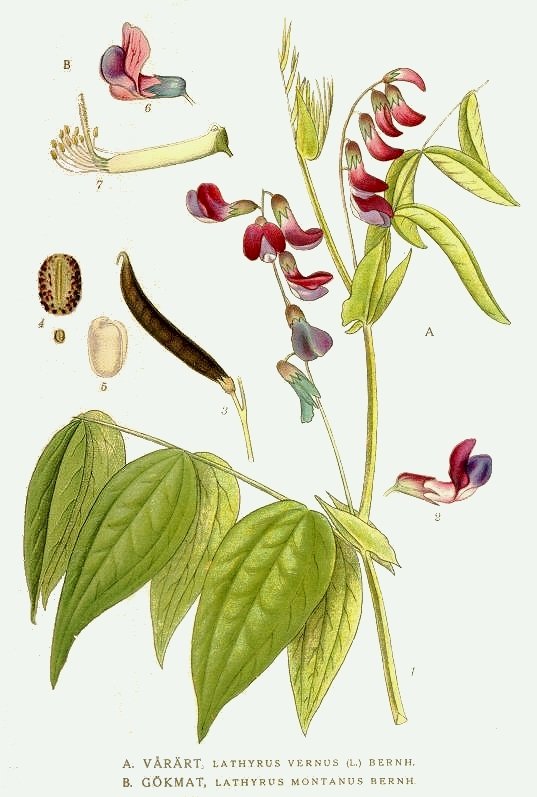
Lathyrus vernus, commonly known as the spring vetchling or early everlasting pea, is an elegant herbaceous perennial belonging to the Fabaceae family, a lineage celebrated for its nitrogen-fixing capabilities and diverse array of legumes. This species is indigenous to the temperate woodland and scrub environments spanning across Europe and extending into Western Asia. Typically forming upright, multi-stemmed clumps, it reaches a modest height of 20-50 cm, presenting a compact and bushy habit. Its foliage consists of pinnately compound leaves, each bearing 4-8 ovate to lanceolate leaflets with distinct pointed apices and smooth margins.
The defining characteristic of Lathyrus vernus is its remarkably early and abundant floral display, often commencing in late spring, frequently synchronized with the emergence of fresh foliage. The pea-like flowers are arranged in racemes, usually comprising 2-6 individual blossoms. Each flower, approximately 1.5-2 cm in length, showcases a vivid and often intricate color spectrum typical of the Lathyrus genus. While some cultivars exhibit deep pink or purplish-red hues, others can present in striking blue, violet, or even creamy white, occasionally with a charming bicolor effect where the standard petal contrasts harmoniously with the wings and keel.
These blooms emit a delicate, sweet fragrance. Post-flowering, the plant develops small, flattened pods, characteristic of legumes, which encase several small, spherical seeds. Lathyrus vernus is a highly valued addition to naturalistic gardens, woodland settings, or as an attractive groundcover, providing essential early-season color.
Trusted Scientific References
1. Authoritative external sources for Lathyrus Vernus
1.1 Wikipedia — Lathyrus Vernus
1.2 Kew POWO (Plants of the World Online)
1.3 PubMed — peer-reviewed research
1.4 NCBI Taxonomy Browser
1.5 GBIF — Global Biodiversity
1.6Lathyrus Vernus should be interpreted through verified botanical identity, practical care, and responsible safety language. This recovery note adds the missing context needed for a complete profile: match light to the plant's habit, use well-drained soil, water according to season, and avoid unsupported medicinal or edible claims. For publishing, the plant can be presented as a source-backed garden plant with clear care guidance, common problem diagnosis, and conservative safety wording.
1.1.Lathyrus Vernus — Key Features
- ✓ <strong>Early Spring Blooms</strong> — Provides vibrant color after winter.
- ✓ <strong>Non</strong> — Vining Growth Habit — Forms attractive clumps, not climbing.
- ✓ <strong>Adaptable to Shade</strong> — Thrives in woodland garden settings.
- ✓ <strong>Low Maintenance</strong> — Once established, requires minimal care.
- ✓ <strong>Ornamental Value</strong> — Highly prized for its showy, colorful flowers.
- ✓ <strong>Native to Europe/Asia</strong> — Well-suited for temperate climates.
- ✓ <strong>Deer Resistant</strong> — Generally not favored by deer.
- ✓ <strong>Attracts Pollinators</strong> — Flowers provide early nectar for bees.
- ✓ <strong>Drought Tolerant (Established)</strong> — Can withstand some dry spells.
- ✓ <strong>Distinctive Foliage</strong> — Pinnately compound leaves add texture.
1.2.Lathyrus Vernus — Quick Summary
- ✓ Early spring blooming perennial, native to Europe and Asia.
- ✓ Attractive ornamental plant for woodland and naturalistic gardens.
- ✓ Contains potentially toxic compounds, especially in seeds.
- ✓ Not recommended for internal medicinal use due to toxicity concerns.
- ✓ Valued for its aesthetic appeal and low maintenance in ideal conditions.
- ✓ Prefers partial shade, well-drained, moist, and fertile soil.
2.Lathyrus Vernus — Scientific Identity
3.Lathyrus Vernus — Quick Facts
4.Lathyrus Vernus — Appearance & Identification
5.Lathyrus Vernus — Native Habitat
6.Lathyrus Vernus — Water Requirements
- ✓ Site Selection — Prefers partial shade to full sun, ideal for woodland gardens or dappled light conditions.
- ✓ Soil Requirements — Thrives in well-drained, moist, and fertile soil with a neutral to slightly acidic pH.
- ✓ Planting — Best planted from seed or young plants in early spring or fall; does not tolerate transplanting well once established.
- ✓ Watering — Requires consistent moisture, especially during dry periods; avoid waterlogging.
- ✓ Fertilization — Benefits from an annual application of balanced organic fertilizer or compost in spring.
- ✓ Pruning — Minimal pruning needed; remove spent flower stalks and any dead or damaged foliage after flowering.
- ✓ Propagation — Primarily by seed, which often requires stratification for optimal germination.
- ✓ Pest and Disease Control — Generally resistant; monitor for common garden pests like aphids and slugs.
Reviewed by the Flora Medical Global Botanical Review Panel
Multi-disciplinary editorial group · Botany · Ethnobotany · Herbal-medicine literature
Who reviewed this: This page was checked by the Flora Medical Global Botanical Review Panel — an in-house editorial group of botany graduates, ethnobotany researchers, and horticulture practitioners who collectively maintain our 7,000+ plant encyclopedia. Meet the team.
Our 4-step verification process
1. Taxonomic verification
Scientific names and synonyms cross-checked against Kew POWO, World Flora Online, and The Plant List.
2. Phytochemical & medicinal cross-reference
Active compounds, traditional uses, and reported activities are cross-referenced with PubMed, USDA Dr. Duke's database, and peer-reviewed ethnobotanical literature.
3. Conservation & distribution check
Distribution, ecology, and conservation status confirmed against GBIF occurrence records and the IUCN Red List.
4. Editorial & safety review
Every entry passes an editorial pass for clarity, originality, and safety notices (toxicity, contraindications, dosage caveats) before publication.
Last reviewed:
Editorial Note: This page is for educational and plant care purposes only.
Written by: Flora Medical Global Editorial Team
Reviewed by: Flora Medical Global Botanical Review Panel
Last Updated: June 15, 2026







Lathyrus Vernus — Comments & Community Reviews
Rate this plant