
Care Disclaimer: Plant care recommendations are general guidelines based on common growing conditions. Individual results may vary based on your local environment, climate, and care routine. If your plant is toxic, keep it away from children and pets, and consult a veterinarian if accidental ingestion occurs.
1.Leucojum — Overview
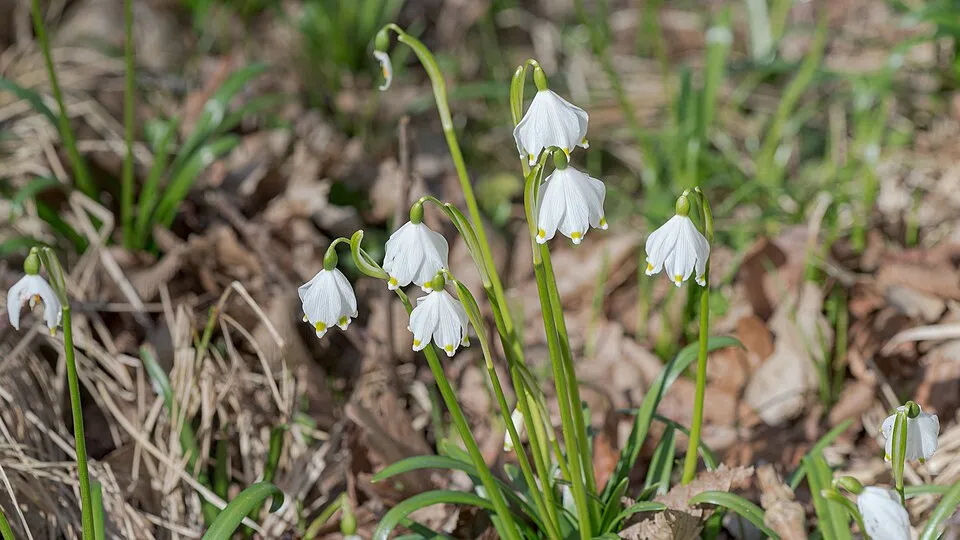
Leucojum vernum, commonly known as the spring snowflake, is a captivating bulbous perennial belonging to the Amaryllidaceae family, a lineage shared with snowdrops (Galanthus) and daffodils. Native to the woodlands, meadows, and stream banks of central and southern Europe, this harbinger of spring typically reaches heights of 15-30 cm (6-12 inches). Its botanical elegance is defined by one to three delicate, nodding, bell-shaped (campanulate) white flowers per stem, each tepal distinctly tipped with emerald green or occasionally yellowish-green markings. The subtle, sweet fragrance emanating from these early blooms adds to their allure.
The plant features glossy, strap-like basal leaves that emerge in late winter or early spring concurrently with the flower scapes, persisting until mid-summer before senescing. Leucojum vernum thrives in moist, well-drained soils and prefers partial shade, making it an excellent choice for naturalizing in woodland gardens where it forms charming colonies over time. Despite a superficial resemblance to snowdrops, spring snowflakes are generally larger and characteristically produce multiple flowers per stem, distinguishing them from their close relatives. The species epithet 'vernum' is Latin for 'of the spring,' aptly reflecting its early blooming cycle.
All parts of Leucojum species contain toxic alkaloids, rendering them unpalatable to common garden pests like deer and rabbits, a beneficial trait for gardeners. The robust bulb acts as an energy reservoir, ensuring subsequent year's blooms, and can be carefully divided after flowering for propagation.
Trusted Scientific References
1. Authoritative external sources for Leucojum vernum
1.1 Wikipedia — Leucojum vernum
1.2 Kew POWO (Plants of the World Online)
1.3 PubMed — peer-reviewed research
1.4 NCBI Taxonomy Browser
1.5 GBIF — Global Biodiversity
1.6Leucojum should be interpreted through verified botanical identity, practical care, and responsible safety language. This recovery note adds the missing context needed for a complete profile: match light to the plant's habit, use well-drained soil, water according to season, and avoid unsupported medicinal or edible claims. For publishing, the plant can be presented as a source-backed garden plant with clear care guidance, common problem diagnosis, and conservative safety wording.
1.1.Leucojum — Key Features
- ✓ <strong>Common Name</strong> — Spring Snowflake
- ✓ <strong>Scientific Name</strong> — Leucojum vernum
- ✓ <strong>Family</strong> — Amaryllidaceae
- ✓ <strong>Key Compound</strong> — Galantamine
- ✓ <strong>Medicinal Use</strong> — Alzheimer's disease treatment (pharmaceutical)
- ✓ <strong>Appearance</strong> — Nodding white bell-shaped flowers with green tips
- ✓ <strong>Blooming Season</strong> — Early spring
- ✓ <strong>Habitat</strong> — Woodlands, meadows in central/southern Europe
- ✓ <strong>Toxicity</strong> — All parts are poisonous
- ✓ <strong>Garden Use</strong> — Ornamental, naturalizes well, deer/rabbit resistant
1.2.Leucojum — Quick Summary
- ✓ Leucojum vernum is the spring snowflake, a beautiful and toxic bulbous perennial.
- ✓ Contains potent Amaryllidaceae alkaloids, notably galantamine.
- ✓ Galantamine is a pharmaceutical drug used for Alzheimer's disease.
- ✓ Acts as an acetylcholinesterase inhibitor, improving cognitive function.
- ✓ All parts of the plant are poisonous; not for self-medication.
- ✓ Offers landscape beauty as an early spring bloomer.
2.Leucojum — Scientific Identity
3.Leucojum — Quick Facts
4.Leucojum — Appearance & Identification
5.Leucojum — Native Habitat
6.Leucojum — Water Requirements
- ✓ Planting Bulbs — Plant Leucojum vernum bulbs in autumn, 4-5 inches deep and 4-6 inches apart, in well-drained soil.
- ✓ Soil Preference — Thrives in organically rich, moist, well-drained soils; avoid waterlogging to prevent root rot.
- ✓ Light Requirements — Prefers partial shade but can tolerate full sun in cooler climates; ideal for woodland settings.
- ✓ Watering — Keep soil consistently moist, especially during active growth in late winter and spring.
- ✓ Fertilization — Lightly fertilize with a balanced slow-release granular fertilizer in early spring if soil fertility is low.
- ✓ Post-Bloom Care — Allow foliage to yellow and die back naturally after flowering to replenish bulb energy for the next season.
- ✓ Propagation — Divide clumps of bulbs in late summer or early autumn after foliage has died back, or allow to naturalize.
- ✓ Pest Resistance — Naturally resistant to deer and rabbits due to toxic alkaloids, minimizing garden damage.
Reviewed by the Flora Medical Global Botanical Review Panel
Multi-disciplinary editorial group · Botany · Ethnobotany · Herbal-medicine literature
Who reviewed this: This page was checked by the Flora Medical Global Botanical Review Panel — an in-house editorial group of botany graduates, ethnobotany researchers, and horticulture practitioners who collectively maintain our 7,000+ plant encyclopedia. Meet the team.
Our 4-step verification process
1. Taxonomic verification
Scientific names and synonyms cross-checked against Kew POWO, World Flora Online, and The Plant List.
2. Phytochemical & medicinal cross-reference
Active compounds, traditional uses, and reported activities are cross-referenced with PubMed, USDA Dr. Duke's database, and peer-reviewed ethnobotanical literature.
3. Conservation & distribution check
Distribution, ecology, and conservation status confirmed against GBIF occurrence records and the IUCN Red List.
4. Editorial & safety review
Every entry passes an editorial pass for clarity, originality, and safety notices (toxicity, contraindications, dosage caveats) before publication.
Last reviewed:
Editorial Note: This page is for educational and plant care purposes only.
Written by: Flora Medical Global Editorial Team
Reviewed by: Flora Medical Global Botanical Review Panel
Last Updated: June 15, 2026







Leucojum — Comments & Community Reviews
Rate this plant