
Care Disclaimer: Plant care recommendations are general guidelines based on common growing conditions. Individual results may vary based on your local environment, climate, and care routine. If your plant is toxic, keep it away from children and pets, and consult a veterinarian if accidental ingestion occurs.
1.Lewisia — Overview
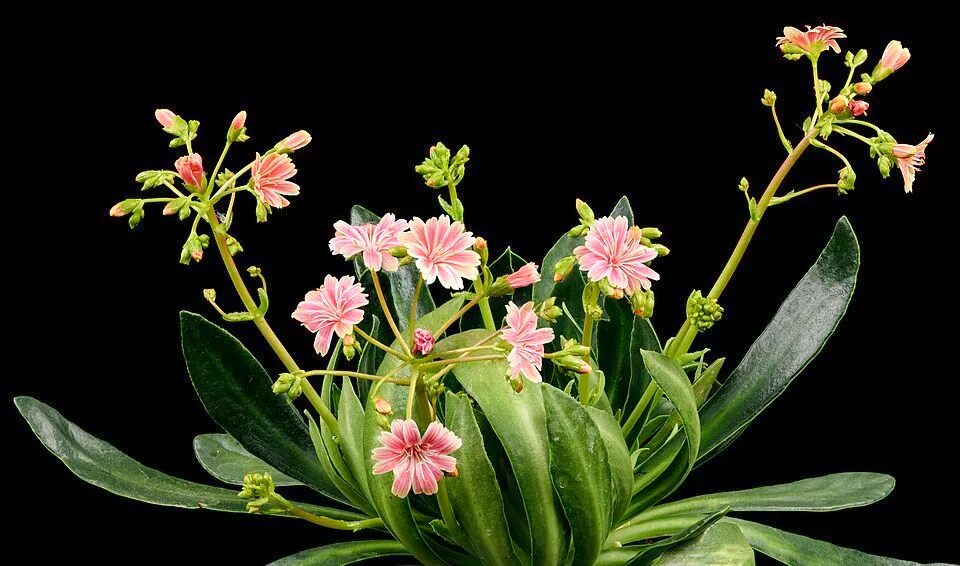
Lewisia cotyledon, often recognized as Siskiyou Lewisia or Cliff Maids, is a resilient evergreen perennial herb indigenous to the mountainous regions of Southern Oregon and Northern California. It is a member of the Montiaceae family, characterized by its striking basal rosettes of succulent, spatulate to oblanceolate leaves. These leaves, typically ranging from 2 to 10 cm in length, exhibit a spectrum of colors from glaucous green to reddish-tinged hues, arising from a robust, deep taproot system that enables its survival in arid, rocky environments.
This plant is celebrated for its delicate yet intensely colored flowers, which can appear in shades of pink, magenta, orange-yellow, or white, frequently adorned with intricate contrasting venation or stripes. The blooms are presented either solitarily or in graceful, open panicles or racemes, held aloft on slender, often branched stems that can reach heights of 10 to 30 cm above the foliage. Each flower typically features 7 to 13 petals, though variations can occur.
Blooming primarily spans from late spring into early summer, creating a vibrant spectacle against its natural rocky backdrops. Its compact, low-growing habit makes Lewisia cotyledon an exceptional choice for xeriscaping, rock gardens, and container cultivation, where its aesthetic appeal is highly valued.
Trusted Scientific References
1. Authoritative external sources for Lewisia cotyledon
1.1 Wikipedia — Lewisia cotyledon
1.2 Kew POWO (Plants of the World Online)
1.3 PubMed — peer-reviewed research
1.4 NCBI Taxonomy Browser
1.5 GBIF — Global Biodiversity
1.6Lewisia should be interpreted through verified botanical identity, practical care, and responsible safety language. This recovery note adds the missing context needed for a complete profile: match light to the plant's habit, use well-drained soil, water according to season, and avoid unsupported medicinal or edible claims. For publishing, the plant can be presented as a source-backed garden plant with clear care guidance, common problem diagnosis, and conservative safety wording.
1.1.Lewisia — Key Features
- ✓ <strong>Evergreen Perennial</strong> — Maintains foliage year-round.
- ✓ <strong>Succulent Leaves</strong> — Spatulate to oblanceolate, store water.
- ✓ <strong>Vibrant Flowers</strong> — Pink, magenta, orange-yellow, white with venation.
- ✓ <strong>Deep Taproot</strong> — Anchors plant and accesses deep water.
- ✓ <strong>Low</strong> — Growing Rosettes — Compact basal growth habit.
- ✓ <strong>Adaptable to Arid Conditions</strong> — Thrives in dry, rocky environments.
- ✓ <strong>Pollinator Attractor</strong> — Draws butterflies and other insects.
- ✓ <strong>Award of Garden Merit</strong> — Recognized by the Royal Horticultural Society.
- ✓ <strong>Native to Western North America</strong> — Specifically Oregon and California.
- ✓ <strong>Deer Resistant</strong> — Generally avoided by deer.
1.2.Lewisia — Quick Summary
- ✓ Primarily an ornamental plant, not medicinal.
- ✓ Thrives in well-draining, rocky soils.
- ✓ Known for vibrant, colorful flowers.
- ✓ Drought-tolerant and low-maintenance.
- ✓ Native to Southern Oregon and Northern California.
- ✓ Excellent for rock gardens and xeriscapes.
2.Lewisia — Scientific Identity
3.Lewisia — Quick Facts
4.Lewisia — Appearance & Identification
5.Lewisia — Native Habitat
6.Lewisia — Water Requirements
- ✓ Site Selection — Plant in full sun near the coast or part sun inland where summers are hot, mimicking its native habitat.
- ✓ Soil Requirements — Prefers slightly acidic, very fast-draining sandy soil; succulent potting mix is ideal.
- ✓ Planting Technique — Plant high in the soil or angled into a rocky wall to ensure the crown remains dry and prevent rot.
- ✓ Watering Regime — Not a thirsty plant; drought tolerant once established. Water sparingly, especially during winter.
- ✓ Drainage Enhancement — Incorporate a top dressing of gravel or granite to simulate its rocky native home and improve drainage.
- ✓ Pruning — Deadhead spent flowers regularly to encourage prolonged blooming and maintain plant vigor.
- ✓ Winter Protection — Protect from overly wet winter conditions to prevent root and crown rot.
Reviewed by the Flora Medical Global Botanical Review Panel
Multi-disciplinary editorial group · Botany · Ethnobotany · Herbal-medicine literature
Who reviewed this: This page was checked by the Flora Medical Global Botanical Review Panel — an in-house editorial group of botany graduates, ethnobotany researchers, and horticulture practitioners who collectively maintain our 7,000+ plant encyclopedia. Meet the team.
Our 4-step verification process
1. Taxonomic verification
Scientific names and synonyms cross-checked against Kew POWO, World Flora Online, and The Plant List.
2. Phytochemical & medicinal cross-reference
Active compounds, traditional uses, and reported activities are cross-referenced with PubMed, USDA Dr. Duke's database, and peer-reviewed ethnobotanical literature.
3. Conservation & distribution check
Distribution, ecology, and conservation status confirmed against GBIF occurrence records and the IUCN Red List.
4. Editorial & safety review
Every entry passes an editorial pass for clarity, originality, and safety notices (toxicity, contraindications, dosage caveats) before publication.
Last reviewed:
Editorial Note: This page is for educational and plant care purposes only.
Written by: Flora Medical Global Editorial Team
Reviewed by: Flora Medical Global Botanical Review Panel
Last Updated: June 15, 2026







Lewisia — Comments & Community Reviews
Rate this plant