

Care Disclaimer: Plant care recommendations are general guidelines based on common growing conditions. Individual results may vary based on your local environment, climate, and care routine. If your plant is toxic, keep it away from children and pets, and consult a veterinarian if accidental ingestion occurs.
1.Lindera Benzoin — Overview
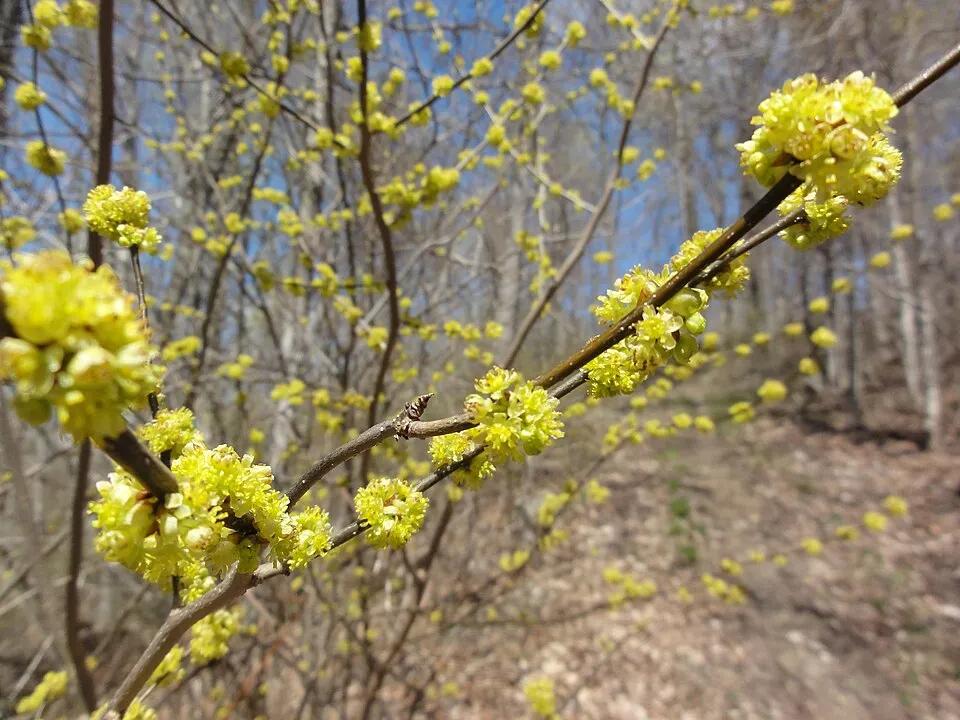
Lindera benzoin, commonly known as Spicebush or Wild Allspice, is an elegant deciduous shrub belonging to the Lauraceae family, native to the eastern and central regions of North America. It typically grows to a height of 6 to 12 feet (1.8-3.7 meters) with a similar spread, forming a rounded, multi-stemmed habit. The plant is characterized by its smooth, olive-green bark and slender, aromatic twigs that release a pungent, spicy fragrance when bruised, reminiscent of allspice.
Its obovate to elliptical leaves, 2 to 5 inches long, are bright green in summer, turning a brilliant golden-yellow in autumn, adding significant ornamental value. In early spring, before the leaves unfurl, Spicebush produces clusters of small, delicate, greenish-yellow flowers along its branches, providing an early source of nectar for pollinators. Female plants, if pollinated, develop bright red, drupe-like berries in late summer, which are highly attractive to birds and persist into early winter.
Lindera benzoin thrives in moist, well-drained woodlands, stream banks, and forest understories, often forming dense thickets. Its ecological significance is notable as a host plant for the Spicebush Swallowtail butterfly and a vital food source for various wildlife.
Trusted Scientific References
1. Authoritative external sources for Lindera benzoin
1.1 Wikipedia — Lindera benzoin
1.2 Kew POWO (Plants of the World Online)
1.3 PubMed — peer-reviewed research
1.4 NCBI Taxonomy Browser
1.5 GBIF — Global Biodiversity
1.6Lindera Benzoin should be interpreted through verified botanical identity, practical care, and responsible safety language. This recovery note adds the missing context needed for a complete profile: match light to the plant's habit, use well-drained soil, water according to season, and avoid unsupported medicinal or edible claims. For publishing, the plant can be presented as a source-backed garden plant with clear care guidance, common problem diagnosis, and conservative safety wording.
1.1.Lindera Benzoin — Key Features
- ✓ <strong>Native North American Deciduous Shrub</strong> — Indigenous to eastern and central regions.
- ✓ <strong>Highly Aromatic</strong> — Leaves, twigs, and berries emit a spicy, pleasant fragrance.
- ✓ <strong>Early Spring Bloomer</strong> — Small, fragrant yellow flowers appear before leaves.
- ✓ <strong>Attractive Red Berries</strong> — Female plants produce vibrant red drupes, attracting wildlife.
- ✓ <strong>Host Plant for Spicebush Swallowtail</strong> — Crucial for butterfly life cycle.
- ✓ <strong>Traditional Medicinal Uses</strong> — Used for colds, fevers, digestion, and insect repellent.
- ✓ <strong>Adaptable to Various Conditions</strong> — Thrives in partial shade to sun with moist soil.
- ✓ <strong>Low Maintenance</strong> — Generally easy to grow and pest-resistant.
- ✓ <strong>Autumn Foliage</strong> — Leaves turn brilliant golden-yellow in fall.
- ✓ <strong>Botanical Family Lauraceae</strong> — Related to cinnamon and bay laurel.
1.2.Lindera Benzoin — Quick Summary
- ✓ Lindera benzoin, or Spicebush, is an aromatic North American shrub.
- ✓ Traditionally used by Native Americans for fever, colds, and digestion.
- ✓ Rich in essential oils like limonene, sabinene, and cineole.
- ✓ Offers anti-inflammatory, digestive, and insect-repellent benefits.
- ✓ Cultivated for its ornamental value and adaptability.
- ✓ Caution advised for pregnant/nursing women and those on medications.
2.Lindera Benzoin — Scientific Identity
3.Lindera Benzoin — Quick Facts
4.Lindera Benzoin — Appearance & Identification
5.Lindera Benzoin — Native Habitat
6.Lindera Benzoin — Water Requirements
- ✓ Site Selection — Prefers partial shade to full sun, especially in cooler climates; tolerates full sun if soil remains consistently moist.
- ✓ Soil Requirements — Thrives in moist, well-drained, organically rich soils with a slightly acidic to neutral pH (6.0-7.0).
- ✓ Watering — Requires consistent moisture, especially during dry periods; young plants need regular watering until established.
- ✓ Propagation — Can be propagated by seed (requires stratification), softwood cuttings in early summer, or by transplanting suckers.
- ✓ Pruning — Generally low maintenance; prune in late winter or early spring to remove dead or crossing branches and maintain shape.
- ✓ Pests and Diseases — Relatively pest and disease resistant; occasional issues may include spicebush swallowtail caterpillars (which feed on leaves but cause minimal damage) or leaf spot in overly wet conditions.
- ✓ Fertilization — Typically does not require fertilization in fertile soils; if needed, use a balanced slow-release fertilizer in early spring.
- ✓ Hardiness — Hardy in USDA zones 4-9, tolerating a wide range of temperatures.
Reviewed by the Flora Medical Global Botanical Review Panel
Multi-disciplinary editorial group · Botany · Ethnobotany · Herbal-medicine literature
Who reviewed this: This page was checked by the Flora Medical Global Botanical Review Panel — an in-house editorial group of botany graduates, ethnobotany researchers, and horticulture practitioners who collectively maintain our 7,000+ plant encyclopedia. Meet the team.
Our 4-step verification process
1. Taxonomic verification
Scientific names and synonyms cross-checked against Kew POWO, World Flora Online, and The Plant List.
2. Phytochemical & medicinal cross-reference
Active compounds, traditional uses, and reported activities are cross-referenced with PubMed, USDA Dr. Duke's database, and peer-reviewed ethnobotanical literature.
3. Conservation & distribution check
Distribution, ecology, and conservation status confirmed against GBIF occurrence records and the IUCN Red List.
4. Editorial & safety review
Every entry passes an editorial pass for clarity, originality, and safety notices (toxicity, contraindications, dosage caveats) before publication.
Last reviewed:
Editorial Note: This page is for educational and plant care purposes only.
Written by: Flora Medical Global Editorial Team
Reviewed by: Flora Medical Global Botanical Review Panel
Last Updated: June 15, 2026







Lindera Benzoin — Comments & Community Reviews
Rate this plant