

Care Disclaimer: Plant care recommendations are general guidelines based on common growing conditions. Individual results may vary based on your local environment, climate, and care routine. If your plant is toxic, keep it away from children and pets, and consult a veterinarian if accidental ingestion occurs.
1.Magnolia Soulangeana — Overview
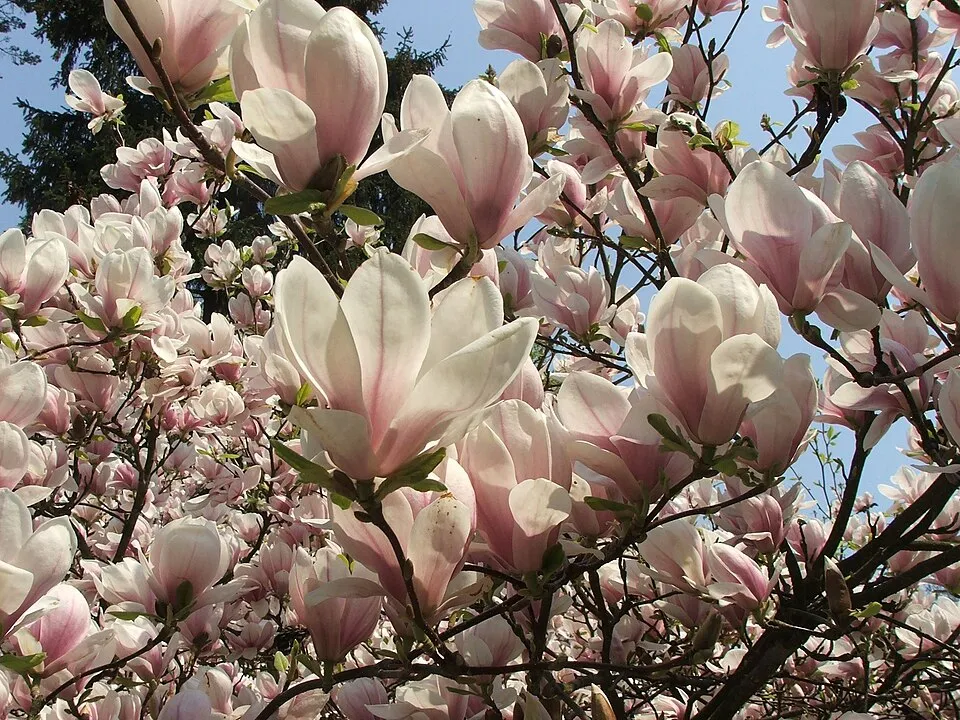
Magnolia × soulangeana, commonly known as the saucer magnolia or tulip tree, is a distinguished deciduous ornamental hybrid renowned for its spectacular early spring floral display. This captivating small tree or large shrub typically reaches heights of 6-9 meters (20-30 feet) with a comparable spread, developing a dense, rounded to vase-shaped canopy. It is a horticultural cross between Magnolia denudata and Magnolia liliiflora, first cultivated in France during the 1820s. Its most striking feature is the profusion of large, goblet to saucer-shaped flowers, approximately 10-15 cm (4-6 inches) across, which emerge in late winter or early spring before the foliage, creating a dramatic visual impact on bare branches.
The flowers exude a subtle, pleasant fragrance, with petals (tepals) typically showcasing a creamy white interior and a vibrant pink or purplish-red exterior, varying in intensity and distribution among numerous cultivars. Cultivars like 'Alexandrina' display pronounced pink hues, while 'Lennei' offers fuller, more rounded tepals. The foliage consists of large, glossy, dark green, oblong to obovate leaves that provide a lush canopy throughout summer and transition to a yellowish-brown or coppery color in autumn, offering secondary seasonal interest. Young trees feature smooth, gray bark that develops slight furrows with age.
Widely prized in landscape design for its exceptional ornamental value, Magnolia × soulangeana serves as a dramatic focal point in gardens, parks, and along avenues. It thrives in moist, well-drained, slightly acidic soils and benefits from a sheltered location to protect its delicate blooms from strong winds and late frosts. Its hardiness and adaptability have cemented its global popularity in temperate regions.
Trusted Scientific References
1. Authoritative external sources for Magnolia × soulangeana
1.1 Wikipedia — Magnolia × soulangeana
1.2 Kew POWO (Plants of the World Online)
1.3 PubMed — peer-reviewed research
1.4 NCBI Taxonomy Browser
1.5 GBIF — Global Biodiversity
1.1.Magnolia Soulangeana — Key Features
- ✓ <strong>Deciduous hybrid tree/shrub.</strong> — Deciduous hybrid tree/shrub.
- ✓ <strong>Large, fragrant, goblet</strong> — shaped flowers.
- ✓ <strong>Blooms early spring</strong> — Blooms early spring before leaves.
- ✓ <strong>Flowers typically white</strong> — Flowers typically white inside, pink/purple outside.
- ✓ <strong>Lush dark green</strong> — Lush dark green summer foliage.
- ✓ <strong>Smooth gray bark,</strong> — Smooth gray bark, becoming furrowed with age.
- ✓ <strong>Ornamental landscape value.</strong> — Ornamental landscape value.
- ✓ <strong>Prefers moist, acidic, well</strong> — drained soil.
- ✓ <strong>Hardiness zones 4</strong> — 9.
- ✓ <strong>Moderate growth rate.</strong> — Moderate growth rate.
1.2.Magnolia Soulangeana — Quick Summary
- ✓ Ornamental hybrid with spectacular early spring blooms.
- ✓ Contains bioactive lignans magnolol and honokiol.
- ✓ Known for anxiolytic, anti-inflammatory, and neuroprotective properties.
- ✓ Traditional uses across various health systems for stress and digestion.
- ✓ Requires moist, well-drained, acidic soil and sheltered location.
- ✓ Caution advised for pregnant individuals, children, and those on certain medications.
2.Magnolia Soulangeana — Scientific Identity
3.Magnolia Soulangeana — Quick Facts
4.Magnolia Soulangeana — Appearance & Identification
5.Magnolia Soulangeana — Native Habitat
6.Magnolia Soulangeana — Water Requirements
- ✓ Site Selection — Choose a location with full sun to partial shade, ideally sheltered from strong winds to protect delicate blooms.
- ✓ Soil Requirements — Prefers moist, well-drained, slightly acidic soil (pH 5.5-6.5); amend heavy clay or sandy soils with organic matter.
- ✓ Watering — Requires consistent moisture, especially during dry periods and in its establishment phase; avoid waterlogging.
- ✓ Mulching — Apply a 5-10 cm (2-4 inch) layer of organic mulch around the base to conserve moisture, regulate soil temperature, and suppress weeds.
- ✓ Fertilization — Fertilize in early spring with a balanced, slow-release granular fertilizer formulated for acid-loving plants.
- ✓ Pruning — Prune after flowering to remove dead, damaged, or crossing branches; minimal pruning is generally required to maintain its natural form.
- ✓ Pest and Disease Management — Monitor for common issues like magnolia scale, powdery mildew, and verticillium wilt; address promptly with appropriate treatments.
- ✓ Winter Protection — In colder zones, protect young plants with burlap or a layer of mulch to prevent frost damage to flower buds.
Reviewed by the Flora Medical Global Botanical Review Panel
Multi-disciplinary editorial group · Botany · Ethnobotany · Herbal-medicine literature
Who reviewed this: This page was checked by the Flora Medical Global Botanical Review Panel — an in-house editorial group of botany graduates, ethnobotany researchers, and horticulture practitioners who collectively maintain our 7,000+ plant encyclopedia. Meet the team.
Our 4-step verification process
1. Taxonomic verification
Scientific names and synonyms cross-checked against Kew POWO, World Flora Online, and The Plant List.
2. Phytochemical & medicinal cross-reference
Active compounds, traditional uses, and reported activities are cross-referenced with PubMed, USDA Dr. Duke's database, and peer-reviewed ethnobotanical literature.
3. Conservation & distribution check
Distribution, ecology, and conservation status confirmed against GBIF occurrence records and the IUCN Red List.
4. Editorial & safety review
Every entry passes an editorial pass for clarity, originality, and safety notices (toxicity, contraindications, dosage caveats) before publication.
Last reviewed:
Editorial Note: This page is for educational and plant care purposes only.
Written by: Flora Medical Global Editorial Team
Reviewed by: Flora Medical Global Botanical Review Panel
Last Updated: June 15, 2026







Magnolia Soulangeana — Comments & Community Reviews
Rate this plant