
Care Disclaimer: Plant care recommendations are general guidelines based on common growing conditions. Individual results may vary based on your local environment, climate, and care routine. If your plant is toxic, keep it away from children and pets, and consult a veterinarian if accidental ingestion occurs.
1.Marigold — Overview
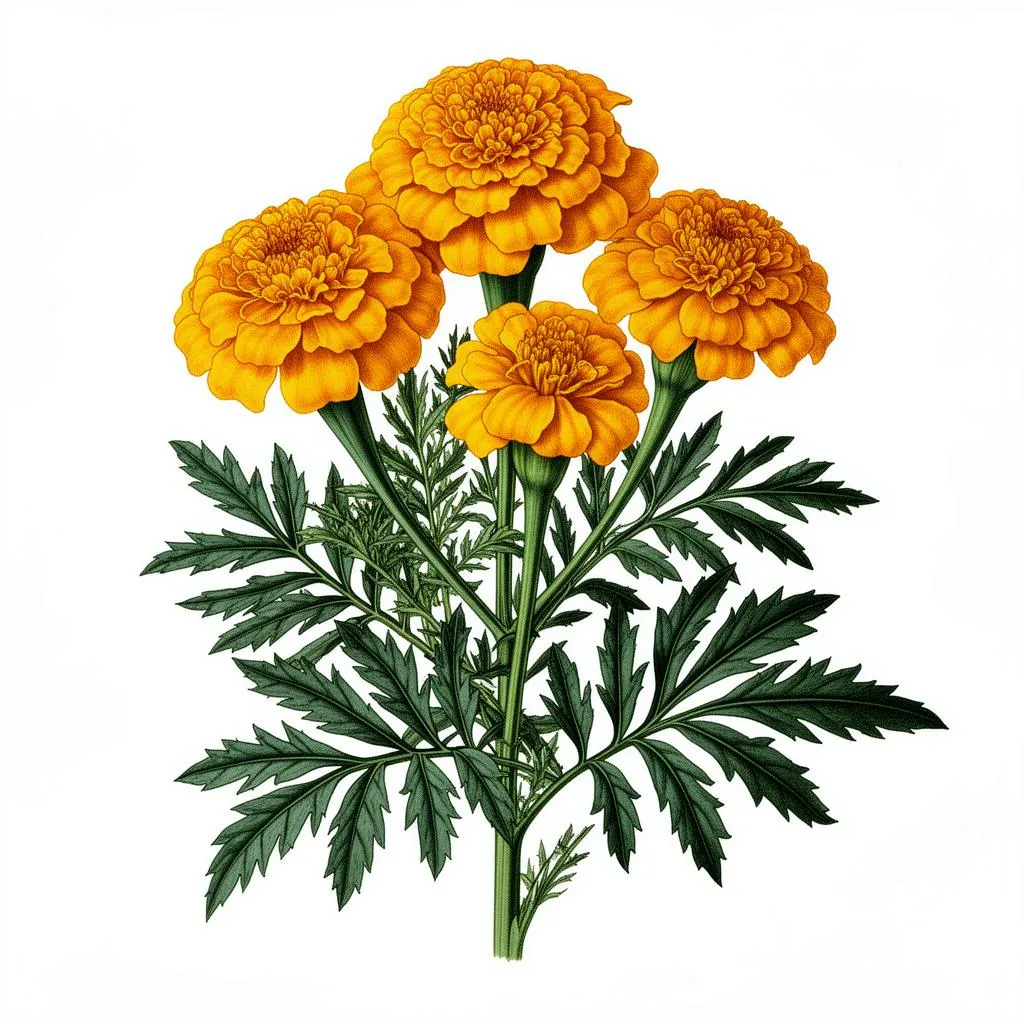
Marigold, encompassing the genus Tagetes, is a diverse group of annual and perennial herbaceous plants belonging to the Asteraceae family. These vibrant plants are native to the Americas, particularly Mexico and Central America, and have since naturalized across various tropical and subtropical regions worldwide. Morphologically, Marigolds are characterized by their deeply lobed or pinnate leaves, often aromatic when crushed, and striking capitula (flower heads) that can be solitary or arranged in cymes.
The flowers display a rich spectrum of colors, predominantly yellow, orange, and reddish-brown, with some cultivars exhibiting bicolour patterns. Notable species include Tagetes erecta (African Marigold), known for its large, globular flower heads, and Tagetes patula (French Marigold), which typically produces smaller, more numerous blooms. Their growth habit varies from compact and bushy to taller, more upright forms, adapting well to diverse garden settings, from ornamental beds to container planting.
Beyond their aesthetic appeal, the distinctive aroma of Tagetes species is often attributed to their essential oil content, which plays a role in their traditional uses and natural pest-repellent properties. The taxonomy of Tagetes is complex, with numerous species and cultivars, but all share the characteristic composite flower structure typical of the daisy family.
Trusted Scientific References
1. Authoritative external sources for Tagetes spp.
1.1 Wikipedia — Tagetes spp.
1.2 Kew POWO (Plants of the World Online)
1.3 PubMed — peer-reviewed research
1.4 NCBI Taxonomy Browser
1.5 GBIF — Global Biodiversity
1.6Marigold should be interpreted through verified botanical identity, practical care, and responsible safety language. This recovery note adds the missing context needed for a complete profile: match light to the plant's habit, use well-drained soil, water according to season, and avoid unsupported medicinal or edible claims. For publishing, the plant can be presented as a source-backed garden plant with clear care guidance, common problem diagnosis, and conservative safety wording.
1.1.Marigold — Key Features
- ✓ <strong>Botanical Name</strong> — Tagetes spp., part of the Asteraceae family.
- ✓ <strong>Primary Bioactives</strong> — Lutein, zeaxanthin, quercetin, thiophenes, limonene.
- ✓ <strong>Traditional Uses</strong> — Eye health, wound healing, anti-inflammation, pest repellent.
- ✓ <strong>Medicinal Actions</strong> — Antioxidant, anti-inflammatory, antiseptic, antimicrobial, insecticidal.
- ✓ <strong>Common Species</strong> — Tagetes erecta (African Marigold), Tagetes patula (French Marigold).
- ✓ <strong>Ornamental Value</strong> — Widely cultivated for vibrant yellow, orange, and red flowers.
- ✓ <strong>Companion Planting</strong> — Known for deterring nematodes and other garden pests.
- ✓ <strong>Edible Petals</strong> — Used for culinary decoration and subtle flavor.
- ✓ <strong>Habitat</strong> — Native to the Americas, now globally distributed in tropical/subtropical regions.
- ✓ <strong>Aromatic Properties</strong> — Distinctive scent from essential oils, particularly from leaves and flowers.
1.2.Marigold — Quick Summary
- ✓ Marigolds (Tagetes spp.) are vibrant Asteraceae plants native to the Americas, known for their colorful flowers.
- ✓ Rich in carotenoids (lutein, zeaxanthin), flavonoids, and thiophenes, offering significant health benefits.
- ✓ Traditionally used for eye health, anti-inflammatory, antiseptic, and wound-healing properties.
- ✓ Essential oils provide antimicrobial action and natural pest deterrence.
- ✓ Easy to cultivate, thriving in full sun and well-draining soil.
- ✓ Caution advised for pregnant women, those with allergies, and individuals on anticoagulant medication.
2.Marigold — Scientific Identity
3.Marigold — Quick Facts
4.Marigold — Appearance & Identification
5.Marigold — Native Habitat
6.Marigold — Water Requirements
- ✓ Seed Sowing — Sow Marigold seeds directly into prepared garden beds after the last frost or start indoors 6-8 weeks prior.
- ✓ Soil Requirements — Prefers well-draining, moderately fertile soil with a pH between 6.0 and 7.0.
- ✓ Sunlight Exposure — Requires full sun, ideally 6-8 hours of direct sunlight daily, for optimal growth and flowering.
- ✓ Watering Schedule — Water regularly, especially during dry periods, but avoid overwatering to prevent root rot.
- ✓ Spacing Guidelines — Space plants according to mature size, typically 6-12 inches apart for smaller varieties and up to 18-24 inches for larger ones.
- ✓ Fertilization — Generally low-maintenance; a balanced, slow-release fertilizer can be applied at planting, or compost can be incorporated.
- ✓ Deadheading — Remove spent blooms (deadhead) to encourage continuous flowering throughout the growing season and prevent self-seeding.
- ✓ Pest Management — Naturally deters many garden pests; occasional issues with spider mites or slugs can be managed with organic solutions.
Reviewed by the Flora Medical Global Botanical Review Panel
Multi-disciplinary editorial group · Botany · Ethnobotany · Herbal-medicine literature
Who reviewed this: This page was checked by the Flora Medical Global Botanical Review Panel — an in-house editorial group of botany graduates, ethnobotany researchers, and horticulture practitioners who collectively maintain our 7,000+ plant encyclopedia. Meet the team.
Our 4-step verification process
1. Taxonomic verification
Scientific names and synonyms cross-checked against Kew POWO, World Flora Online, and The Plant List.
2. Phytochemical & medicinal cross-reference
Active compounds, traditional uses, and reported activities are cross-referenced with PubMed, USDA Dr. Duke's database, and peer-reviewed ethnobotanical literature.
3. Conservation & distribution check
Distribution, ecology, and conservation status confirmed against GBIF occurrence records and the IUCN Red List.
4. Editorial & safety review
Every entry passes an editorial pass for clarity, originality, and safety notices (toxicity, contraindications, dosage caveats) before publication.
Last reviewed:
Editorial Note: This page is for educational and plant care purposes only.
Written by: Flora Medical Global Editorial Team
Reviewed by: Flora Medical Global Botanical Review Panel
Last Updated: June 15, 2026







Marigold — Comments & Community Reviews
Rate this plant