

Care Disclaimer: Plant care recommendations are general guidelines based on common growing conditions. Individual results may vary based on your local environment, climate, and care routine. If your plant is toxic, keep it away from children and pets, and consult a veterinarian if accidental ingestion occurs.
1.Massonia Pustulata — Overview
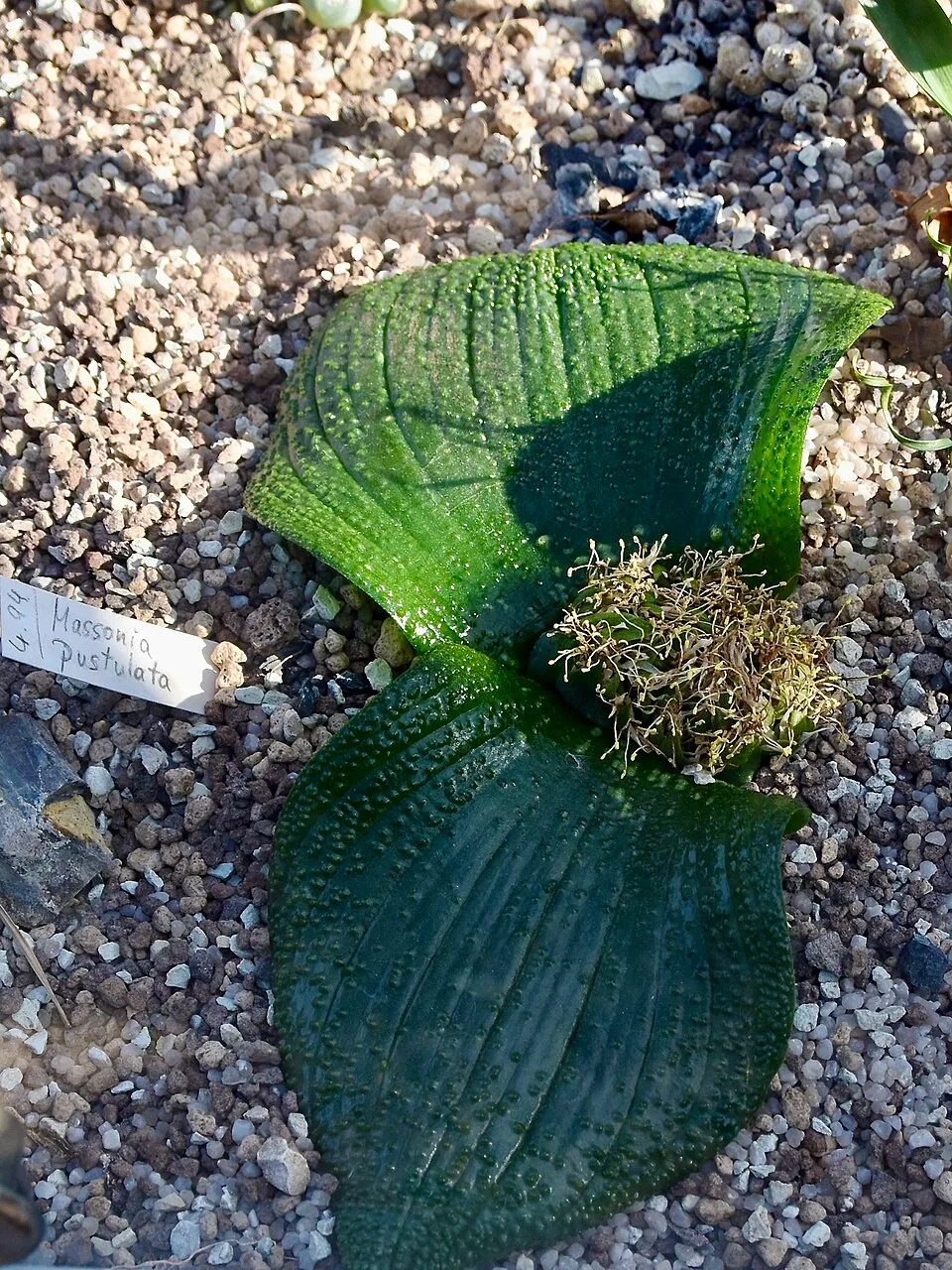
Massonia pustulata is a distinctive bulbous geophyte belonging to the family Asparagaceae, subfamily Scilloideae, and is indigenous to the Cape Provinces of South Africa, specifically thriving in the winter-rainfall regions. This captivating plant is renowned for its unique morphology, primarily exhibiting two broad, prostrate, and markedly fleshy leaves that lie flat against the ground. These leaves are characteristically adorned with prominent, often densely packed pustules or bumps, which directly inspired its specific epithet 'pustulata'.
The plant typically forms a compact rosette, with the leaves varying in color from deep green to glaucous. In late winter to early spring, a remarkable inflorescence emerges directly from the center of the basal leaves, often nestled almost at ground level. This consists of a dense, brush-like cluster of numerous small, star-shaped flowers, typically white or pale pink, with a prominent display of stamens.
The flowers emit a sweet, honey-like fragrance, serving as an attractant for various pollinators in its native fynbos and renosterveld habitats. Massonia pustulata is a deciduous species, entering dormancy during the hot, dry summer months, at which point its leaves wither and the bulb conserves energy underground. Its compact size, intriguing texture, and early-season bloom make it a highly sought-after ornamental species for specialized succulent and bulb collections.
Trusted Scientific References
1. Authoritative external sources for Massonia Pustulata
1.1 Wikipedia — Massonia Pustulata
1.2 Kew POWO (Plants of the World Online)
1.3 PubMed — peer-reviewed research
1.4 NCBI Taxonomy Browser
1.5 GBIF — Global Biodiversity
1.6Massonia Pustulata should be interpreted through verified botanical identity, practical care, and responsible safety language. This recovery note adds the missing context needed for a complete profile: match light to the plant's habit, use well-drained soil, water according to season, and avoid unsupported medicinal or edible claims. For publishing, the plant can be presented as a source-backed garden plant with clear care guidance, common problem diagnosis, and conservative safety wording.
1.1.Massonia Pustulata — Key Features
- ✓ <strong>Distinctive Pustulated Leaves</strong> — Broad, fleshy leaves with unique bumpy texture.
- ✓ <strong>Ground</strong> — Hugging Inflorescence — Dense cluster of fragrant white/pink flowers emerging at soil level.
- ✓ <strong>Winter</strong> — Flowering Geophyte — Blooms in late winter to early spring, providing seasonal interest.
- ✓ <strong>Honey</strong> — Scented Flowers — Emit a sweet fragrance, attracting pollinators.
- ✓ <strong>Drought Tolerant</strong> — Adapted to arid environments, requiring minimal water.
- ✓ <strong>Deciduous Bulb</strong> — Enters summer dormancy, conserving energy underground.
- ✓ <strong>Compact Size</strong> — Ideal for small spaces, containers, and specialized collections.
- ✓ <strong>Ornamental Value</strong> — Highly sought after by collectors for its unusual beauty.
- ✓ <strong>South African Endemic</strong> — Native to specific winter-rainfall regions of South Africa.
- ✓ <strong>Asparagaceae Family</strong> — Belongs to the broader Asparagaceae family, subfamily Scilloideae.
1.2.Massonia Pustulata — Quick Summary
- ✓ Unique Ornamental Bulb — Highly prized for distinctive pustulated leaves and fragrant, ground-hugging flowers.
- ✓ South African Native — Thrives in winter-rainfall regions, adapted to arid conditions.
- ✓ Low Maintenance — Drought-tolerant and easy to care for once established.
- ✓ No Medicinal Use — Primarily cultivated for aesthetic value; not used in traditional or modern herbal medicine.
- ✓ Mild Toxicity Risk — Ingestion may cause digestive upset; generally considered safe for handling.
- ✓ Attracts Pollinators — Flowers emit a sweet scent, drawing beneficial insects.
2.Massonia Pustulata — Scientific Identity
3.Massonia Pustulata — Quick Facts
4.Massonia Pustulata — Appearance & Identification
5.Massonia Pustulata — Native Habitat
6.Massonia Pustulata — Water Requirements
- ✓ Soil Preference — Plant in well-drained, gritty soil mix, typically sandy or loamy, with a pH between 6.0 and 7.0.
- ✓ Planting Depth — Plant bulbs with their tops just at or slightly above the soil surface in autumn, ensuring proper exposure.
- ✓ Light Requirements — Thrives in partial shade to full sun, adapting to various light conditions for optimal growth.
- ✓ Watering Schedule — Water thoroughly when the top inch of soil is dry, allowing for drainage to prevent root rot, especially during the growing season.
- ✓ Fertilization — Apply a balanced, slow-release fertilizer every 4-6 weeks during the active growing season to support robust growth.
- ✓ Pruning — Prune after flowering by removing dead leaves and spent flowers to maintain plant health and encourage new growth.
- ✓ Dormancy Care — Reduce watering significantly during the summer dormancy period to prevent bulb rot, resuming in autumn with new growth.
Reviewed by the Flora Medical Global Botanical Review Panel
Multi-disciplinary editorial group · Botany · Ethnobotany · Herbal-medicine literature
Who reviewed this: This page was checked by the Flora Medical Global Botanical Review Panel — an in-house editorial group of botany graduates, ethnobotany researchers, and horticulture practitioners who collectively maintain our 7,000+ plant encyclopedia. Meet the team.
Our 4-step verification process
1. Taxonomic verification
Scientific names and synonyms cross-checked against Kew POWO, World Flora Online, and The Plant List.
2. Phytochemical & medicinal cross-reference
Active compounds, traditional uses, and reported activities are cross-referenced with PubMed, USDA Dr. Duke's database, and peer-reviewed ethnobotanical literature.
3. Conservation & distribution check
Distribution, ecology, and conservation status confirmed against GBIF occurrence records and the IUCN Red List.
4. Editorial & safety review
Every entry passes an editorial pass for clarity, originality, and safety notices (toxicity, contraindications, dosage caveats) before publication.
Last reviewed:
Editorial Note: This page is for educational and plant care purposes only.
Written by: Flora Medical Global Editorial Team
Reviewed by: Flora Medical Global Botanical Review Panel
Last Updated: June 15, 2026







Massonia Pustulata — Comments & Community Reviews
Rate this plant