
Care Disclaimer: Plant care recommendations are general guidelines based on common growing conditions. Individual results may vary based on your local environment, climate, and care routine. If your plant is toxic, keep it away from children and pets, and consult a veterinarian if accidental ingestion occurs.
1.Meconopsis Cambrica — Overview
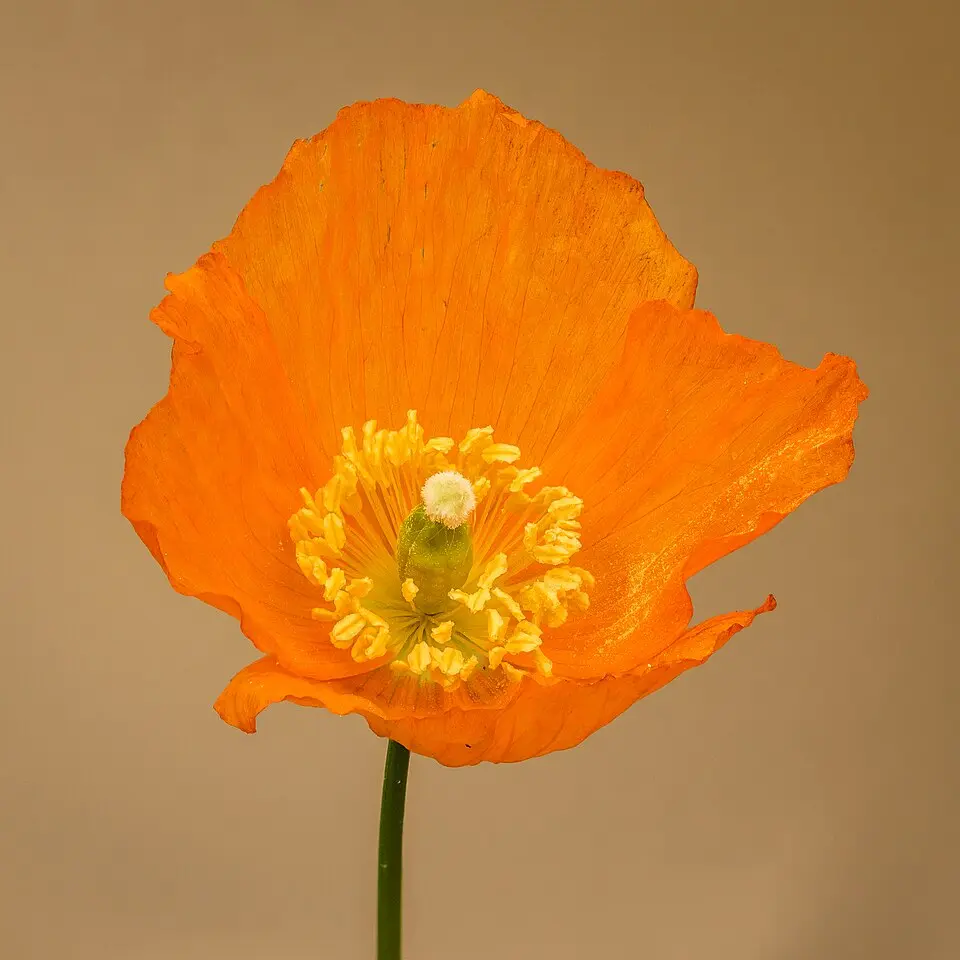
Meconopsis cambrica, commonly known as the Welsh Poppy, is a captivating herbaceous perennial indigenous to the mountainous regions of Wales, and also found across parts of England, Ireland, and the Massif Central in France. It holds the distinction of being the sole native poppy species in the United Kingdom. This plant is characterized by its vivid yellow to orange-yellow, delicate, papery flowers, typically solitary and measuring 5-7.5 cm (2-3 inches) in diameter.
These blossoms emerge from buds in late spring and early summer, frequently continuing their display intermittently until autumn. Each flower showcases numerous stamens encircling a central ovary, which subsequently develops into a nodding, capsule-like fruit upon maturity.
The foliage of Meconopsis cambrica forms a distinct basal rosette comprising deeply lobed, bristly, dark green leaves. The leaf stalks are notably hairy and can extend to considerable lengths, imparting a relaxed, naturalistic aesthetic to the plant. It thrives optimally in cool, moist, and semi-shaded environments, frequently observed growing in woodland clearings, on rocky slopes, and alongside stream banks within its natural range.
While possessing a similar name, Meconopsis cambrica is notably hardier and less finicky than many of its Himalayan relatives within the Meconopsis genus, making it a more forgiving choice for cultivation. It readily self-seeds, contributing to its graceful, natural spread within a garden setting. Although individual plants are often short-lived, typically persisting for 3-5 years, its prolific self-seeding ensures its continuous presence.
This hardy plant generally tolerates frost once established but can suffer under prolonged periods of intense heat and drought. The plant's sap contains alkaloids and can cause mild irritation to sensitive skin, warranting caution during handling, particularly for individuals with known allergies. The genus name 'Meconopsis' is derived from the Greek 'mekon' (poppy) and 'opsis' (likeness), accurately reflecting its poppy-like morphology, while 'cambrica' refers to its Welsh origin.
Trusted Scientific References
1. Authoritative external sources for Meconopsis Cambrica
1.1 Wikipedia — Meconopsis Cambrica
1.2 Kew POWO (Plants of the World Online)
1.3 PubMed — peer-reviewed research
1.4 NCBI Taxonomy Browser
1.5 GBIF — Global Biodiversity
1.1.Meconopsis Cambrica — Key Features
- ✓ <strong>Native European Poppy</strong> — The only Meconopsis species indigenous to Europe.
- ✓ <strong>Vibrant Floral Display</strong> — Striking yellow to orange-yellow, solitary flowers.
- ✓ <strong>Self</strong> — Seeding Habit — Prolific self-seeder ensuring continuity in gardens.
- ✓ <strong>Hardy Perennial</strong> — More robust than many Himalayan Meconopsis relatives.
- ✓ <strong>Alkaloid</strong> — Rich — Contains various isoquinoline alkaloids with medicinal potential.
- ✓ <strong>Basal Rosette Foliage</strong> — Distinctive deeply lobed, bristly dark green leaves.
- ✓ <strong>Shade/Moisture Lover</strong> — Prefers cool, moist, and semi-shaded growing conditions.
- ✓ <strong>Medicinal History</strong> — Traditional external uses for pain and inflammation.
- ✓ <strong>Ornamental Value</strong> — Highly valued for its aesthetic appeal in gardens.
- ✓ <strong>Short</strong> — Lived Individual Plants — Though self-seeding ensures longevity in a patch.
1.2.Meconopsis Cambrica — Quick Summary
- ✓ Native to Wales, UK, and parts of Europe.
- ✓ Bright yellow to orange-yellow, papery flowers.
- ✓ Contains various alkaloids, including protopine and allocryptopine.
- ✓ Primarily used externally in traditional medicine for pain and inflammation.
- ✓ Internal use is not recommended due to potential toxicity.
- ✓ Thrives in cool, moist, semi-shaded environments.
2.Meconopsis Cambrica — Scientific Identity
3.Meconopsis Cambrica — Quick Facts
4.Meconopsis Cambrica — Appearance & Identification
5.Meconopsis Cambrica — Native Habitat
6.Meconopsis Cambrica — Water Requirements
- ✓ Site Selection — Choose a cool, moist, and semi-shaded location, mimicking its natural woodland habitat.
- ✓ Soil Preparation — Ensure well-drained, humus-rich, slightly acidic to neutral soil, amending with compost if necessary.
- ✓ Sowing Seeds — Sow seeds thinly on the surface in late autumn or early spring, as they require light for germination.
- ✓ Watering — Maintain consistently moist soil, especially during dry spells; avoid waterlogging.
- ✓ Fertilization — Light feeding with a balanced organic fertilizer in spring can promote vigorous growth.
- ✓ Pest and Disease Control — Generally robust, but monitor for slugs and snails, especially on young plants.
- ✓ Propagation — Readily self-seeds, but can also be propagated by division in early spring or seed collection.
- ✓ Winter Care — Protect from harsh winter winds and extreme cold with a layer of mulch in colder climates.
Reviewed by the Flora Medical Global Botanical Review Panel
Multi-disciplinary editorial group · Botany · Ethnobotany · Herbal-medicine literature
Who reviewed this: This page was checked by the Flora Medical Global Botanical Review Panel — an in-house editorial group of botany graduates, ethnobotany researchers, and horticulture practitioners who collectively maintain our 7,000+ plant encyclopedia. Meet the team.
Our 4-step verification process
1. Taxonomic verification
Scientific names and synonyms cross-checked against Kew POWO, World Flora Online, and The Plant List.
2. Phytochemical & medicinal cross-reference
Active compounds, traditional uses, and reported activities are cross-referenced with PubMed, USDA Dr. Duke's database, and peer-reviewed ethnobotanical literature.
3. Conservation & distribution check
Distribution, ecology, and conservation status confirmed against GBIF occurrence records and the IUCN Red List.
4. Editorial & safety review
Every entry passes an editorial pass for clarity, originality, and safety notices (toxicity, contraindications, dosage caveats) before publication.
Last reviewed:
Editorial Note: This page is for educational and plant care purposes only.
Written by: Flora Medical Global Editorial Team
Reviewed by: Flora Medical Global Botanical Review Panel
Last Updated: June 15, 2026







Meconopsis Cambrica — Comments & Community Reviews
Rate this plant